Aligner Attachments Explained: What Patients Need to Know
July 19, 2026
Aligner Attachments Explained: What Patients Need to Know
TL;DR:
- Aligner attachments are small, tooth-colored shapes bonded to teeth to enable complex movements like rotations and intrusions. They improve aligner grip and accuracy by creating precise contact points, helping teeth move as planned. Attachments are essential for moderate to complex cases and are painless to place and remove.
Aligner attachments are defined as small, tooth-colored composite resin shapes bonded directly to specific teeth at the start of clear aligner treatment. They serve as anchors that give aligners the grip needed to perform complex tooth movements like rotations, intrusions, and extrusions that the aligner plastic alone cannot reliably achieve. Without them, a clear aligner tray simply slides over smooth enamel with limited mechanical leverage. Attachments solve that problem by creating precise contact points that translate your orthodontist’s digital treatment plan into real, controlled force inside your mouth. Gloworthodontics uses them as a standard part of treatment planning for patients who need more than basic tooth tipping.
What are aligner attachments and how do they work?
Attachments work by creating mechanical grip between the aligner tray and the tooth surface. A standard aligner tray fits over smooth enamel and can push teeth in simple directions, but it struggles to rotate a tooth around its long axis or pull a tooth vertically. An attachment changes that equation. The composite bump sits on the tooth, and the aligner tray is fabricated with a corresponding hollow that snaps over it. When you seat the tray, it presses against the attachment from a specific angle, generating a directed force.
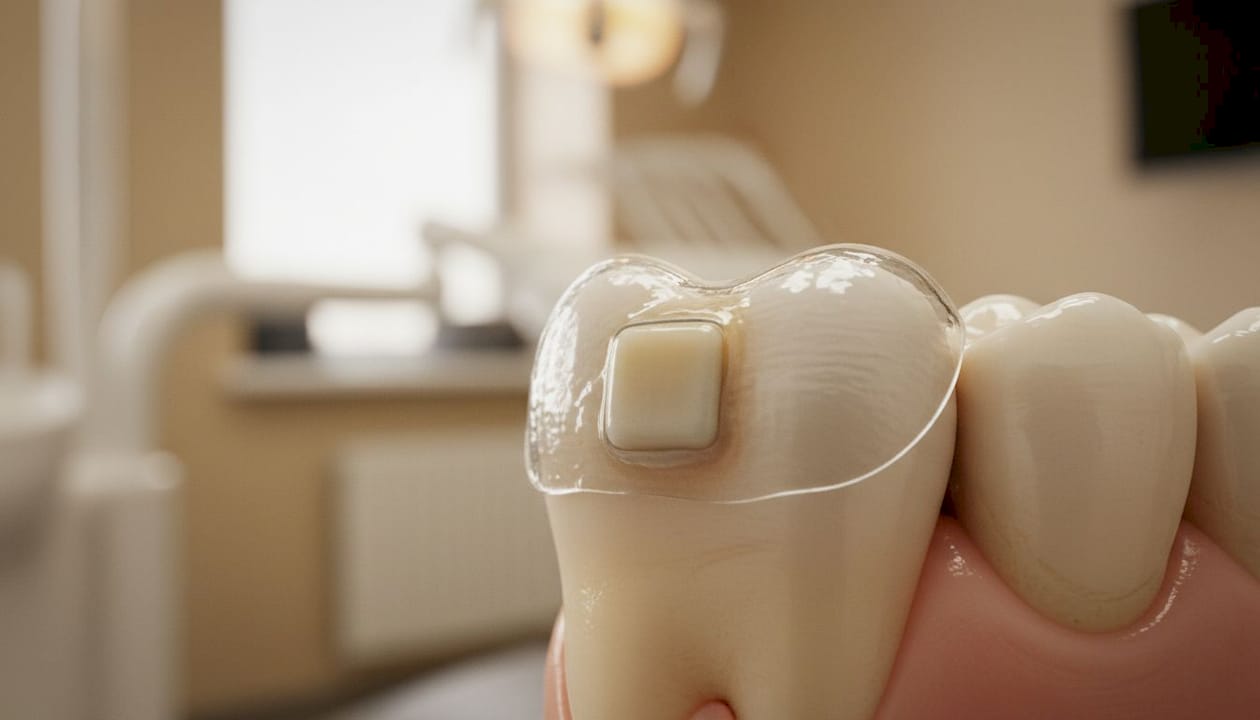
The shape of the attachment determines the direction and magnitude of that force. A rectangular attachment placed on the side of a tooth creates a lever arm for rotation. A beveled attachment angled toward the gumline pushes a tooth downward into the arch. This is why orthodontists do not place the same attachment on every tooth. Each one is positioned and shaped according to the specific movement required at that location in the treatment sequence.
Attachments also improve aligner effectiveness overall by increasing the surface area the tray can grip. A tray that fits tightly over several attachments tracks far more accurately than one resting on bare enamel. Tracking accuracy matters because each aligner in a series is designed to move teeth a fraction of a millimeter. If the tray does not seat fully, the planned movement does not happen, and the next tray in the series will not fit correctly.
Pro Tip: Press each aligner tray firmly with your fingertips over every attachment site when you first seat it. Incomplete seating is the most common reason tooth movements fall behind schedule.
The key movements that attachments enable include:
- Rotation: Turning a tooth around its vertical axis, common for canines and premolars
- Intrusion: Pressing a tooth deeper into the jawbone, used in deep bite correction
- Extrusion: Pulling a tooth upward out of the bone, needed when a tooth sits too low
- Torque: Tipping the root of a tooth while keeping the crown in place
- Vertical repositioning: Moving teeth along the arch to close or open spaces
What types of aligner attachments are there?
Attachments are classified into two broad categories: conventional shapes and optimized shapes. Conventional shapes include ellipsoid, rectangular, and beveled designs. Optimized shapes are generated by treatment planning software and customized to the specific biomechanical objective for each tooth.
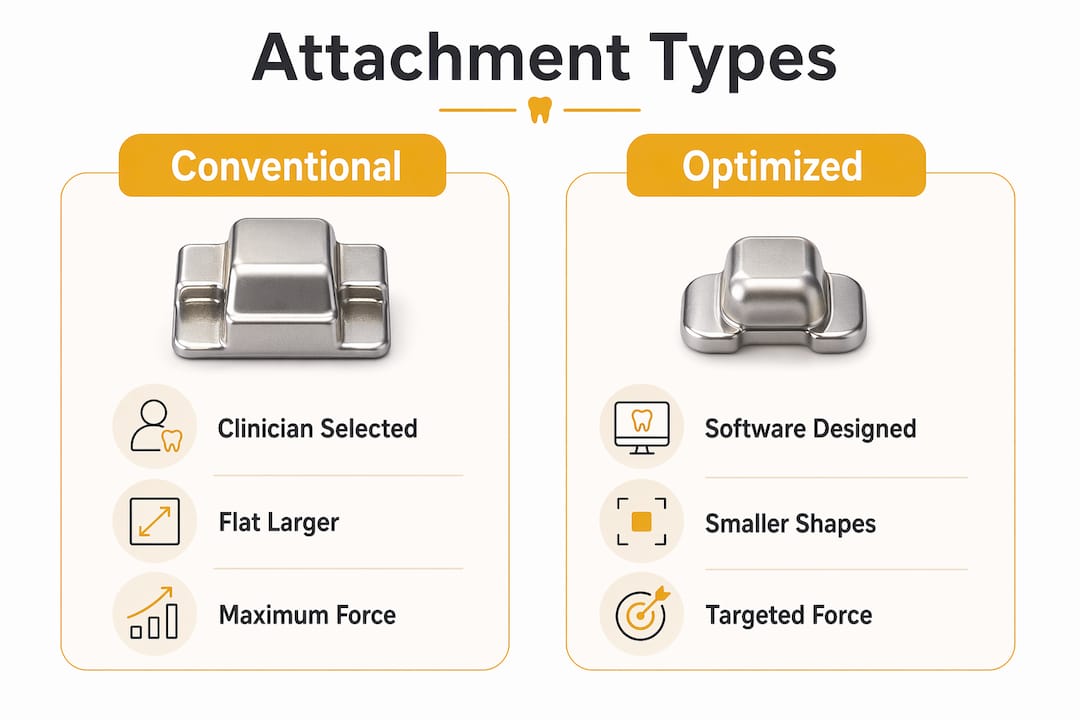
Conventional vs. optimized attachment shapes
| Feature | Conventional shapes | Optimized shapes |
|---|---|---|
| Design source | Clinician selection | Software-generated |
| Common forms | Ellipsoid, rectangular, beveled | Custom geometry per tooth |
| Best for | Standard tipping and rotation | Complex multi-axis movements |
| Force profile | Predictable, well-studied | Tailored to individual tooth geometry |
| Adjustability | Modified by placement angle | Built into the shape itself |
Flat, larger attachments maximize the force applied to a tooth. That extra force is useful for stubborn rotations, but clinical studies show it also increases stress on the periodontal ligament and surrounding bone. Curved designs distribute force more broadly, reducing biological stress at the cost of some mechanical efficiency. Your orthodontist weighs both factors when selecting attachment geometry for your specific case.
Pro Tip: Ask your orthodontist which attachment type is planned for each tooth and why. Understanding the reasoning helps you appreciate why some teeth move faster than others during treatment.
Beveled attachments are particularly common on upper front teeth, where torque control is critical for a natural-looking result. Ellipsoid attachments appear frequently on premolars and molars, where the goal is vertical repositioning rather than rotation. Rectangular attachments are the workhorse for canine rotation, one of the most mechanically demanding movements in clear aligner therapy.
When and why are attachments recommended?
Attachments are common in moderate and comprehensive cases. The decision to use them depends on the specific tooth movements required, the geometry of each tooth, and the overall complexity of the treatment plan. Not every patient needs them. Simple cases involving minor crowding or small spacing issues may complete treatment with no attachments at all.
The treatment planning phase determines exactly which teeth receive attachments, what shape each one takes, and at what stage of treatment they are placed. This planning happens digitally before a single tray is fabricated. Your orthodontist reviews the simulated tooth movements and identifies where the aligner alone will not generate enough force or control.
Situations that commonly require attachments include:
- Rotated teeth: Canines and premolars rotated more than 15 degrees almost always need attachments
- Deep bite correction: Intruding upper front teeth requires vertical force that attachments provide
- Open bite treatment: Extruding posterior teeth to close an open bite needs attachment support
- Significant crowding: Teeth with limited space need precise directional control during alignment
- Single tooth extrusion: Pulling one tooth into alignment with its neighbors requires a dedicated attachment
One important clinical signal: if a provider promises a moderate or complex case with no attachments at all, that claim warrants scrutiny. Attachment necessity correlates strongly with case complexity, and skipping them in complex cases often signals incomplete treatment planning rather than a superior technique.
What is the patient experience like with attachments?
Most patients notice attachments with their tongue for the first few days after placement. The sensation is similar to running your tongue over a small bump on a tooth. This tongue awareness typically resolves within 72 hours as patients adapt to the new texture. The placement appointment itself is painless. Your orthodontist etches the tooth surface, applies composite resin, and cures it with a light in a process that takes only a few minutes per tooth.
Living with attachments day to day is straightforward if you follow a few habits:
- Brush around each attachment carefully. Composite resin can stain if plaque accumulates around the base. Use a soft-bristle brush and angle the bristles toward the attachment edges.
- Avoid staining foods and drinks when your trays are out. Coffee, tea, and red wine can discolor composite resin over time. Rinse with water immediately after consuming them.
- Check for loose attachments weekly. Run your tongue over each one. A missing attachment means that tooth is no longer receiving its planned force. Contact your orthodontist promptly.
- Seat your trays fully every time. Press firmly over each attachment site. A tray that does not seat completely over an attachment delivers incorrect force.
- Do not try to remove attachments yourself. They are bonded with dental adhesive and require professional tools to remove safely.
Attachments are tooth-colored and discreet. Most patients report that other people do not notice them in conversation. When treatment ends, removal is painless. Your orthodontist gently buffs off the composite material with a polishing instrument, and the enamel underneath is restored to its natural feel. No drilling, no discomfort, and no lasting marks on the tooth surface.
For day-to-day practical guidance on living with aligners, the Invisalign everyday tips resource covers attachment care alongside broader aligner habits.
Key Takeaways
Aligner attachments are fundamental biomechanical components, not optional add-ons, and their shape, placement, and material directly determine whether complex tooth movements succeed or stall.
| Point | Details |
|---|---|
| Core function | Attachments give aligners the grip needed to perform rotations, intrusions, and extrusions. |
| Two main categories | Conventional shapes (ellipsoid, rectangular, beveled) and software-generated optimized shapes serve different movement types. |
| Case complexity drives need | Simple cases may need no attachments; moderate and complex cases almost always require them. |
| Patient adaptation is fast | Tongue awareness from new attachments typically resolves within 72 hours of placement. |
| Removal is painless | Clinicians buff off composite at treatment end with no drilling and no lasting enamel damage. |
The part most patients overlook about attachments
Patients often ask me whether attachments are a sign that their case is more difficult than average. The honest answer is that attachments are a sign that their orthodontist is being thorough. Force expression is the term clinicians use for how well a planned movement actually transfers from the digital model into the patient’s mouth. Attachments are the primary tool for improving that transfer. A treatment plan without them, for a case that genuinely needs them, is not simpler. It is less complete.
The second thing patients miss is the trade-off in attachment design. Bigger and flatter attachments move teeth faster, but they also put more stress on the periodontal ligament. Selecting attachment geometry requires balancing speed against biological safety. A good orthodontist does not just pick the attachment that moves the tooth fastest. They pick the one that moves it safely, at a rate the surrounding bone and tissue can tolerate.
My advice to any patient starting clear aligner treatment: ask your orthodontist to walk you through the attachment plan before your first tray is delivered. Ask which teeth are getting attachments, what movements those attachments are designed to achieve, and what happens if one pops off. That conversation takes five minutes and gives you a much clearer picture of what your treatment is actually doing. Patients who understand their treatment plan tend to wear their trays more consistently and report better outcomes. That is not a coincidence.
— Juiced
Personalized Invisalign care at Gloworthodontics
Gloworthodontics incorporates attachments as a planned part of Invisalign treatment for patients in Langley, BC who need precise, predictable tooth movement. The team reviews each patient’s digital treatment plan in detail before any trays are fabricated, identifying exactly where attachments are needed and why.

For families and teens starting the process, the Invisalign treatment guide walks through every phase from consultation to final polish, including how attachments fit into the overall timeline. Gloworthodontics combines clinical precision with a welcoming approach so patients understand each step before it happens. Book a consultation at gloworthodontics.ca to get a personalized assessment of whether attachments will be part of your treatment plan.
FAQ
What are aligner attachments made of?
Aligner attachments are made from tooth-colored composite resin, the same material used in tooth-colored dental fillings. The material bonds directly to the enamel surface and is matched to the natural shade of the tooth.
Do aligner attachments hurt when placed or removed?
Placement is painless and takes only a few minutes per tooth. Removal is equally painless. Clinicians buff the composite off with a polishing instrument, leaving the enamel surface smooth and undamaged.
Will people notice my attachments?
Attachments are tooth-colored and blend with natural enamel. Most patients report that other people do not notice them during normal conversation, especially when the aligner tray is in place over them.
Can I get clear aligners without attachments?
Simple cases with minor crowding or spacing may not require attachments at all. Moderate and complex cases almost always need them. Your orthodontist determines attachment necessity during the digital treatment planning phase.
What happens if an attachment falls off?
Contact your orthodontist promptly if an attachment detaches. That tooth is no longer receiving its planned force, which can slow or stall the movement. Your orthodontist will rebond the attachment at your next available appointment.