Baby teeth and orthodontics: What parents need to know
May 10, 2026
Baby teeth and orthodontics: What parents need to know
TL;DR:
- Baby teeth serve as crucial foundations for permanent teeth, influencing jaw development, bite patterns, and facial structure. Early orthodontic treatment can reduce long-term crowding and trauma risk, but its necessity depends on specific dental issues and timing. Consulting a specialist to assess your child’s unique growth can help determine the best approach for lasting oral health.
Most parents know baby teeth eventually fall out, so it’s easy to assume they’re just placeholders that don’t really matter in the long run. But that thinking can lead to costly orthodontic problems down the road. Early treatment reduces overjet by 3.5 to 7.0 mm, and 85% of children maintain that correction a full decade later. In this guide, you’ll learn exactly why baby teeth are central to your child’s orthodontic future, what early treatment looks like, and how to make confident, informed decisions for your child’s smile.
Table of Contents
- Why baby teeth matter for orthodontic health
- Early orthodontic treatment: What is it and does it work?
- Benefits and considerations of early orthodontic care
- What to expect: Common treatments and the journey ahead
- The real story: Why timing isn’t everything
- Explore orthodontic options for your child
- Frequently asked questions
Key Takeaways
| Point | Details |
|---|---|
| Baby teeth set the stage | Caring for baby teeth is vital as they guide the growth of permanent teeth and jaw. |
| Early treatment can help | Targeted early orthodontic care can reduce future dental complications and trauma risks. |
| Not all kids need intervention | Expert assessment is essential because not every child will benefit from starting orthodontics early. |
| Understand your options | Knowing common early treatments helps parents make informed choices for their children. |
Why baby teeth matter for orthodontic health
Think of baby teeth as the construction scaffolding for your child’s adult smile. They hold the space where permanent teeth will eventually erupt, guide the jawbones as they grow, and help shape the muscles and structures of the face. When that scaffolding is removed too early or damaged by decay, the permanent teeth that come in later have nowhere to go except crooked.
Baby teeth do three important jobs at once. First, they act as natural space maintainers, literally reserving the correct amount of room for adult teeth that won’t arrive for years. Second, they stimulate the jawbone through normal chewing, which drives healthy bone density and growth. Third, they help establish proper bite patterns, which are the relationship between the upper and lower teeth that affects everything from speech to digestion.
What happens when baby teeth are lost too early?
- Neighboring teeth drift or tip into the gap, stealing space meant for permanent teeth
- Permanent teeth erupt at odd angles, leading to crowding and crossbites
- Jaw development can become uneven or underdeveloped on one side
- Children may develop habits like tongue thrusting to compensate, which worsens bite problems
“The early loss of primary teeth is one of the most preventable causes of orthodontic crowding we see in school-age children. Prevention and monitoring during this window can save families years of treatment later.” — Common clinical observation among pediatric orthodontists
The effects of pacifiers on teeth also play a role during this developmental window. Prolonged pacifier use can alter jaw shape and tooth alignment in ways that show up as orthodontic problems by age 7 or 8.
Proper care during the baby teeth years is not about vanity. It’s about giving your child the best possible foundation for the teeth they’ll have for the rest of their life. Early orthodontic treatment maintains 85% Class II correction at 10 years, which shows just how durable the results of early care can be.
Early orthodontic treatment: What is it and does it work?
Early orthodontic treatment, sometimes called interceptive orthodontics, refers to care that begins while a child still has some baby teeth, typically between ages 7 and 10. The goal is not to finish everything at once. Instead, it targets specific problems that are easier and more effective to fix during active jaw growth.
Common interceptive treatments include palate expanders to widen a narrow upper jaw, partial braces on just the front teeth, and habit appliances that help children break thumb-sucking or tongue-thrusting habits. These are not full-mouth treatments. They’re strategic interventions timed to match a child’s natural development.
Does it actually work? The evidence paints an interesting, nuanced picture.
| Outcome measure | Early treatment | Late treatment |
|---|---|---|
| Overjet reduction | 3.5 to 7.0 mm improvement | Smaller reduction |
| Overbite reduction | 2.1 mm average improvement | Variable results |
| Incisal trauma risk | 19 to 20% incidence | 29 to 30% incidence |
| Class II correction at 10 years | 85% maintained | Lower long-term stability |
| Skeletal change (ANB angle) | Modest improvement | Similar in some studies |
The data on overjet (how far the upper front teeth stick out) and overbite correction is encouraging. Early treatment reduces overjet and overbite, and children treated early are significantly less likely to chip or break a front tooth from an accidental fall or bump, a real and underappreciated benefit.
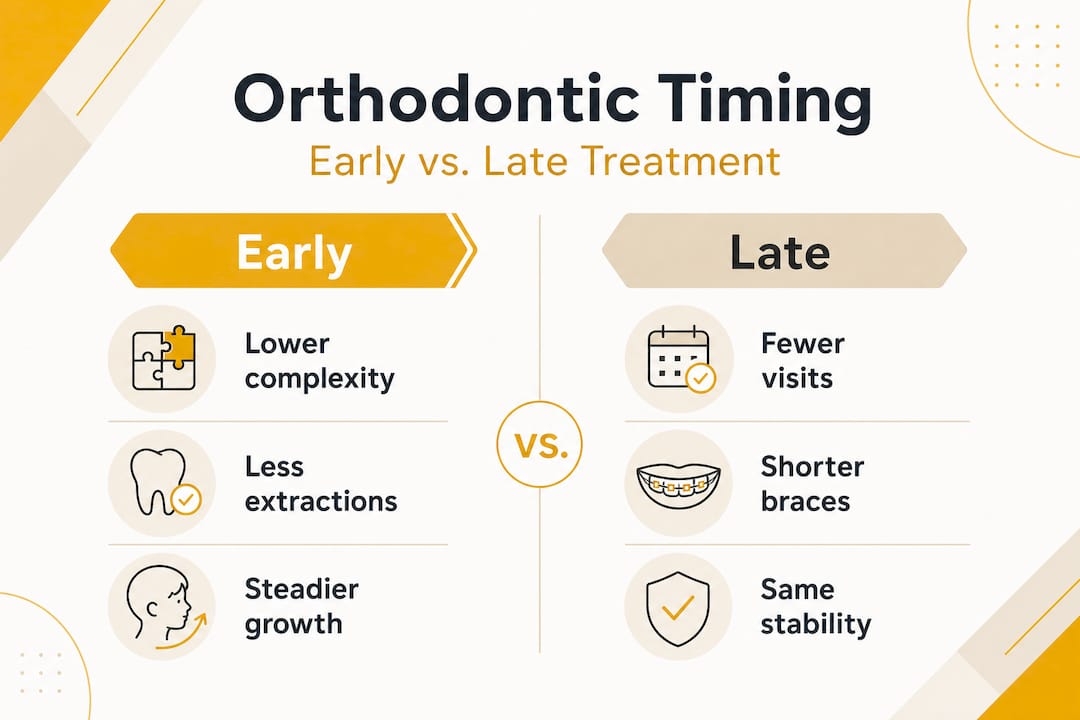
That said, some meta-analyses show no significant long-term overjet stability difference between early and late treatment groups, with an SMD of only 0.18 mm and modest skeletal changes. This means early treatment is not universally superior for every child and every problem. The key takeaway is that it depends enormously on the specific issue being treated.
Pro Tip: Ask your orthodontist not just whether your child needs treatment, but why now versus later. A good answer will reference your child’s specific jaw growth pattern, not just a general age guideline.
Benefits and considerations of early orthodontic care
So how do these treatment choices play out in the real world for both children and parents? There are clear advantages to catching certain problems early, but there are also legitimate reasons why waiting is sometimes the smarter call. Understanding both sides helps you ask better questions at your child’s next appointment.
Key benefits of early orthodontic intervention
- Reduced trauma risk: Early treatment lowers incisal trauma from 29 to 30% in untreated kids down to 19 to 20%, which means fewer chipped or broken front teeth from sports and everyday childhood activity
- Simpler second-phase treatment: Children who receive early care often need less complex braces or shorter treatment times as teenagers
- Better long-term correction rates: The 85% Class II correction maintenance rate at 10 years is a compelling argument for acting at the right time
- Psychological benefit: Children with protruding teeth or visible crowding can experience teasing or self-consciousness; early correction can meaningfully improve confidence
- Guides jaw development: Expanders and similar appliances work best during growth spurts, which you simply cannot replicate after the jaw has finished developing
What to consider before starting early
- Some children will need a second phase of treatment anyway, meaning two rounds instead of one
- Not all bite issues are urgent; some crossbites and crowding resolve on their own as permanent teeth come in
- Early treatment might prolong total treatment time in some children, adding months or even a year to the overall orthodontic journey
- Financial investment is real, and families need to factor in the possibility of phased treatment costs
The good news is that early treatment can also reduce the need for tooth extractions, which is both physically and emotionally easier on children. Knowing when to act and when to wait is exactly why a specialist consultation matters so much.
Understanding what happens if you don’t address a problem is just as important. For example, orthodontic emergencies such as broken wires or poking brackets are easier to manage when the overall treatment plan is simpler and well-timed from the start.

Pro Tip: If your child’s orthodontist recommends early treatment, ask for a written explanation of which specific problem is being addressed, the goal of treatment, and what happens if you wait 12 to 18 months instead. This gives you context and confidence, not pressure.
One more thing worth knowing: teeth can shift after braces no matter when treatment happens. Retainer use is non-negotiable, and starting good habits early sets children up for long-term success.
What to expect: Common treatments and the journey ahead
Let’s get practical. If your child needs care, here’s what the journey will look like and what you should expect along the way.
The most common early orthodontic treatments for ages 7 to 12 include palate expanders, partial braces, clear aligners, space maintainers, and habit-breaking appliances. Each has a different role, timeline, and level of parental involvement.
| Treatment type | Typical duration | Comfort level | Best for | Approximate complexity |
|---|---|---|---|---|
| Palate expander | 6 to 12 months | Moderate adjustment period | Narrow upper jaw, crossbite | Moderate |
| Space maintainer | Until permanent tooth erupts | High (usually unnoticed) | Premature baby tooth loss | Low |
| Partial braces | 12 to 18 months | Low to moderate | Front tooth alignment, overjet | Moderate |
| Clear aligners | 6 to 18 months | Low | Mild to moderate crowding | Low to moderate |
| Habit appliance | 3 to 6 months | Variable | Thumb-sucking, tongue thrust | Low |
What you, as the parent, are responsible for during this period is just as important as what the orthodontist does. Children in this age range cannot always be relied on to manage appliance care independently. Your daily involvement makes a measurable difference in how well and how quickly treatment works.
Your role as a parent during early treatment
- Help your child brush and floss around brackets, wires, or expander hardware every single day
- Follow dietary restrictions consistently, especially avoiding sticky or hard foods that damage appliances
- Attend every scheduled checkup, as missed appointments extend total treatment time
- Watch for signs of discomfort that go beyond normal soreness, such as a wire poking or a loose bracket
- Encourage your child’s cooperation with a positive attitude rather than making it feel like a punishment
Early orthodontic care can reduce the need for extractions and deliver lasting benefits, but it does require consistent follow-through from the whole family. The orthodontist provides the plan; you and your child execute it daily at home.
A good dental hygiene routine with braces is one of the most important habits to establish early. Children who learn to clean their teeth thoroughly during early treatment carry that skill into their teenage years, which matters enormously when full braces come along.
The real story: Why timing isn’t everything
Wrapping up, here’s the balanced viewpoint most experts wish parents understood: early orthodontic treatment is genuinely powerful in the right situations, but it is not a race and it is not a guarantee. Rushing into treatment because a child is 7 years old, without a specific clinical reason, does not improve outcomes. And waiting too long when there is a clear problem also has real costs.
The honest clinical picture is that the cases where early treatment delivers the strongest outcomes tend to involve protruding upper front teeth, severe crossbites, jaw discrepancies, and habit-driven tooth movement. These are problems where timing genuinely changes what’s possible. For mild crowding or spacing, some studies show no significant differences in long-term stability between early and late treatment, and in those cases, watchful waiting is completely appropriate.
What we see in practice is that parents who have the best experiences are the ones who come in with curiosity rather than urgency. They ask questions, they understand what they’re treating and why, and they trust a qualified specialist to help them decide when to act. That approach beats both “do everything as early as possible” and “wait and see forever.”
The other thing worth saying clearly: orthodontic treatment is not a single event. Knowing how long braces last and what the full treatment arc looks like helps families plan emotionally and financially. A child who gets an expander at age 8 may still need full braces at 12 or 13, and that’s not a failure of early treatment. It’s the plan working as designed.
The goal is not to finish treatment the fastest. The goal is to give your child the healthiest possible foundation, one that holds up for decades.
Explore orthodontic options for your child
Taking action on your child’s orthodontic health does not have to feel overwhelming. At Glow Orthodontics in Langley, BC, we work with families to create personalized plans that match each child’s specific stage of development, not a one-size-fits-all timeline.

Whether your child is approaching the early treatment window or heading into the teen years, our team can help you understand what’s needed and when. Explore our guide to orthodontic care for teens or compare your options with our breakdown of clear braces vs Invisalign. When you’re ready, booking a consultation is the easiest way to get a clear, honest picture of where your child stands and what steps, if any, make sense right now.
Frequently asked questions
At what age should my child first see an orthodontist?
Children should have their first orthodontic evaluation by age 7, when enough permanent teeth have erupted to identify developing problems while the jaw is still growing and treatment is most effective.
Does early orthodontic treatment always prevent braces later?
Early intervention can reduce the complexity and duration of future treatment, but early treatment does not always eliminate the need for braces as a teenager, since permanent teeth continue to emerge and shift through adolescence.
What are signs my child might need orthodontic care?
Watch for crowded or overlapping teeth, difficulty chewing or biting, frequent cheek biting, mouth breathing during the day, or upper front teeth that visibly protrude beyond the lower teeth.
Is it necessary to treat all orthodontic problems early?
No. Some studies caution against unnecessary early intervention because not all conditions benefit from early treatment, and some mild issues resolve naturally as permanent teeth come in without any intervention at all.
How do I know if my child’s dentist or an orthodontist should evaluate them?
A general dentist can flag concerns and refer when needed, but an orthodontist has specialized training in jaw growth and tooth movement, making a direct orthodontic evaluation the most accurate way to assess whether and when treatment is truly needed.