Best alternatives to Invisalign for adults in Langley, BC
May 17, 2026
Best alternatives to Invisalign for adults in Langley, BC
TL;DR:
- Adults in Langley seeking orthodontic alternatives to Invisalign should consider options like ClearCorrect, which offers advanced features and effective results for mild to moderate cases. Traditional braces remain the most reliable choice for complex movements requiring precise, continuous force, especially when compliance is uncertain. Selecting the best system depends on your case complexity, lifestyle, and consultation with an experienced orthodontist.
If you’re an adult in Langley considering orthodontic treatment and wondering what is the best alternative to Invisalign, you’re asking exactly the right question. Invisalign is popular, but it isn’t the only path to a straighter smile, and it isn’t always the best fit for every case, budget, or lifestyle. The right Invisalign alternative depends on your tooth movement needs, how committed you can be to wearing a removable appliance, and what you’re willing to invest. This guide breaks down the real differences between your options so you can walk into a consultation already knowing what to ask.
Table of Contents
- How to evaluate alternatives to Invisalign: Key criteria explained
- ClearCorrect: A popular Invisalign alternative with advanced features
- At-home clear aligner programs: Convenience vs. control
- Traditional braces: The reliable alternative when precision matters most
- Comparison table: Invisalign alternatives side-by-side
- Choosing the best alternative for your smile: Practical tips for adults in Langley
- Why the “best” alternative to Invisalign is highly personal and case-dependent
- Explore professional orthodontic options in Langley to find your ideal clear aligner alternative
- Frequently asked questions
Key Takeaways
| Point | Details |
|---|---|
| Treatment suitability is key | Choose an aligner based on your specific orthodontic needs and complexity of your case. |
| Compliance impacts success | Wearing your aligners consistently 20–22 hours daily is essential for effective results. |
| ClearCorrect as strong option | ClearCorrect offers high retention, comfort, and customization comparable to Invisalign. |
| Braces remain reliable | Braces provide superior control for complex tooth movements but are less discreet. |
| Personalized consultation matters | Professional orthodontic assessment is crucial to select the best alternative for your smile goals. |
How to evaluate alternatives to Invisalign: Key criteria explained
Before comparing specific systems, you need a framework. Not all clear aligners work the same way, and what makes one system better for your neighbor may make it a poor choice for you.
The single most important factor is case complexity. Case selection is critical for clear aligner success, meaning an aligner system that works beautifully for mild crowding may fall short for a significant bite issue. Your orthodontist’s assessment determines which options are even on the table.
Here’s what to weigh when comparing any Invisalign substitutes:
- Compliance demands: Nearly all removable aligners require 20 to 22 hours of daily wear. Miss that window consistently and your treatment stalls.
- Aesthetic impact: Most clear aligners are nearly invisible, but material clarity varies between brands over time. Some stain faster with coffee or wine.
- Oral hygiene: Removable aligners let you brush and floss normally. That’s a real advantage over fixed appliances for many adults.
- Customization features: Bite ramps, engagers (small tooth-colored attachments bonded to teeth), and elastic cutouts allow orthodontists to handle more complex movements. Not every system offers all of these.
- Cost and duration: Prices vary widely. Understanding the differences between clear aligners and braces helps you see where your money actually goes.
- Provider expertise: Whichever system you choose, the skill of the orthodontist managing your case matters as much as the aligner brand.
Pro Tip: Before your first consultation, write down three things: your biggest aesthetic concern, your daily schedule (can you really wear aligners 20+ hours?), and your timeline. This shapes which options are realistic for you. You can also review common aligner care mistakes to understand what trips patients up during treatment.
ClearCorrect: A popular Invisalign alternative with advanced features
ClearCorrect is one of the strongest competitors in the professional clear aligner market and deserves serious consideration as a best clear aligners alternative for adults.
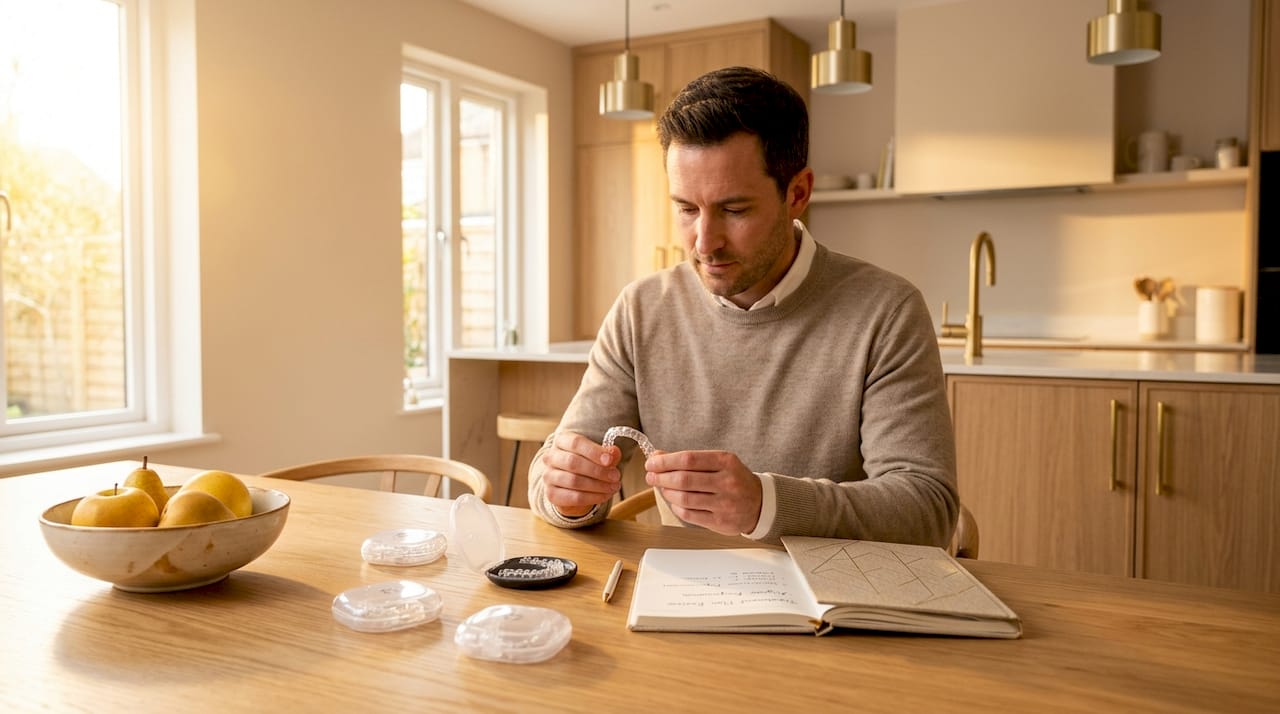
What sets ClearCorrect apart technically is its material and trimline design. ClearCorrect uses a flat trimline above the gum line and a tri-layer ClearQuartz material engineered for high retention and minimal staining. Most aligners use a scalloped trimline that follows the gum contour, which can create slight gaps. The flat edge grips teeth more securely and tends to stay cleaner.
Key features worth knowing:
- ClearQuartz material: Three layers of thermoplastic designed to apply consistent, controlled force throughout each aligner stage, reducing the “heavy pressure” feeling some patients report in the first day or two of a new tray.
- Engager compatibility: Like Invisalign, ClearCorrect supports tooth-colored attachments for rotating and tipping teeth that wouldn’t move with pressure alone.
- Elastic cutouts: These allow the use of rubber bands to correct bite issues, expanding the range of cases ClearCorrect can address.
- Clarity over time: The tri-layer material resists discoloration better than single-layer plastics, which matters if you drink coffee daily.
Understanding what clear aligners actually cost for ClearCorrect versus Invisalign is important too, because the price difference at some clinics is meaningful. Many patients also ask do clear aligners really work before committing, and ClearCorrect’s clinical track record supports its effectiveness for mild to moderate cases and even some complex ones when managed by a skilled orthodontist.
Pro Tip: Ask your orthodontist to show you before-and-after cases they’ve personally treated with ClearCorrect. A brand’s marketing claims are one thing. Real local results are another.
At-home clear aligner programs: Convenience vs. control
At-home aligner services took the orthodontic world by storm promising affordable alternatives to Invisalign without the clinic visits. The appeal is real. Lower price points, no waiting rooms, and trays shipped to your door. But the trade-offs matter.
Here’s a clear breakdown of what at-home aligner programs offer and where they fall short:
- Cost: Significantly lower than in-office treatment, often a fraction of professional system pricing.
- Convenience: Remote monitoring via app and no regular in-person appointments needed.
- Case limitation: These services are designed for mild spacing or crowding only. Complex bite issues, significant rotations, or skeletal problems are outside their safe scope.
- No physical exams: Some services use remote scans or mail-in impression kits rather than in-person records, which limits diagnostic accuracy.
- Compliance still matters: Aligner effectiveness depends heavily on both case selection and how consistently you wear them. At-home programs can’t enforce either.
- Risk of unsupervised movement: Moving teeth without professional oversight risks root resorption (shortening of tooth roots), bite changes, and results that require correction later.
If your misalignment is genuinely mild, an at-home option might get you there safely. But most adults in Langley seeking real smile transformation have more going on than a simple gap, and the price guide for active aligners shows that the gap between at-home and professional pricing has narrowed enough that skipping professional care is rarely the savings it appears to be. The clinical evidence on clear aligner effectiveness consistently points back to supervised treatment as the standard for reliable outcomes.
Traditional braces: The reliable alternative when precision matters most
Clear braces options get most of the attention, but traditional braces remain the strongest tool in orthodontics for a specific group of patients. If your case involves significant bite correction, severe crowding, or complex rotations, braces may not just be an option. They may be the right one.
Why braces still win in certain situations:
- Continuous, precise force: Braces are fixed to teeth 24/7. There’s no removal, no forgetting, no compliance gap. The wire applies force continuously and an orthodontist can adjust it at every visit.
- Complex movement capability: Braces offer more reliable control for difficult tooth movements, particularly torque (rotating a tooth along its long axis) and intrusion (pushing a tooth deeper into the jaw).
- No patient compliance factor: For patients who know they won’t wear aligners 20+ hours a day, braces remove the variable entirely.
- Modern aesthetics: Ceramic braces use tooth-colored brackets that are far less visible than traditional metal. Not invisible, but far from the “metal mouth” of past decades.
- Oral hygiene challenges: Brushing and flossing around brackets and wires takes more effort and time. This is a real consideration for busy adults.
- Treatment timeline: Braces sometimes take longer, but for complex cases, they often deliver more predictable final positions.
Understanding the full comparison between clear aligners and braces helps clarify which path fits your specific tooth movement needs. You should also explore how clear braces compare to Invisalign if ceramic options interest you.
Pro Tip: Ask your orthodontist to show you a digital simulation of your final result with both aligner and braces treatment plans. Seeing the projected outcome side by side makes the decision far clearer.
Comparison table: Invisalign alternatives side-by-side
Research comparing clear aligners and braces shows clear aligners average 14.5 months of treatment versus 16.2 months for braces, with higher patient satisfaction scores overall. But treatment time is just one variable. Here’s how the main options compare across the factors that matter most.
| Factor | Invisalign | ClearCorrect | At-home aligners | Traditional braces | Ceramic braces |
|---|---|---|---|---|---|
| Case complexity | Mild to complex | Mild to complex | Mild to moderate only | Any complexity | Mild to complex |
| Aesthetics | Excellent | Excellent | Excellent | Noticeable | Good |
| Compliance required | Yes (20-22 hrs/day) | Yes (20-22 hrs/day) | Yes (20-22 hrs/day) | No | No |
| Comfort | High | High | Moderate | Moderate | Moderate |
| Avg. treatment time | 12-18 months | 12-18 months | 4-6 months (mild cases) | 18-24 months | 18-24 months |
| Professional oversight | Yes | Yes | Limited | Yes | Yes |
| Oral hygiene ease | Easy | Easy | Easy | Challenging | Challenging |
| Relative cost | Higher | Moderate to high | Lower | Moderate | Moderate to high |
See the full Invisalign vs. braces breakdown for deeper cost and timeline details specific to the Langley area.
Choosing the best alternative for your smile: Practical tips for adults in Langley
Knowing the options is only useful if you apply the criteria to your actual situation. Here’s a practical decision process to work through before your consultation.
- Get a proper orthodontic assessment first. Don’t choose a treatment before you know your case complexity. An orthodontist uses X-rays and 3D scans to identify bite issues, bone structure, and tooth positions that a mirror cannot reveal.
- Be honest about your compliance. Clear aligners only work when you wear them. If your schedule, habits, or lifestyle make 20+ hours a day difficult, a fixed option may serve you better.
- Rank your priorities. Is it speed? Aesthetics? Cost? Write them down. The best option matches your movement needs and compliance levels, not just the one with the best ads.
- Understand your budget and insurance. Many BC dental insurance plans cover a portion of orthodontics regardless of system. Ask your provider what’s covered before assuming one option is unaffordable.
- Ask about customization. Inquire whether your plan includes engagers, bite ramps, or elastics. These features indicate your orthodontist is planning for actual tooth movement precision, not just tray progression.
- Request a timeline with checkpoints. A good orthodontic plan includes progress milestones, not just a start date and estimated end date.
If crowding is your main concern, the teeth crowding solutions guide offers case-specific context. And if you’re weighing clear brackets against aligner systems, the clear braces vs. Invisalign guide covers the nuances well.
Pro Tip: Bring photos of smiles you admire to your consultation. Visual references help your orthodontist understand your aesthetic goals faster than any description.
Why the “best” alternative to Invisalign is highly personal and case-dependent
Here’s the perspective most aligner brand websites won’t give you: the marketing around clear aligners has gotten so polished that many patients arrive at their first orthodontic consultation already convinced they need a specific product. They’ve watched videos, read reviews, and decided. The problem is that treatment decisions made before a proper clinical assessment are often wrong, sometimes expensively so.
Clear aligner success varies significantly by case type and patient compliance. A ClearCorrect case managed poorly will underperform a well-managed braces case every single time. The aligner brand is not the most important variable. The orthodontist’s planning, the accuracy of the digital treatment setup, and your commitment to wearing the trays are what drive results.
The adults who get the best outcomes are the ones who treat their orthodontist as a partner rather than an order-taker. They ask hard questions. They request to see treatment simulations. They understand what engagers are and why their plan does or doesn’t include them. They don’t assume that because at-home aligners are cheaper, the savings are real once you factor in the risk of retreatment.
ClearCorrect and Invisalign are both strong systems when used for the right cases. At-home aligners have a place for genuinely mild alignment issues. Braces remain the gold standard for complex cases and for patients who simply won’t wear a removable appliance consistently. None of these is universally best. The evidence on clear aligner effectiveness consistently shows that case selection and clinical management outweigh brand choice every time.
Choose your orthodontist carefully. The right system follows from that.
Explore professional orthodontic options in Langley to find your ideal clear aligner alternative
Finding the right Invisalign alternative starts with one step: a professional assessment from an orthodontist who knows how to match the right system to your case.

At Glow Orthodontics in Langley, we offer Invisalign, ClearCorrect, and traditional braces so your treatment plan is built around your teeth, not around which product we happen to carry. Whether you’re exploring the step-by-step Invisalign process, comparing ClearCorrect costs, or trying to decide between clear braces and Invisalign, our team gives you honest, evidence-based guidance. Book a consultation at Glow Orthodontics and get a clear picture of your smile options before making any decisions.
Frequently asked questions
What are the most effective alternatives to Invisalign for adults?
ClearCorrect and traditional braces are among the most effective alternatives, with aligners offering shorter treatment time and higher satisfaction scores, while braces deliver superior control for complex cases.
Can at-home clear aligners replace Invisalign for complex orthodontic cases?
No. Case selection and compliance are the limiting factors for at-home aligners, which are only appropriate for mild to moderate alignment issues and should not be used without professional supervision for complex cases.
How important is patient compliance when choosing a clear aligner alternative?
It’s critical. Aligners require consistent daily wear of 20 to 22 hours to produce the tooth movement planned in your treatment, and skipping wear time directly delays or undermines results.
Are traditional braces still a good option for adults seeking discreet treatment?
Yes, especially ceramic braces, which blend with tooth color. Braces provide superior control for complex movements and are the right call when precision matters more than near-invisibility.
Do Invisalign alternatives offer shorter treatment durations?
Often yes. Clear aligners averaged 14.5 months compared to 16.2 months for braces in comparative studies, though your actual timeline depends on your case complexity and how consistently you wear your aligners.