Braces Consultation: What Happens at Your Child’s Visit
June 18, 2026
Braces Consultation: What Happens at Your Child’s Visit
TL;DR:
- A braces consultation is a diagnostic appointment where an orthodontist evaluates a child’s teeth, jaw, and bite to create a personalized treatment plan. Families leave with detailed information and next steps without any appliances being bonded to the teeth during this visit. The process involves exams, imaging, discussion of treatment options, and financial review, often leading to monitoring instead of immediate treatment.
A braces consultation is a diagnostic appointment where an orthodontist evaluates your child’s teeth, bite, and jaw alignment to build a personalized treatment plan. Nothing gets bonded to your child’s teeth that day. You leave with information, not hardware. Understanding the braces consultation process removes the anxiety and helps you walk in prepared, ask the right questions, and make confident decisions for your child’s smile.
What happens at a braces consultation, step by step
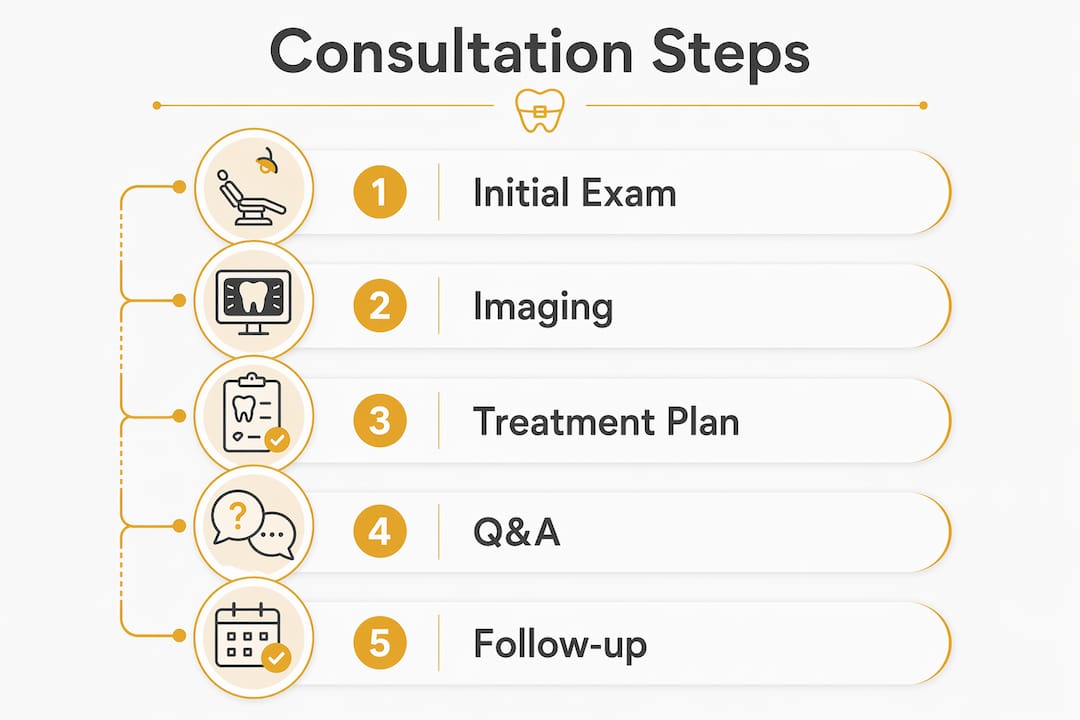
The initial orthodontic evaluation follows a predictable sequence, which makes it easy to prepare. Consultations typically run 30–90 minutes and include a clinical exam, digital photos, and sometimes X-rays or 3D scans. No appliances are placed during the visit. Here is exactly what to expect:
-
Check-in and paperwork. You complete a health history form covering your child’s dental background, any habits like thumb-sucking or grinding, and current medications. Bring your insurance card. Treatment coordinators verify coverage on-site, so having that information ready allows immediate cost estimates.
-
Clinical examination. The orthodontist examines your child’s teeth, jaw alignment, and bite function. This is distinct from a general dental checkup. Orthodontists focus on jaw relationships and bite, not cavities or gum disease. They are looking at how the upper and lower teeth come together, whether the jaw is growing symmetrically, and how crowded or spaced the teeth are.
-
Digital photos and imaging. The team takes photos of your child’s face and teeth from multiple angles. X-rays or a 3D cone-beam scan may follow, depending on what the clinical exam reveals. These images let the orthodontist see root positions, bone density, and any teeth that have not yet erupted.
-
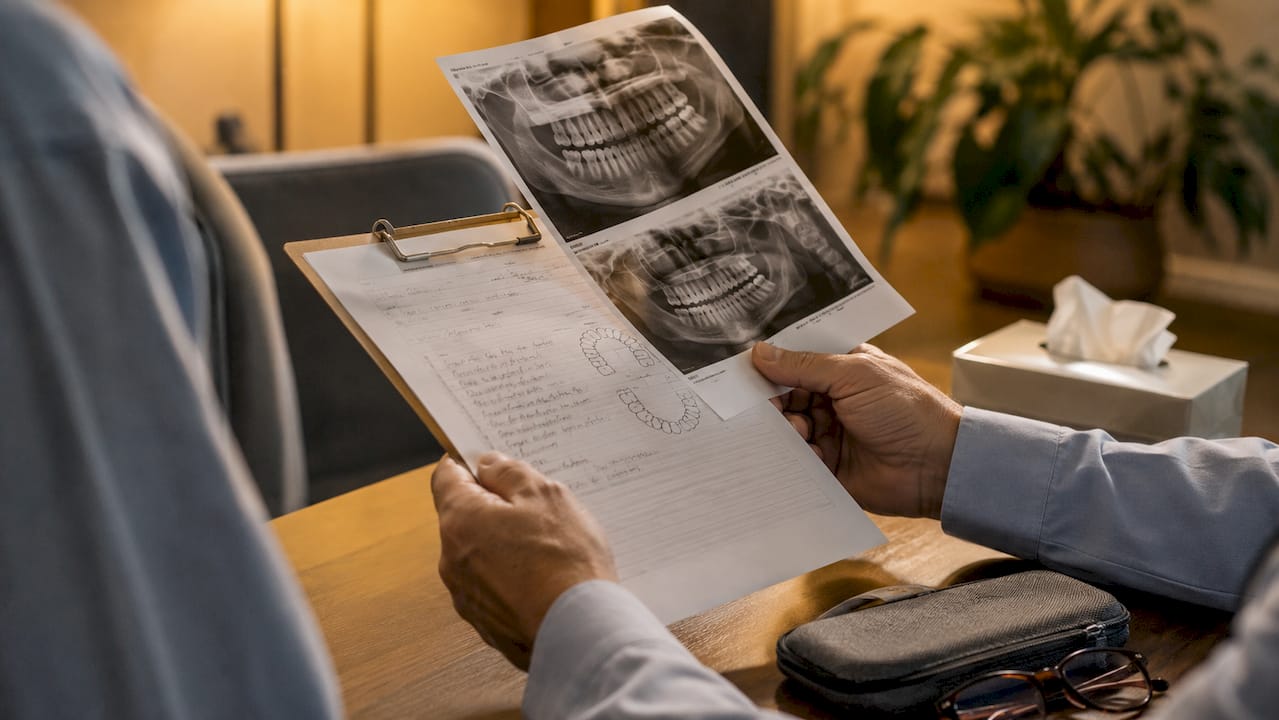
Review of findings. The orthodontist walks you through what the images show. This is the moment parents often find most valuable. You can review diagnostic images directly with the orthodontist and ask about factors like airway health or nighttime grinding that may affect treatment timing.
-
Treatment options discussion. The orthodontist presents the recommended path, whether that is braces, clear aligners, an expander, or simply monitoring growth. Treatment recommendations balance clinical needs with patient lifestyle, so your child’s preferences matter here too.
-
Financial review with a treatment coordinator. After the clinical discussion, a treatment coordinator explains costs, insurance coverage, and payment plan options. Financial discussions post-examination are standard practice and set realistic expectations before you commit to anything.
Pro Tip: Write down two or three specific concerns before the appointment, whether that is crowding, an overbite, or your child’s self-confidence. Orthodontists expect and welcome questions, and a focused list helps you cover what matters most to your family.
How does an orthodontist decide on a treatment plan?
Orthodontists do not recommend treatment based on appearance alone. The clinical decision involves several interconnected factors that only a trained specialist can assess.
- Bite function and jaw relationship. The orthodontist measures how the upper and lower jaws relate to each other. A significant overbite, underbite, or crossbite affects chewing, speech, and long-term jaw health.
- Growth stage. For children aged 7–12, the jaw is still developing. Timing treatment to coincide with growth spurts can reduce overall treatment length and complexity.
- Tooth positioning and crowding. The orthodontist maps where each tooth sits and where it needs to move. Severe crowding may require different mechanics than mild spacing issues.
- Parafunctional habits. Grinding, tongue thrusting, or mouth breathing can influence which appliance works best and whether any habit-correction tools are needed first.
- Patient lifestyle and preferences. A teenager who plays contact sports or a wind instrument has different needs than one who does not. Clinicians explain the reasoning behind metal braces versus aligners based on these real-world factors.
One point most parents do not expect: the orthodontist may recommend no treatment yet. Monitoring growth and waiting for the right developmental window is a clinically sound strategy. It avoids unnecessary intervention and respects the fact that orthodontics is a personalized process tied to individual development.
Pro Tip: Ask the orthodontist to show you the X-rays and explain what they reveal. Most are happy to do this, and seeing the images yourself makes the treatment recommendation far easier to understand and trust.
Braces vs. clear aligners: what options get presented?
Most families learn about two primary treatment paths at the consultation. Here is a direct comparison to help you follow the conversation when it happens.
| Feature | Traditional Metal Braces | Clear Aligners (e.g., Invisalign) |
|---|---|---|
| Visibility | Visible metal brackets and wires | Nearly invisible trays |
| Removal | Fixed, cannot be removed | Removable for eating and brushing |
| Best suited for | Complex bite corrections, younger children | Mild to moderate cases, motivated teens |
| Compliance required | Low (fixed in place) | High (must be worn 20–22 hours daily) |
| Cost comparison | Often similar pricing at most practices | Often similar pricing at most practices |
| Maintenance | Regular wire adjustments | Tray changes every 1–2 weeks |
A few points worth knowing before you sit down with the orthodontist:
- Metal braces handle complex tooth movements and severe bite issues more predictably than aligners in most cases.
- Clear aligners like Invisalign work well for teenagers who are disciplined about wearing them consistently. Compliance is the biggest variable in aligner outcomes.
- Some practices also offer ceramic braces, which use tooth-colored brackets for a less visible fixed option.
- Cost is often quoted at a similar level for braces and Invisalign at many practices, so the decision usually comes down to clinical fit and patient preference rather than price alone.
For a deeper breakdown, the clear braces versus Invisalign comparison covers seven specific differences that affect everyday life with each option.
What happens after the initial orthodontic evaluation?
The consultation ends, but the process continues. Here is what typically follows:
- Written treatment plan and cost estimate. You receive a document outlining the recommended treatment, estimated duration, and total cost. Review it carefully before scheduling any follow-up.
- Immediate treatment scheduling. If the orthodontist recommends starting now, you book a separate appointment to place the braces or begin the aligner process. That first treatment visit is a distinct appointment from the consultation.
- Watch mode or monitoring. Follow-up rechecks are often scheduled 6–12 months after the consultation when treatment is not yet recommended. This is standard practice, not a delay. Waiting for the right growth window often produces better results than starting too early.
- Insurance verification follow-up. If the coordinator could not confirm your coverage on the day, they will follow up with your provider. Bring your insurance card and policy number to avoid delays.
- Preparing your child. Talk to your child about what the orthodontist found and what the plan involves. Children who understand the process cooperate better with treatment. The step-by-step braces preparation guide at Gloworthodontics walks families through exactly what to expect before the first treatment appointment.
Nothing is bonded or applied to teeth during the consultation. That fact alone removes most of the anxiety children feel going into the visit.
Key takeaways
A braces consultation is a diagnostic visit, not a treatment appointment, and families leave with a clear picture of their child’s orthodontic needs and a written plan for next steps.
| Point | Details |
|---|---|
| Consultation is diagnostic only | No braces or appliances are placed during the visit; it is purely for evaluation and planning. |
| Appointment runs 30–90 minutes | Expect a clinical exam, digital photos, and possibly X-rays or a 3D scan. |
| Watch mode is a valid outcome | Monitoring growth for 6–12 months before starting treatment is clinically sound, not a delay. |
| Financial review happens on-site | Bring your insurance card so the treatment coordinator can estimate coverage immediately. |
| Questions are expected and welcomed | Preparing specific concerns in advance helps you get the most from the orthodontist’s time. |
What i tell every parent before their child’s first consultation
Parents often walk into a braces consultation expecting to leave with a treatment start date. Most do not. That surprises them, and sometimes it creates unnecessary worry. The truth is that leaving with a monitoring plan is often the best possible outcome for a child whose jaw is still developing.
The consultation is designed to be low-pressure, and orthodontic teams genuinely expect questions. Use that space. Ask about the difference between cosmetic alignment and functional bite correction. Those are not the same goal, and the treatment path can differ significantly depending on which one drives the recommendation.
One thing I see parents overlook: the financial conversation. Many families focus entirely on the clinical findings and then feel blindsided by cost. Go into the consultation ready to discuss your insurance plan, your budget, and what payment options are available. A good treatment coordinator will walk you through all of it, but you get more out of that conversation when you come prepared.
Do not rush the decision. The consultation gives you information. Take it home, talk it over, and ask follow-up questions before you commit. The questions to ask your orthodontist before starting treatment is a resource worth reviewing before you book anything. The right treatment at the right time produces better results than the fastest possible start.
— Juiced
Start your child’s orthodontic journey at Gloworthodontics
Gloworthodontics serves families in the Langley, British Columbia area with a warm, patient-centered approach to orthodontic care. The consultation process is thorough and unhurried, designed specifically for kids and teens who may feel nervous about their first visit.

The team at Gloworthodontics handles insurance verification on-site and offers flexible payment plans so cost is never a barrier to getting the right information. Whether your child ends up in traditional braces or Invisalign, the first step is a conversation. Explore the full orthodontic care guide for teens to understand what treatment looks like beyond the consultation, or book your child’s first appointment directly at gloworthodontics.ca.
FAQ
Do you need a dentist referral for a braces consultation?
No referral is required. The American Association of Orthodontists confirms that patients can book directly with an orthodontist without a dentist’s sign-off.
Does anything get put on my child’s teeth at the consultation?
Nothing is bonded or applied during the consultation. The visit is diagnostic only, and treatment begins at a separate appointment after your family decides to proceed.
How old should my child be for a first orthodontic evaluation?
The American Association of Orthodontists recommends a first evaluation by age 7. Early assessment allows the orthodontist to monitor jaw development and time treatment for the best possible outcome.
How long does a braces consultation take?
Most consultations run 30–90 minutes, covering the clinical exam, imaging, findings review, and financial discussion with a treatment coordinator.
What should i bring to the braces consultation?
Bring your child’s dental insurance card, a list of any current medications, and a note of specific concerns you want to discuss. Having insurance information on hand allows the treatment coordinator to provide immediate coverage estimates.