Braces for 9 Years: What It Really Means
June 13, 2026
Braces for 9 Years: What It Really Means
TL;DR:
- Wearing braces for nine years typically involves multiple treatment phases and retention periods, not continuous active movement.
- Biological limits, case severity, age, and patient compliance primarily determine the overall timeline, with active treatment usually lasting 12 to 36 months.
Wearing braces for 9 years does not mean nine straight years of wires tightening your teeth. That figure almost always describes a total orthodontic care period spanning multiple distinct phases, including early intervention, active treatment, and lifelong retention, rather than one unbroken stretch of active force. Standard active treatment lasts 12 to 36 months, making nine continuous years biologically implausible. What patients and families often count as “braces for nine years” is better understood as a long orthodontic era shaped by biology, compliance, and case complexity. Traditional metal braces, ceramic braces, lingual braces, and Invisalign all operate within the same biological limits.
What clinical factors influence braces treatment length?
Bone remodeling is the single biological constraint that governs how fast teeth move. Orthodontic force stimulates bone cells to break down tissue on one side of a tooth and rebuild it on the other, and that process cannot be rushed without causing permanent harm. Attempting to accelerate beyond biological limits causes irreversible root damage and higher relapse rates, which is exactly why your orthodontist sets adjustment intervals of four to eight weeks rather than days.
Case severity is the next major driver of braces duration. Mild crowding resolves in 6 to 12 months, moderate misalignment in 12 to 24 months, and severe skeletal discrepancies in 24 to 36 months or more. A patient with a significant jaw mismatch requiring orthognathic surgery alongside braces will naturally accumulate more total treatment time than someone correcting minor spacing.
Age plays a measurable role as well. Children benefit from flexible, still-developing bone, which allows teeth to shift more predictably. Adults generally require 18 to 30 months because mature bone tissue is denser and less responsive to orthodontic force. This is not a flaw in adult treatment. It is simply biology, and it explains why braces for adults often run longer than childhood cases of similar complexity.
Patient compliance is the most controllable variable in the equation. Poor oral hygiene or missed visits extend timelines directly, since broken brackets, decalcification, and skipped adjustments each set progress back by weeks. Clear aligner patients who leave their trays out for hours daily face the same penalty.
- Bone remodeling pace sets a hard biological ceiling on tooth movement speed
- Case severity (crowding, bite issues, skeletal problems) determines the baseline timeline
- Age affects bone density and treatment responsiveness
- Compliance with hygiene, appointments, and appliance wear controls whether you finish on schedule
Pro Tip: Ask your orthodontist for a written treatment timeline at your consultation. Knowing the projected end date and what milestones trigger each phase keeps you accountable and reduces the chance of avoidable delays.
Why do some patients wear braces for many years?
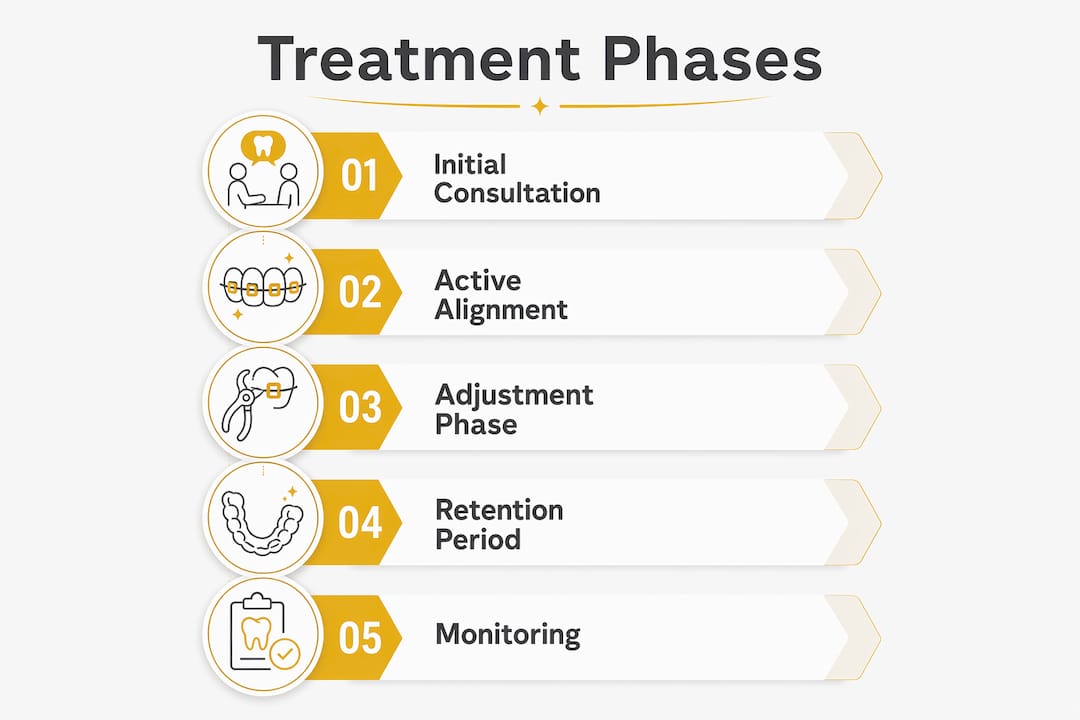
The most common reason a patient describes wearing braces for 9 years is multi-phase treatment, and understanding the structure of those phases removes most of the confusion. Orthodontic care is not a single event. It is a complex sum of active movement, pause periods, and retention, and each phase serves a distinct clinical purpose.
Here is how a multi-phase timeline typically unfolds:
- Phase 1 (early intervention): Begins around ages 7 to 9 when the jaw is still growing. This phase lasts roughly 6 to 12 months and addresses problems like severe crowding, crossbites, or jaw width issues that are easier to correct before growth is complete.
- Growth observation period: After Phase 1, braces come off and the patient waits for permanent teeth to erupt. This gap can last two to four years. The patient is still under orthodontic supervision but is not wearing active braces.
- Phase 2 (comprehensive treatment): Full braces or clear aligners go on once most permanent teeth are present, typically in the early teen years. This phase lasts 18 to 24 months for most patients.
- Retention: Retainers begin immediately after active treatment ends. For children, retention may be a few years. For adults, retention is often indefinite because mature bone does not stabilize as reliably as a growing jaw.
Add those phases together and a patient who started Phase 1 at age 8 and is still wearing a retainer at age 17 has technically been in orthodontic care for nine years. That is not the same as nine years of active braces. The distinction matters enormously for setting realistic expectations.
“The notion of ‘nine years of braces’ is almost always a misunderstanding of orthodontic care spanning multiple phases and retention rather than one continuous wearing period.” — Treatment Duration: Why Braces Take Years
Treatment interruptions also extend total timelines. Dental health setbacks like gum disease, tooth decay, or the need for extractions pause active orthodontic work until the underlying problem is resolved. Appliance changes, such as switching from metal braces to Invisalign mid-treatment, reset some progress. Complex cases involving jaw surgery require a pre-surgical braces phase, surgery recovery, and a post-surgical refinement phase, which can push total treatment time past three years on its own. You can read more about extended care timelines and what they mean for your smile outcome.
How do different braces types compare on treatment time?

Appliance choice influences treatment length, but not as dramatically as most patients expect. The biology of bone remodeling applies equally to every system. What varies is efficiency, comfort, and the degree to which patient behavior affects outcomes.
| Appliance type | Typical active duration | Key trade-off |
|---|---|---|
| Traditional metal braces | 18 to 36 months | Most control for complex cases; requires careful hygiene |
| Ceramic braces | 18 to 36 months | Less visible but brackets more fragile |
| Lingual braces | 18 to 36 months | Hidden behind teeth; higher adjustment complexity |
| Invisalign and clear aligners | 12 to 36 months | Faster for simple cases; compliance-dependent |
| Self-ligating brackets | 16 to 34 months | Reduce friction but only speed treatment by 2 to 4 months typically |
Metal braces remain the standard for complex cases because they give orthodontists precise three-dimensional control over tooth movement. Ceramic braces and lingual systems offer aesthetic advantages without meaningfully changing the timeline. Invisalign works faster than metal braces for mild to moderate cases, but for severe crowding or significant bite correction, the timelines converge.
Self-ligating brackets, marketed under systems like Damon, reduce friction between the wire and bracket. The clinical reality is that the speed advantage is modest. The more meaningful benefit is fewer adjustment appointments, which suits patients with demanding schedules.
Pro Tip: If you are choosing between clear braces and Invisalign, ask your orthodontist to show you cases similar to yours treated with each system. Real case comparisons tell you far more than marketing claims about speed.
What are the long-term dental health impacts of extended braces wear?
Extended orthodontic treatment carries real risks when managed poorly, and real benefits when managed well. Understanding both sides helps you protect your investment over the long haul.
The primary risk of prolonged treatment is root resorption, a process where orthodontic force gradually shortens tooth roots. Excessive or continuous force accelerates this process, which is why responsible orthodontists use gentle, consistent pressure rather than aggressive adjustments. Patients with naturally short roots or a history of trauma are monitored more closely during long treatment periods.
Periodontal health is the second major concern. Braces create more surfaces for plaque to accumulate, and over years of treatment, inadequate cleaning leads to gum inflammation, bone loss, and white spot lesions on enamel. A structured oral hygiene routine with braces is not optional. It is the difference between finishing treatment with healthy teeth and finishing with permanent enamel damage.
The benefits of extended treatment, when clinically justified, are significant:
- Corrected bite function reduces wear on teeth, jaw joint strain, and long-term chipping
- Aligned teeth are easier to clean, lowering the lifetime risk of decay and gum disease
- Aesthetic outcomes from well-executed long-term treatment are stable when retention is maintained
- Modern smaller brackets and updated wire materials reduce discomfort during extended wear, making multi-year treatment more tolerable than it was a decade ago
Retention after active treatment is not a footnote. Retention is a critical, often indefinite part of orthodontic care, particularly for adults. Teeth have a biological memory and will drift back toward their original positions without consistent retainer wear. Patients who complete a nine-year orthodontic journey and then abandon their retainers are at high risk of teeth shifting after braces, undoing years of work.
Diet and hygiene habits also require sustained attention. Sticky foods, hard foods, and sugary drinks are problems at any stage of treatment, but the cumulative damage over years of wear is far greater than over 18 months. Pairing your orthodontic care with a solid oral hygiene checklist reduces that risk substantially.
Key takeaways
Braces for 9 years almost always describes a total orthodontic care period across multiple phases, not nine continuous years of active tooth movement.
| Point | Details |
|---|---|
| Nine years is multi-phase, not continuous | Active treatment phases last 12 to 36 months; the rest is growth observation and retention. |
| Biology sets the speed limit | Bone remodeling cannot be safely rushed; forcing faster movement causes root damage and relapse. |
| Compliance drives the timeline | Missed appointments, poor hygiene, and skipped retainer wear are the top causes of extended treatment. |
| Retention is lifelong for adults | Adults require indefinite retainer wear because mature bone does not stabilize as reliably as growing bone. |
| Appliance choice matters less than case complexity | Metal braces, Invisalign, and self-ligating systems all operate within the same biological constraints. |
What I’ve learned from patients who’ve been through the long haul
The patients who struggle most with extended orthodontic timelines are the ones who were never given a clear picture of what “nine years” actually means. They started Phase 1 at age eight, had their braces removed at ten, waited through middle school without active appliances, and then went back into full braces at thirteen. By the time they finished retention at seventeen, they felt like they had been in braces their entire childhood. Technically, they had been in orthodontic care for nine years. In reality, they had about three years of active treatment spread across two phases.
The emotional weight of that distinction is real. Patients who understand the structure of their treatment stay motivated. Those who feel like the process is endless tend to skip appointments, neglect hygiene, and resist retainer wear at the end, which is exactly when consistency matters most. Patient education is not a soft skill in orthodontics. It is a clinical tool.
My honest advice: if you or your child is facing a long orthodontic timeline, ask your provider to map out every phase in writing, including the expected retention period. Knowing that you are in a growth observation gap rather than a stalled treatment changes how you experience the time. And if you are an adult in long-term braces, getting used to life with braces is a skill worth developing deliberately. The patients who build consistent hygiene habits and keep every appointment finish on time and with better outcomes. The ones who treat braces as a passive process they endure tend to extend their own timelines without realizing it.
— Juiced
How Gloworthodontics supports patients through extended treatment
Extended orthodontic treatment requires a provider who communicates clearly at every stage, not just at the start. Gloworthodontics serves families and adults in Langley, BC with personalized treatment plans that account for multi-phase timelines, complex cases, and the real lifestyle demands of long-term braces wear.

Whether you are exploring options for your child’s early intervention, considering braces for adults, or trying to understand why your current treatment is taking longer than expected, Gloworthodontics provides the guidance and ongoing support to keep your care on track. Their complete family orthodontic guide covers multi-phase treatment in detail, and their team is available to answer questions about your specific case. Book a consultation at Gloworthodontics to get a clear, honest timeline built around your biology and goals.
FAQ
How long do braces actually take on average?
Active orthodontic treatment averages 12 to 24 months for most patients, with complex cases extending to 36 months. Nine years of total orthodontic care typically reflects multi-phase treatment and retention combined, not one continuous active period.
Can wearing braces too long damage your teeth?
Prolonged orthodontic force without adequate monitoring increases the risk of root resorption and gum problems. Modern orthodontic protocols use gentle, consistent pressure and regular X-rays to catch and manage these risks before they become permanent.
Do adults take longer in braces than children?
Adults generally require 18 to 30 months in active treatment compared to shorter timelines for children, because adult bone is denser and less responsive to orthodontic force. Compliance and case severity also play significant roles in final duration.
Is a retainer required forever after braces?
For adults, retainer wear is often indefinite because mature bone does not stabilize as predictably as a growing jaw. Stopping retainer use prematurely is the leading cause of orthodontic relapse.
Does the type of braces affect how long treatment takes?
Appliance type has a modest effect on duration. Self-ligating brackets reduce treatment time by roughly 2 to 4 months compared to traditional systems, while Invisalign can be faster for simple cases but matches or exceeds metal braces timelines for complex ones.