Children’s Dentist and Orthodontist: A Parent’s Guide
June 11, 2026
Children’s Dentist and Orthodontist: A Parent’s Guide
TL;DR:
- Children should see a pediatric dentist by age one to promote healthy habits and monitor development. An orthodontic evaluation at age seven helps detect growth issues early, even if teeth appear straight. Early, coordinated care from specialists can reduce invasive treatments and improve lifelong oral health.
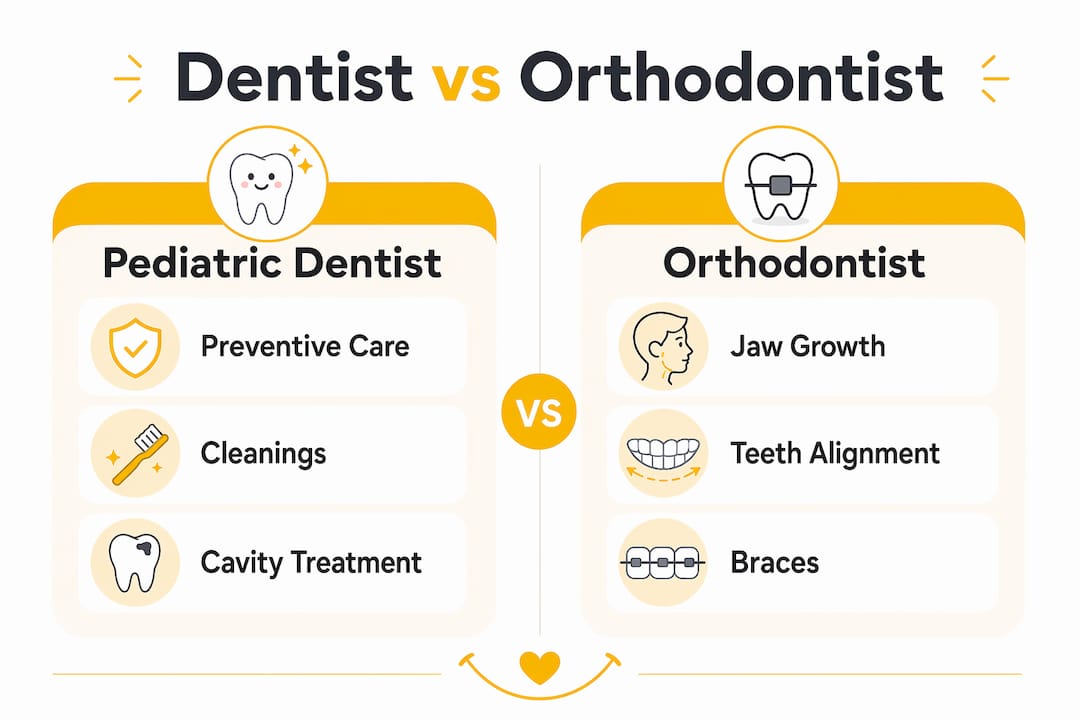
A children’s dentist and orthodontist are two distinct specialists who work together to protect your child’s oral health from the first tooth through the teenage years. Pediatric dentists focus on prevention, cavity treatment, and healthy gum development. Orthodontists specialize in correcting tooth and jaw alignment. For parents of kids aged 7 to 12, understanding when each specialist is needed, and what to expect from each visit, removes the guesswork from one of the most important health decisions you will make for your child.
When should children see a pediatric dentist and orthodontist?
The timing of dental and orthodontic visits follows a clear, evidence-based schedule. Most parents are surprised to learn that both types of care start much earlier than they expect.
The first dental visit is recommended by age 1 or when your child’s first tooth appears. That early start is not about finding cavities. It is about building habits, checking jaw development, and giving parents guidance on feeding, fluoride, and teething. By the time your child is 7 or 8, routine visits should already feel normal.
For orthodontic care, the American Association of Orthodontists (AAO) recommends a first orthodontic evaluation by age 7. This is the “rule of 7” that pediatric dental professionals reference constantly. At age 7, a child has a mix of baby and permanent teeth, giving an orthodontist a clear picture of how the jaw is growing and whether any alignment issues are forming.
Here is what each type of visit looks like in practice:
- Pediatric dentist visits (ages 7 to 12): Cleanings every six months, fluoride treatments, dental sealants on back molars, cavity fillings, and monitoring of incoming permanent teeth.
- First orthodontic evaluation (age 7): A visual exam and X-rays to assess jaw growth, tooth spacing, bite alignment, and eruption patterns.
- Orthodontic monitoring (ages 7 to 10): Most children are placed on observation programs, not started on treatment immediately.
- Phase 1 treatment (ages 7 to 10): Reserved for children with specific growth issues that benefit from early intervention.
- Phase 2 treatment (ages 11 to 14): Comprehensive braces or aligners once most permanent teeth have erupted.
Pro Tip: Book the first orthodontic evaluation even if your child’s teeth look straight. Jaw development issues are not always visible without X-rays, and catching them at age 7 gives you far more options than waiting until the teen years.
The critical point most parents miss is that an evaluation at age 7 is not a commitment to treatment. The vast majority of 7-year-olds require no immediate orthodontic work. The visit simply gives your orthodontist a baseline to monitor growth over time.
What does pediatric dental care include for kids aged 7 to 12?
Pediatric dentistry is not just smaller-scale adult dentistry. It is a specialty with two to three additional years of post-dental school training focused entirely on children’s physical and emotional development. Pediatric dentists are trained in child communication and behavior management specifically to prevent dental anxiety from forming in the first place.
For school-age children between 7 and 12, a full scope of pediatric dental services typically includes:
- Preventive care: Professional cleanings every six months, fluoride varnish applications, and dental sealants applied to the chewing surfaces of back molars. Sealants alone reduce cavity risk in those teeth by up to 80%.
- Restorative care: Tooth-colored fillings for cavities, stainless steel crowns for severely damaged baby teeth, and pulp therapy (a pediatric version of a root canal) when decay reaches the nerve.
- Emergency care: Treatment for knocked-out or chipped teeth, which are common in active kids aged 7 to 12.
- Habit management: Guidance on stopping thumb sucking or pacifier use that can shift teeth and affect jaw development.
- Behavior management: Techniques ranging from tell-show-do (explaining each step before doing it) to nitrous oxide sedation for anxious children.
Pro Tip: Ask your pediatric dentist about cavity prevention habits your child can practice at home. The combination of sealants, fluoride, and consistent brushing technique reduces cavities more effectively than any single intervention alone.
One area parents often overlook is the emotional side of dental care. Children who have stressful early dental experiences are significantly more likely to avoid dental care as adults. Choosing a pediatric specialist over a general family dentist for this age group is not just about clinical skill. It is about building a relationship with dental care that lasts a lifetime.
What orthodontic treatments are available for children?
Orthodontic treatment for kids is divided into two phases, each with a specific purpose and timing. Understanding the difference helps you avoid both under-treating and over-treating your child.

Phase 1 treatment runs from approximately ages 7 to 10. It is interceptive care, meaning it addresses growth problems while the jaw bones are still malleable and responsive to guidance. Phase 1 treatment typically lasts 6 to 18 months and uses appliances like palate expanders, space maintainers, and partial braces. The goal is not to finish orthodontic treatment early. It is to create the right conditions so that Phase 2 treatment is shorter, less invasive, and more predictable.
Phase 2 treatment begins between ages 11 and 14, once most permanent teeth have erupted. This is the comprehensive alignment phase, using full braces or clear aligners like Invisalign to position every tooth correctly. For a comparison of those two options, the guide on Invisalign vs. braces for kids breaks down the key differences by age and case type.
Here is how the two phases compare:
| Feature | Phase 1 (Ages 7 to 10) | Phase 2 (Ages 11 to 14) |
|---|---|---|
| Primary goal | Guide jaw growth and create space | Align all permanent teeth |
| Common appliances | Expanders, space maintainers, partial braces | Full braces or clear aligners |
| Duration | 6 to 18 months | 12 to 24 months |
| Triggers treatment | Jaw discrepancy, severe crowding, crossbite | Most permanent teeth erupted |
| Outcome | Reduces need for extractions | Achieves final bite and alignment |
Early intervention carries real clinical benefits. Early orthodontic treatment can reduce the need for permanent tooth extractions by up to 60% in children with severe crowding. That number matters because extractions are irreversible, and avoiding them preserves more natural tooth structure for life.
The numbered steps below show how a typical Phase 1 treatment unfolds:
- Orthodontic evaluation at age 7 identifies a jaw width problem.
- A palate expander is fitted and worn for 9 to 12 months to widen the upper jaw.
- The expander is removed and a retainer holds the new position.
- The child enters an observation period until enough permanent teeth erupt.
- Phase 2 braces or aligners complete the alignment at age 12 or 13.
Not every child needs Phase 1. An early evaluation simply identifies who does and who can wait safely. That distinction is what makes the age-7 visit so valuable.
How to choose the best children’s dentist and orthodontist
Choosing the right providers for your child is a decision that affects years of care. The wrong fit means missed issues, anxious kids, and costly corrections later. The right fit means a child who actually looks forward to dental appointments.
Start with credentials. Board-certified specialists in pediatric dentistry and orthodontics have completed residency training beyond dental school specifically in their field. A general dentist can perform cleanings and basic fillings, but general dentists may not provide the growth guidance that a pediatric or orthodontic specialist delivers. For children aged 7 to 12, that growth guidance is the entire point.
Look for these qualities when evaluating providers:
- Child-centered communication: The provider should speak directly to your child, not just to you. Offices that use tell-show-do techniques and explain procedures in age-appropriate language reduce anxiety measurably.
- Combined or coordinated care: Offices that offer both pediatric dental and orthodontic services under one roof allow for coordinated treatment planning. When the pediatric dentist and orthodontist share records and communicate directly, your child’s care is more consistent.
- Sedation safety protocols: If your child needs sedation for a procedure, ask whether it is performed with a certified anesthesiologist present. Sedation for pediatric dental procedures should prioritize safety, ideally in a controlled environment. Hospital-based general anesthesia is the standard for extensive procedures.
- Individualized treatment plans: Avoid any provider who recommends the same treatment for every child. A good orthodontist places many 7-year-olds on observation, not on appliances. A good pediatric dentist adjusts behavior management techniques to each child’s temperament.
- Transparent cost and timing discussions: Affordable kids dentistry does not mean the cheapest option. It means a provider who explains what is necessary now, what can wait, and what the full cost of a treatment plan looks like before you commit.
If your child has an overbite or jaw alignment concern, the resource on fixing an overbite in kids explains the treatment options by age group and helps you ask better questions at your next appointment.
Key takeaways
Early, coordinated care from a pediatric dentist and orthodontist gives children the best foundation for lifelong oral health and proper jaw development.
| Point | Details |
|---|---|
| Start dental visits early | First dental visit by age 1 builds habits and catches development issues before they worsen. |
| Orthodontic evaluation at age 7 | The AAO recommends this visit for early detection, not immediate treatment. |
| Phase 1 vs. Phase 2 treatment | Phase 1 guides jaw growth; Phase 2 aligns permanent teeth after age 11. |
| Choose board-certified specialists | Pediatric dentists and orthodontists have training general dentists do not. |
| Early intervention reduces extractions | Interceptive treatment can cut the need for permanent tooth extractions by up to 60%. |
Why I think parents wait too long on orthodontic evaluations
The most common pattern I see is parents waiting until a child’s teeth look visibly crowded or crooked before booking an orthodontic consultation. By that point, the window for the most effective, least invasive intervention has often closed. Jaw bones are most responsive to guidance between ages 7 and 10. Waiting until 13 or 14 to address a problem that was visible at 8 often means longer treatment, higher costs, and sometimes extractions that could have been avoided.
That said, I want to be clear about the other side of this. Not every child who sees an orthodontist at age 7 needs treatment. The majority do not. The evaluation is about information, not commitment. Parents who understand this distinction stop dreading the appointment and start using it as a planning tool.
The providers who do this best are the ones who are honest about waiting. An orthodontist who puts a 7-year-old on observation and says “come back in a year” is doing exactly the right thing. That kind of restraint is a sign of clinical confidence, not inaction. When you are choosing a provider for your child, look for someone who explains why they are not treating yet, not just what they plan to do.
Building positive dental experiences in the 7 to 12 age range also pays dividends that are hard to quantify. Kids who feel safe and respected in a dental office grow into adults who keep their appointments, catch problems early, and spend far less on restorative care over a lifetime.
— Juiced
Start your child’s orthodontic journey with Glow Orthodontics

Gloworthodontics serves families in the Langley, British Columbia area with personalized orthodontic care designed for every stage of your child’s development. From early Phase 1 evaluations to comprehensive teen treatment with braces and Invisalign, the team at Gloworthodontics builds individualized plans that fit your child’s growth timeline, not a one-size-fits-all schedule. The office environment is designed to feel welcoming for kids and informative for parents, with clear explanations at every step. If you are ready to understand your child’s orthodontic needs and explore treatment options, the orthodontic care guide for teens is a strong starting point. You can also visit Glow Orthodontics directly to book a consultation and meet the team.
FAQ
When should a child first see an orthodontist?
The American Association of Orthodontists recommends a first orthodontic evaluation by age 7. This visit is for assessment and monitoring, not necessarily for starting treatment.
What is the difference between a pediatric dentist and an orthodontist?
A pediatric dentist handles prevention, cleanings, cavities, and overall oral health for children. An orthodontist specializes in correcting tooth and jaw alignment using braces, expanders, and aligners.
Does my 7-year-old need braces?
Most 7-year-olds do not need braces immediately. The age-7 evaluation identifies growth patterns and determines whether early intervention is needed or whether monitoring is the right approach.
What is Phase 1 orthodontic treatment?
Phase 1 treatment occurs between ages 7 and 10 and uses appliances like palate expanders and space maintainers to guide jaw growth. It reduces the complexity of Phase 2 treatment, which addresses full alignment after age 11.
How do I find a qualified children’s dentist and orthodontist?
Look for board-certified specialists with dedicated pediatric or orthodontic training. Offices that offer coordinated pediatric dental and orthodontic care under one roof provide the most consistent treatment planning for your child.