Children’s Orthodontics Near Me: Langley Parent Guide
June 5, 2026
Children’s Orthodontics Near Me: Langley Parent Guide
TL;DR:
- Children should see an orthodontist by age seven to address developing jaw and teeth issues early on. Early evaluations often lead to monitoring rather than immediate treatment, with options like braces or aligners based on case complexity. Choosing a qualified, patient-focused orthodontist in Langley ensures a personalized approach that optimizes long-term dental health and confidence.
Children’s orthodontics near me refers to specialized care from pediatric orthodontists in your local area who focus on aligning children’s teeth and jaws, typically starting evaluations by age seven. In Langley, BC, parents of children aged 7 to 12 have access to modern orthodontic clinics offering everything from traditional metal braces to Invisalign with 3D scanning technology. The American Association of Orthodontists (AAO), Glow Orthodontics, and providers across the Fraser Valley all point to the same truth: earlier evaluation means more treatment options and fewer surprises down the road. This guide gives you a clear picture of what to expect, what to ask, and how to choose the right provider for your child.
Why should children see an orthodontist by age 7?
The AAO recommends that every child receive an orthodontic check-up no later than age 7. At this age, a child has a mix of baby and permanent teeth, which gives an orthodontist a clear window into how the jaw and bite are developing. Problems that are invisible to parents, such as a narrow palate, crowding, or a developing crossbite, are far easier to address when the jaw is still growing.
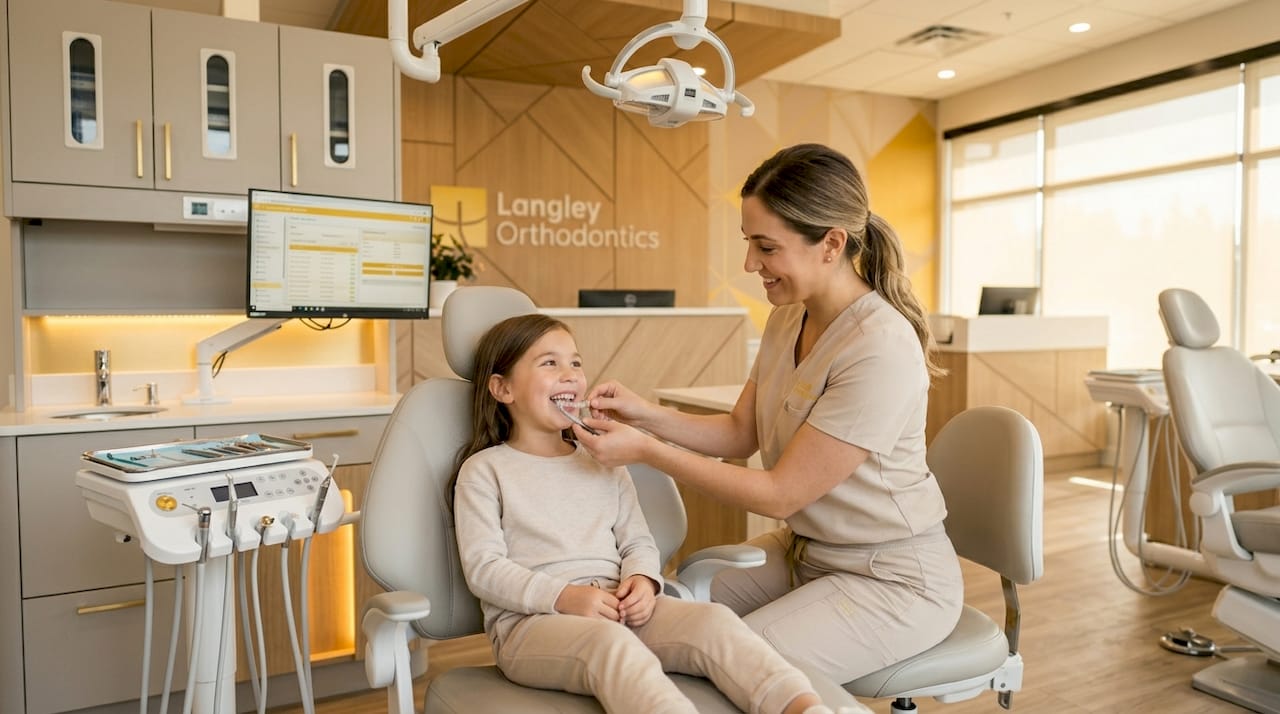
What surprises most parents is that early evaluation often results in monitoring rather than immediate treatment. The orthodontist may simply say, “Come back in six months,” and track how the teeth are erupting. This is not a wasted visit. It establishes a baseline and means the provider will catch the right moment to act if intervention becomes necessary.
When early treatment is recommended, the benefits are real. Starting treatment early can reduce the complexity and cost of future orthodontic work by addressing jaw discrepancies before the bones fully harden. A child who gets a palate expander at age 8 may avoid jaw surgery at age 16. That is a meaningful difference in both experience and expense.
Here is what to expect from a first orthodontic visit for a child aged 7 to 12:
- A visual exam of the teeth, bite, and jaw alignment
- X-rays to check tooth development below the gumline
- A conversation about whether treatment is needed now, later, or not at all
- A follow-up schedule if monitoring is the recommended path
Pro Tip: Many AAO-affiliated orthodontists, including those in Langley, BC, offer free initial consultations with no referral required. You do not need your family dentist to send you. You can call and book directly.
The age-7 recommendation is not arbitrary. By this age, the first permanent molars and incisors have typically erupted, giving the orthodontist enough information to evaluate bite relationships and spot developing issues. Waiting until all permanent teeth are in, usually around age 12 to 13, can mean missing the window for simpler interventions.
What are the common treatment options for kids aged 7 to 12?
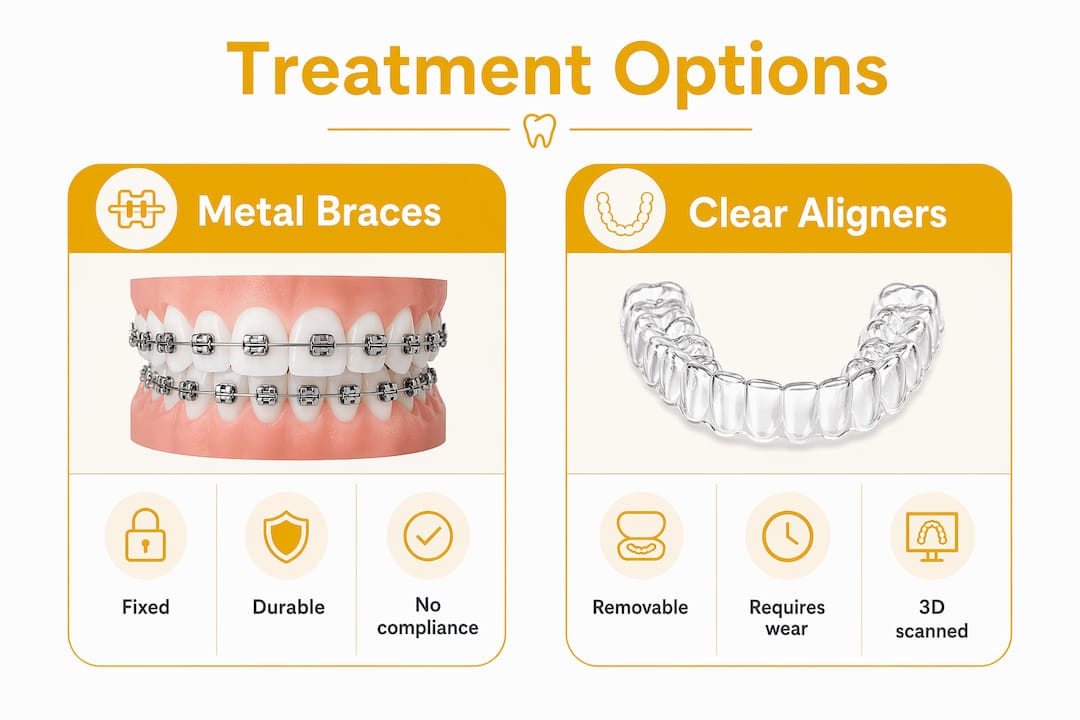
Two treatment paths dominate children’s orthodontics: traditional metal braces and clear aligners such as Invisalign. Each has genuine strengths, and the right choice depends on your child’s specific dental needs, maturity level, and your family’s priorities.
Traditional metal braces
Metal braces remain the most widely used orthodontic treatment for children, and for good reason. They are fixed to the teeth, so compliance is not a variable. The orthodontist controls the movement, and parents do not need to remind their child to wear anything. Braces handle complex tooth movements, severe crowding, and significant bite corrections with precision that is hard to match. The main trade-offs are aesthetics and the dietary restrictions that come with brackets and wires.
Clear aligners for children
Invisalign and similar clear aligner systems have become a genuine option for children aged 7 to 12, not just teenagers. Clear aligners use advanced 3D scanning technology instead of traditional putty impressions, which makes the process faster and more comfortable. Treatment typically completes within 12 to 18 months for straightforward cases, though more complex alignment issues may take longer. The removable nature of aligners makes eating and brushing far easier than with fixed braces.
The critical variable with clear aligners is compliance. Aligner success depends on the child wearing the trays for 20 to 22 hours per day, every day. For younger children, this requires consistent parental involvement. Providers who offer tracking tools, app-based monitoring, or structured check-in schedules give families a real advantage in staying on course.
Pro Tip: Before choosing between braces and aligners, read through the key differences between the two options for children. The decision is rarely just about looks.
| Feature | Metal braces | Clear aligners |
|---|---|---|
| Compliance required | No (fixed) | Yes (20+ hours/day) |
| Visibility | Noticeable | Nearly invisible |
| Eating restrictions | Yes | No (remove to eat) |
| Oral hygiene | More complex | Easier |
| Best for | Complex cases | Mild to moderate cases |
| Technology used | Traditional wires | 3D scanning, digital trays |
The 3D scanning technology used in modern aligner treatment improves both the accuracy of tooth movement and the comfort of the fitting process. Children who have experienced traditional impressions, the goopy trays that trigger gag reflexes, consistently prefer the digital scan. This matters more than it sounds. A child who is comfortable at appointments is a child who cooperates with treatment.
How to find and choose the best children’s orthodontist nearby in Langley, BC
Finding a qualified pediatric orthodontist nearby in Langley is not difficult, but choosing the right one takes a few deliberate steps. The provider you select will work with your child for one to three years, so the relationship matters as much as the credentials.
Here is a practical process for evaluating local orthodontic clinics:
- Confirm AAO board certification. An orthodontist who completed a full orthodontic specialty residency after dental school has two to three years of additional training beyond a general dentist. This is the baseline credential to look for when searching for the best kids orthodontics in your area.
- Book a free consultation. Most reputable orthodontic clinics in Langley offer complimentary first visits. Use this appointment to assess how the team interacts with your child, not just what they say to you.
- Ask about the technology in use. Clinics using 3D digital scanning, digital treatment planning software, and modern bracket systems deliver more predictable results and more comfortable experiences than those relying on older methods.
- Ask specific questions about your child’s case. A good orthodontist will explain exactly what they see, why they recommend a specific treatment, and what happens if you choose to wait. Vague answers are a red flag.
- Understand the full cost and payment options. Ask for a written treatment estimate that includes all phases, retainers, and follow-up appointments. Many clinics in Langley offer monthly payment plans that make affordable children’s braces accessible without large upfront costs.
- Check patient reviews with a focus on families. Reviews from parents of young patients tell you more about the actual experience than general star ratings.
You can also use a Langley orthodontist comparison resource to evaluate local providers side by side before booking. Knowing what questions to bring to your first consultation makes the visit far more productive.
What practical steps can parents take during orthodontic treatment?
Parents are active participants in their child’s orthodontic outcome, not just appointment schedulers. The habits you build at home directly affect how well treatment works and how smoothly it goes.
- Track wear time for aligners. If your child uses clear aligners, build a daily routine around putting them back in after meals. A simple chart on the bathroom mirror works better than relying on memory alone.
- Attend every adjustment appointment. Skipping or delaying appointments extends treatment time. Each visit moves the teeth according to the treatment plan, and gaps in the schedule create gaps in progress.
- Adapt brushing and flossing techniques. Children with braces need to brush after every meal and use floss threaders or water flossers to clean between brackets. Children with aligners should brush before reinserting trays to avoid trapping food against the teeth.
- Know how to handle common discomfort. Soreness after adjustments is normal and typically lasts two to three days. Soft foods, cold water, and over-the-counter pain relief appropriate for children manage this well. A loose bracket or poking wire is not an emergency, but it does warrant a call to the clinic.
- Watch what your child eats. Hard, sticky, and chewy foods break brackets and bend wires. Apples, popcorn, caramel, and hard candies are the most common culprits. Clear aligner patients have fewer restrictions since they remove trays to eat, but sugary drinks should still be avoided while trays are in.
Pro Tip: For families managing Invisalign treatment day to day, the practical tips for Invisalign guide covers real-world strategies that make compliance easier for both parents and kids.
Successful aligner treatment in children requires clinical tracking and a clear retainer plan for after treatment ends. Ask your orthodontist at the start of treatment how they monitor compliance and what the retention protocol looks like. Retainers are not optional. They are the step that makes the result permanent.
Key takeaways
Early orthodontic evaluation at age 7 is the single most effective step Langley parents can take to protect their child’s long-term dental health and reduce future treatment costs.
| Point | Details |
|---|---|
| Start evaluations at age 7 | The AAO recommends a first orthodontic check-up by age 7 to catch developing issues early. |
| Most early visits mean monitoring | Many children leave their first appointment with a follow-up schedule, not braces. |
| Braces vs. aligners depends on the case | Complex alignment issues favor braces; mild to moderate cases may suit clear aligners well. |
| Compliance drives aligner success | Clear aligner treatment requires 20-plus hours of daily wear and consistent parental involvement. |
| Free consultations lower the barrier | Most Langley orthodontic clinics offer no-cost first visits with no referral needed. |
What I’ve learned from watching parents navigate this decision
The most common mistake I see is parents waiting until a child’s teeth look obviously crooked before booking an orthodontic consultation. By that point, the jaw has often finished most of its growth, and the treatment options narrow considerably. The age-7 recommendation from the AAO is not a sales tactic. It reflects real biology. A growing jaw responds to guidance. A finished jaw does not.
The second pattern worth naming is the anxiety parents feel about choosing between braces and clear aligners. Many families spend weeks researching this decision when the orthodontist will usually make it straightforward at the consultation. The provider who has examined your child’s X-rays and bite knows which option fits the clinical picture. Your job is to ask good questions and understand the reasoning, not to arrive with the answer already decided.
What I genuinely believe, based on everything I have seen, is that the provider relationship matters more than the treatment type. A skilled orthodontist who communicates clearly, who your child actually likes walking in to see, and who tracks progress carefully will get a better result with either braces or aligners than a technically capable but impersonal clinic. Langley has good options. The goal is finding the one that fits your family.
— Juiced
Start your child’s orthodontic care at Glow Orthodontics
Glow Orthodontics in Langley, BC, specializes in pediatric orthodontic care for children aged 7 and up, offering both traditional braces and Invisalign treatment with 3D digital scanning. The team takes a warm, family-centered approach that makes kids feel at ease from the first visit.

Complimentary consultations are available with no referral required. Whether your child needs early monitoring or is ready to start treatment, Glow Orthodontics builds a personalized plan around their specific needs and your family’s schedule. For a broader look at orthodontic options as your child grows, the orthodontic care for teens guide covers everything from treatment timing to retention. Book your child’s first visit at gloworthodontics.ca and take the first step toward a confident smile.
FAQ
When should my child first see an orthodontist?
The AAO recommends a first orthodontic check-up no later than age 7. This allows the orthodontist to assess jaw development and tooth eruption while there is still time to guide growth if needed.
Does my child need braces right away after the first visit?
Not necessarily. Many children leave their first orthodontic appointment with a monitoring plan rather than immediate treatment. The orthodontist will schedule follow-up visits to watch for the right time to act.
How long does children’s orthodontic treatment take?
Treatment duration depends on the case. Clear aligner treatment for mild to moderate issues typically completes within 12 to 18 months. Traditional braces for more complex cases often run 18 to 24 months.
Are clear aligners a good option for kids aged 7 to 12?
Clear aligners work well for children with mild to moderate alignment issues who can commit to wearing the trays 20-plus hours per day. Compliance management and a clear retainer plan after treatment are both required for lasting results.
Do I need a referral to book a children’s orthodontic consultation in Langley?
No referral is needed. Most orthodontic clinics in Langley, including Glow Orthodontics, accept direct bookings and offer complimentary first consultations for new patients.