Choosing the Right Orthodontist for Your Child
May 21, 2026
Choosing the Right Orthodontist for Your Child
TL;DR:
- Choosing an orthodontist involves verifying credentials, technology, and experience to ensure quality care for your child. Communication, transparency, and a personalized treatment plan significantly influence treatment success and satisfaction. Prioritize a provider who explains options clearly, uses modern technology, and makes your child feel comfortable.
Most parents spend more time researching a new car than they do selecting the person who will reshape their child’s smile for the next one to three years. Choosing the right orthodontist is one of the most consequential healthcare decisions you will make for your child, and the difference between a great provider and a mediocre one shows up not just in the final result but in the comfort, communication, and cost of the entire experience. This guide covers exactly what to look for, what questions to ask, and what mistakes to avoid.
Table of Contents
- Key takeaways
- Choosing the right orthodontist: credentials that matter
- Treatment options and technology to look for
- How to prepare for orthodontic consultations
- When to start: age and timing for kids
- Common mistakes parents make when choosing an orthodontist
- My honest take on what actually matters most
- Gloworthodontics: expert care your family can count on
- FAQ
Key takeaways
| Point | Details |
|---|---|
| Verify credentials first | ABO board certification confirms clinical proficiency beyond a standard dental degree. |
| Ask about technology | Practices offering digital scans and 3D planning typically provide more precise and comfortable treatment. |
| Prepare for consultations | Bring a written list of questions and request an itemized cost estimate at the first visit. |
| Timing matters | Most children benefit from an initial evaluation between ages 10 and 14, with earlier checks for complex cases. |
| Trust your instincts | A provider who communicates clearly and makes your child feel at ease is a genuine asset to treatment success. |
Choosing the right orthodontist: credentials that matter
Not every provider who straightens teeth is an orthodontist. A general dentist can legally offer braces or clear aligners, but an orthodontist completes an additional two to three year specialty residency after dental school, focused exclusively on tooth movement, jaw alignment, and facial development. That extra training matters enormously when your child has a complex bite problem or significant crowding.
The most credible credential to look for is board certification from the American Board of Orthodontics. ABO board certification requires passing both written and clinical examinations after completing a residency program, confirming a higher level of verified clinical skill. Many licensed orthodontists never pursue it, which makes it a meaningful differentiator.
Community tenure also tells a story. Local practice longevity corresponds to patient trust and accountability, meaning a provider who has been serving families in the same area for years is less of an unknown quantity than someone new to town with no local track record.
Key credentials to verify before shortlisting a provider:
- Completion of an accredited orthodontic residency program (not just a dental degree)
- ABO board certification or documented board eligibility
- Active membership in recognized professional organizations such as the American Association of Orthodontists
- Experience treating patients in your child’s age group specifically
Pro Tip: Ask the front desk directly: “Is the orthodontist ABO board certified?” It is a simple question that reveals both their credential status and how transparently the practice communicates.
Treatment options and technology to look for
The range of treatment options a practice offers matters more than most parents realize. A provider who only offers traditional metal braces may not be the best fit if your child is a good candidate for clear aligners, and vice versa. When finding a good orthodontist, you want someone who matches the treatment to the patient, not the patient to the treatment.
Here is a quick comparison of common options your child may encounter:
| Treatment type | Best suited for | Key advantage |
|---|---|---|
| Metal braces | Most bite and alignment cases | Most affordable; highly effective |
| Clear ceramic braces | Teens who want less visible hardware | Blends with tooth color |
| Invisalign or clear aligners | Mild to moderate crowding; compliant patients | Removable; easier oral hygiene |
| Lingual braces | Patients who want fully hidden hardware | Placed behind the teeth |
| Self-ligating braces | Cases requiring faster adjustment | Less friction; fewer appointments |
Technology is the other half of this equation. Digital scanning and 3D planning are now markers of quality in orthodontic practices. A digital scan replaces the gag-inducing impression trays most parents remember from childhood, while 3D treatment planning lets the orthodontist show you a projected outcome before a single bracket is placed. These are not luxury features. They affect precision, comfort, and how long treatment takes.
Not every practice offers the same technology, so confirm what is available before committing. If you are exploring clear aligner options specifically, reviewing the Invisalign vs. clear braces differences can help you ask smarter questions during the consultation.
Pro Tip: During your visit, look for a digital scanner in the treatment room. If the practice is still using putty impressions, that tells you something about where they sit on the technology adoption curve.
How to prepare for orthodontic consultations
Good preparation separates confident decisions from guesswork. Start by building a shortlist of two or three candidates using a combination of referrals from your child’s dentist, online reviews, and proximity. Reviews are useful but read them critically. Look for patterns in comments about communication and wait times rather than isolated praise or complaints.

Once you have a shortlist, book consultations. Most orthodontists offer a free first visit, and you should use that time deliberately. Review the key questions to ask before you walk in, and bring them written down.
Questions worth asking at every consultation:
- What treatment options are appropriate for my child’s specific case, and why?
- How long is the estimated treatment duration?
- What does the fee cover, including retainers, refinements, and emergency appointments?
- How often will my child need to come in for adjustments?
- What happens if my child’s needs change mid-treatment?
- Do you have experience treating children in this age group?
What you observe during the visit matters just as much as the answers you receive. Communication style and office environment affect how well your child will stick to treatment protocols over a 12 to 24 month period. A rushed consultation, an indifferent front desk, or a clinical environment that makes your child visibly uncomfortable are all signals worth taking seriously.
Always leave with a written, itemized cost estimate. Requesting a detailed cost breakdown at the consultation stage prevents unexpected bills and gives you an honest comparison point across providers. The orthodontic consultation process guide from Gloworthodontics walks through exactly what to expect if you want to go in fully prepared.
Pro Tip: Bring your child to the consultation, not just for assessment purposes, but so you can watch how the orthodontist interacts with them. A provider who talks at your child rather than with them will make the next two years harder for everyone.
When to start: age and timing for kids
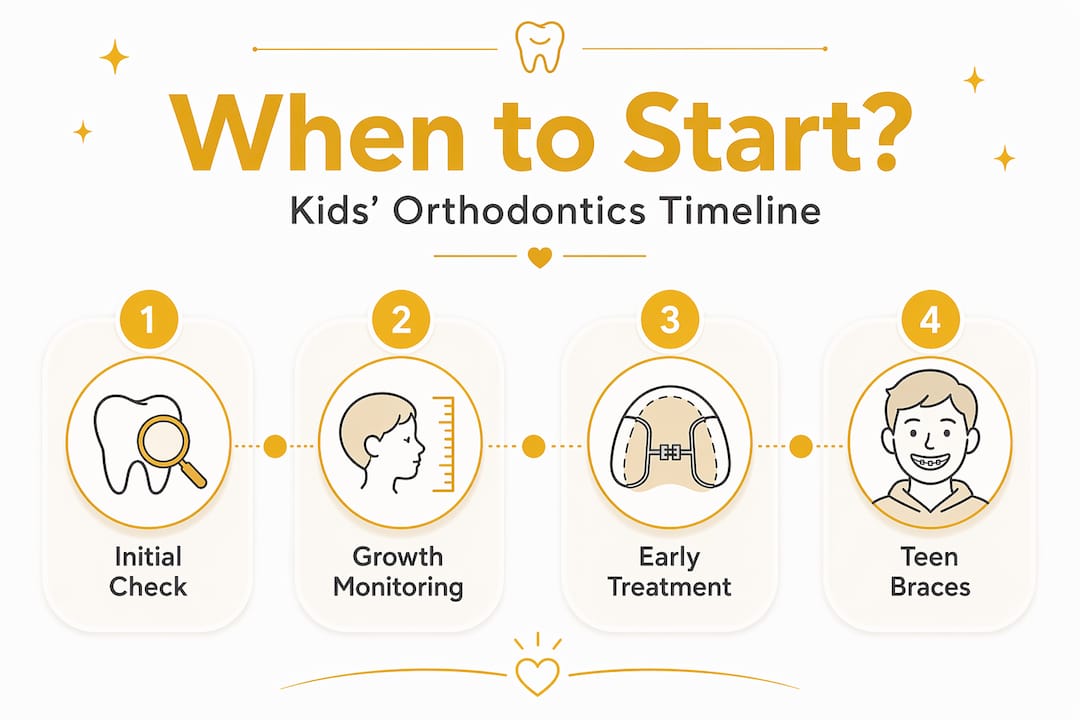
Orthodontic evaluation is typically recommended between ages 10 and 14, when most permanent teeth have erupted and the jaw is still growing. That growth window makes tooth movement faster and often more stable long term.
However, earlier evaluation makes sense in certain situations. Signs your child may need an orthodontic checkup before age 10 include:
- Difficulty chewing or biting
- Mouth breathing or snoring that may suggest airway or jaw issues
- Early or late loss of baby teeth (significantly outside the normal range)
- Crossbite, underbite, or noticeably crowded teeth even before all permanent teeth have come in
- Thumb sucking or pacifier use that continued past age four
Early intervention does not always mean early treatment. Sometimes the orthodontist evaluates a seven year old and recommends simply monitoring until the right time. But catching a developing skeletal issue at age eight is far easier to address than the same problem at age fifteen. For complex cases, early treatment windows of six months to two years can reduce the need for more invasive procedures later. You can also explore the braces options for kids available in Langley to get a clearer picture of what different age groups typically need.
Common mistakes parents make when choosing an orthodontist
This part of how to choose an orthodontist does not get talked about enough. Parents frequently make selection errors that seem reasonable in the moment but create real problems once treatment begins.
Selecting based on price or location alone without checking credentials and treatment offerings is the most common mistake. A provider who charges less and is conveniently close is not a good deal if they lack the technology or training your child’s case actually requires.
Other mistakes that are worth actively avoiding:
- Skipping credential verification because the office looks polished and professional (aesthetics are not a proxy for clinical skill)
- Not asking about the specific technology used for scanning, diagnostics, and treatment planning
- Ignoring your child’s comfort level during the consultation visit
- Failing to ask what happens if treatment takes longer than estimated and whether the fee changes
- Accepting a verbal cost summary rather than insisting on a written, itemized estimate
A personalized treatment plan tailored to your child’s specific needs is a genuine sign of quality care. If a provider gives you a generic recommendation without thoroughly examining your child’s records, X-rays, and photos, that is a warning sign worth heeding.
My honest take on what actually matters most
I have reviewed a lot of guidance on tips for choosing an orthodontist, and most of it focuses on credentials and technology. That is correct as far as it goes. But the factor I would put at the top of my list is communication, and I do not think it gets nearly enough credit.
When I look at cases where parents feel genuinely satisfied with their child’s treatment, the common thread is not always the most advanced technology or the lowest price. It is a provider who took the time to explain what was happening, why, and what came next. Orthodontic treatment runs for months or years. You are not buying a product. You are entering a working relationship, and relationships where communication breaks down become costly and stressful quickly.
Board certification matters. Up-to-date technology matters. But if the orthodontist makes your child feel like a number on a schedule rather than a patient with a specific face, jaw, and set of concerns, the technical credentials will not make up for it. Trust your read of that first consultation. The way a practice treats you when you are still a prospective patient is usually the best version of how they will treat you once you sign on.
— Juiced
Gloworthodontics: expert care your family can count on

If you are at the start of this process and want to skip the guesswork, Gloworthodontics serves families in the Langley, British Columbia area with a genuinely family-centered approach. The practice combines modern treatment technology with transparent, personalized care planning. That means digital scans instead of uncomfortable impressions, written cost estimates at the first visit, and an orthodontic team that explains your child’s plan in plain language.
For parents exploring options for their teenager, the teen orthodontic care guide covers the full range of treatment choices available for young patients at different stages. If Invisalign is on your radar, the Invisalign treatment walkthrough gives you a step-by-step picture of what that process looks like from consultation to final result. Gloworthodontics makes it straightforward to book a consultation online and ask all your questions with no pressure and no surprises.
FAQ
What qualifications should an orthodontist have?
An orthodontist should hold a dental degree plus completion of an accredited specialty residency in orthodontics. ABO board certification is an additional mark of verified clinical proficiency that goes beyond the minimum licensing requirements.
What age should my child first see an orthodontist?
Most children benefit from an initial orthodontic evaluation between ages 10 and 14, when permanent teeth are erupting and the jaw is still developing. Children showing early signs of bite problems or crowding may benefit from an assessment as young as six or seven.
How do I know if an orthodontist offers the right technology?
Ask specifically whether the practice uses digital scanning instead of traditional impressions and whether 3D treatment planning is part of their process. These tools are now standard in quality practices and directly affect comfort and treatment accuracy.
Is it okay to choose an orthodontist based on cost?
Cost is a legitimate factor, but choosing based on price alone without verifying credentials and technology often leads to longer treatment times or unexpected expenses. Always request an itemized written estimate and compare it alongside credentials, not instead of them.
What is a personalized treatment plan and why does it matter?
A personalized treatment plan accounts for your child’s specific jaw structure, bite, age, and tooth positions rather than applying a one-size approach. Customized plans are associated with better outcomes and higher patient satisfaction throughout the treatment process.