Does Medical Insurance Cover Invisalign? 2026 Guide
June 23, 2026
Does Medical Insurance Cover Invisalign? 2026 Guide
TL;DR:
- Medical insurance rarely covers Invisalign unless a health condition directly causes tooth misalignment.
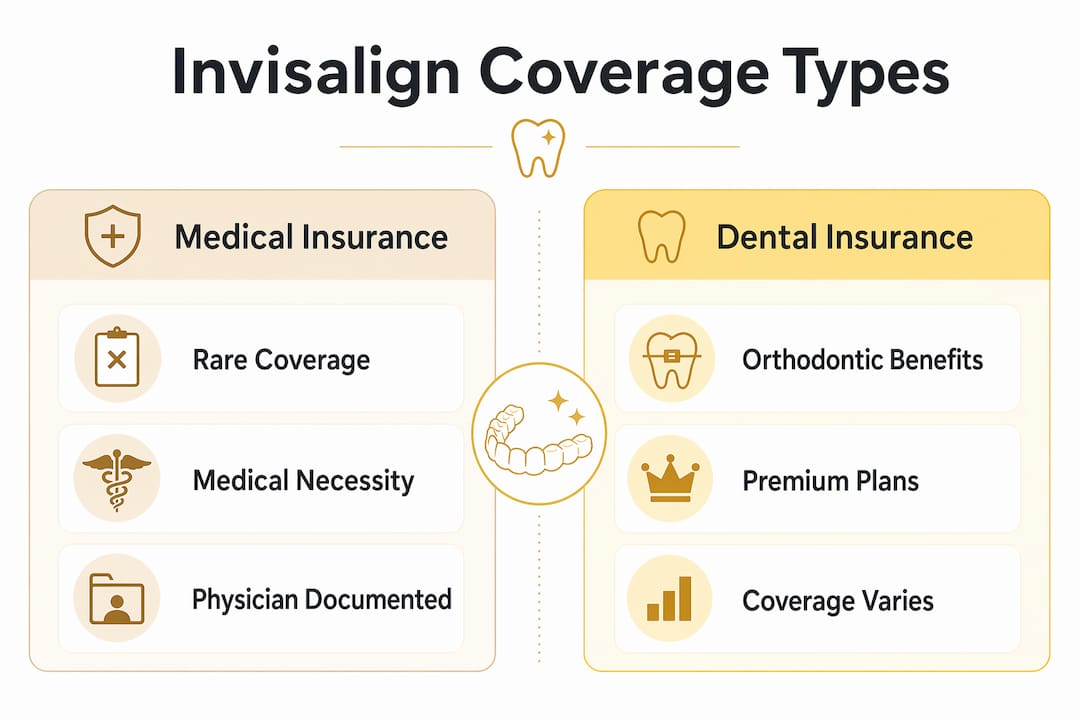
- Dental plans with orthodontic benefits may cover part of the cost, but coverage varies widely and often excludes clear aligners.
Standard medical insurance does not cover Invisalign. Coverage for Invisalign falls under dental insurance orthodontic benefits, not traditional medical plans, and even then it depends entirely on how your specific plan classifies clear aligner treatment. Whether Invisalign qualifies as a covered orthodontic service or gets rejected as cosmetic is the central question every patient needs to answer before starting treatment. Insurers like Delta Dental, Cigna, Humana, and Medi-Cal each handle this differently, and the gap between “partially covered” and “full out-of-pocket cost” can run into thousands of dollars.

Does medical cover Invisalign, or is it always dental?
Medical insurance almost never covers Invisalign. The rare exception is when a physician documents that tooth misalignment directly causes a medical condition, such as severe sleep apnea or a jaw disorder requiring surgical intervention. In those cases, a medical plan may cover part of the treatment. For the vast majority of patients, though, Invisalign coverage is a dental insurance question, not a medical one.
Dental insurance that covers Invisalign does so through orthodontic benefits. These are separate from your basic dental coverage for cleanings and fillings. Not every dental plan includes orthodontic benefits at all, and among those that do, not all of them extend that coverage to clear aligners. Confirming whether your plan has an orthodontic benefit is the first step, and confirming that the benefit applies to Invisalign specifically is the second.
How do dental insurance plans generally cover Invisalign?
Coverage for Invisalign varies significantly from plan to plan. Humana notes that some plans treat Invisalign the same as traditional braces under orthodontic benefits, while others exclude it entirely as a cosmetic treatment, leaving patients responsible for the full cost. The classification your insurer uses determines everything.
Cigna advises that dental plans covering orthodontics typically come with several built-in restrictions. Understanding those restrictions before you commit to treatment prevents expensive surprises. The most common limits include:
- Lifetime orthodontic maximums: Many plans cap orthodontic benefits at a set dollar amount, often between $1,000 and $2,000, regardless of total treatment cost.
- Waiting periods: Some plans require you to be enrolled for 12 months before orthodontic benefits activate.
- Age restrictions: Orthodontic benefits frequently apply only to patients under 18 or 19, leaving adults without coverage even on plans that cover children.
- Clear aligner exclusions: A plan may cover braces but explicitly exclude Invisalign or other clear aligner systems.
Pro Tip: Ask your insurer two separate questions: “Does my plan include orthodontic benefits?” and “Does that benefit cover clear aligners like Invisalign?” A yes to the first does not guarantee a yes to the second.
Insurers like Delta Dental offer multiple plan tiers, and orthodontic coverage often appears only on premium tiers. Checking your Summary of Benefits document, not just the plan name, is the only reliable way to confirm what applies to you. If you want a deeper breakdown of how dental insurance covers Invisalign for families, that resource covers plan comparisons in detail.
What do Medicaid and Medicare cover for Invisalign?
Medicaid and Medicare represent two very different situations, and neither is straightforward for Invisalign patients.
Medicaid covers orthodontics for children under 21 when treatment is medically necessary, meaning a functional problem like a severe bite issue must be documented. Traditional braces qualify under this standard in most states. Invisalign, however, is rarely covered under Medicaid because it is typically classified as a cosmetic alternative rather than a medically required appliance. Adult Medicaid orthodontic coverage is even rarer and varies by state program.
Medicare Part A and Part B exclude routine dental and orthodontic treatment entirely. Medicare will only consider orthodontic-related costs when they are part of medically necessary care ordered by a physician, such as jaw reconstruction following an injury. Invisalign for teeth straightening does not meet that threshold under standard Medicare rules.
The key concept across both programs is “medical necessity.” Here is how that determination typically works:
- A physician or dentist documents that the misalignment causes a functional health problem, not just an aesthetic concern.
- The treating provider submits clinical records, X-rays, and a written justification to the insurer or program.
- The program reviews whether the proposed treatment, Invisalign specifically, is the appropriate and cost-effective solution.
- Approval is granted only if the treatment meets the program’s clinical criteria.
For Denti-Cal, which is California’s Medicaid dental program, the same general rule applies. Braces for children with documented functional problems may be covered. Invisalign is not a standard covered benefit under Denti-Cal. Patients relying on public insurance programs should discuss traditional braces as the more likely covered option and ask their orthodontist to document medical necessity thoroughly if pursuing any aligner coverage.
Can FSA or HSA accounts cover Invisalign costs?
Flexible Spending Accounts and Health Savings Accounts are among the most practical tools for managing Invisalign costs when insurance coverage is limited. FSA and HSA funds can cover Invisalign when the treatment is medically necessary, but the IRS defines eligible expenses strictly. Purely cosmetic orthodontic work does not qualify.
IRS Publication 502 establishes that orthodontic expenses are deductible as medical expenses only when they exceed 7.5% of your adjusted gross income and are not reimbursed by insurance or an FSA/HSA. That threshold is high enough that most patients will not reach it through Invisalign costs alone. Itemizing deductions is also required, which means the standard deduction must be lower than your total itemized expenses for the year.
Key rules for using FSA and HSA funds for Invisalign:
- Documentation is required. Keep all receipts, treatment plans, and a letter of medical necessity from your orthodontist.
- No double-dipping. IRS rules prohibit using FSA/HSA funds for expenses already reimbursed by insurance. Coordinate your insurance Explanation of Benefits before submitting FSA/HSA claims.
- FSA use-it-or-lose-it rules apply. If your FSA has a year-end deadline, plan your Invisalign payments to align with your benefit period.
- HSA funds roll over. HSA balances carry forward indefinitely, making them useful for multi-year treatment plans.
Pro Tip: Ask your orthodontist to provide a letter of medical necessity before you submit an FSA or HSA claim. This single document significantly reduces the risk of a denied reimbursement.
The tax deduction route is less useful for most patients than FSA/HSA reimbursement. Using pre-tax FSA or HSA dollars effectively reduces your Invisalign cost by your marginal tax rate, which is a real and immediate saving without requiring you to hit the IRS income threshold.
How to verify and maximize your Invisalign coverage
Verifying coverage before treatment starts is the single most effective way to avoid unexpected costs. Cigna stresses that patients should request orthodontic-specific benefit details, not just general dental coverage summaries, because the two are often structured differently within the same plan.
Ask your insurer these specific questions:
- Does my plan include an orthodontic benefit?
- Does that benefit cover clear aligners, specifically Invisalign?
- What is the lifetime orthodontic maximum on my plan?
- Is there a waiting period before orthodontic benefits activate?
- Does coverage differ for patients under 18 versus adults?
- Is my preferred orthodontist in-network for orthodontic benefits?
Using an in-network provider matters more for orthodontics than for general dental care. Out-of-network orthodontists may still receive some benefit payment, but the patient portion increases substantially. Questions to ask your orthodontist before treatment include whether the practice files insurance claims on your behalf and whether they offer payment plans for the remaining balance.
| Coverage option | Best for | Key limitation |
|---|---|---|
| Dental insurance orthodontic benefit | Patients with employer-sponsored dental plans | Lifetime maximums, age restrictions, clear aligner exclusions |
| Medicaid | Children under 21 with documented medical necessity | Rarely covers Invisalign; traditional braces more likely approved |
| Medicare | Medically necessary jaw-related treatment only | Routine orthodontics excluded entirely |
| FSA/HSA | Patients with employer-sponsored accounts | Requires medical necessity documentation; no double-dipping |
| IRS medical deduction | High out-of-pocket costs exceeding 7.5% AGI | Requires itemizing; most patients do not reach the threshold |
If your coverage is limited or nonexistent, orthodontic discount plans through organizations like the Dental Savings Plan network offer reduced rates at participating providers. Many orthodontic practices, including those in the Langley area, also offer in-house financing with low or no interest for qualified patients. Knowing what questions to ask insurance providers about orthodontic benefits helps you walk into that conversation prepared.
Key Takeaways
Medical insurance does not cover Invisalign for cosmetic purposes. Coverage depends on dental plan orthodontic benefits, medical necessity documentation, and the right use of tax-advantaged accounts.
| Point | Details |
|---|---|
| Medical vs. dental coverage | Invisalign is covered by dental insurance orthodontic benefits, not standard medical plans. |
| Plan classification matters | If your insurer classifies Invisalign as cosmetic, you pay the full cost out-of-pocket. |
| Medicaid covers children first | Medicaid covers braces for children under 21 when medically necessary; Invisalign is rarely approved. |
| FSA/HSA reduces real costs | Pre-tax FSA or HSA funds can cover Invisalign when medical necessity is documented and insurance is coordinated. |
| Verify before you start | Ask your insurer specifically about clear aligner coverage, lifetime maximums, and age limits before beginning treatment. |
What most patients get wrong about Invisalign coverage
The most common mistake I see is patients assuming that because their dental plan covers orthodontics, it automatically covers Invisalign. That assumption costs people thousands of dollars. Humana points out that the cosmetic classification is the single biggest reason claims get denied, and it catches patients completely off guard.
The second mistake is not involving the orthodontist in the insurance conversation early enough. A good orthodontist will document your case in clinical terms, not cosmetic ones, which gives your insurer a stronger basis for approving coverage. If your bite is causing jaw pain, headaches, or difficulty chewing, those are functional problems. They belong in your chart and in your insurance submission.
The third mistake is treating FSA and HSA funds as a backup plan rather than a primary strategy. If your dental plan has a $1,500 lifetime orthodontic maximum and your Invisalign costs $5,000, your FSA can cover the remaining $3,500 with pre-tax dollars. That is a meaningful reduction in real cost, and most patients leave that money sitting unused.
Plan literacy is the skill nobody teaches you. Reading your Summary of Benefits document, understanding what “orthodontic benefit” actually means in your specific plan, and knowing your lifetime maximum before you sit in the orthodontist’s chair puts you in control of the financial side of treatment.
— Juiced
Gloworthodontics and your Invisalign coverage options
Navigating insurance for Invisalign is genuinely complicated, and Gloworthodontics makes that process easier for patients in the Langley area.

The team at Gloworthodontics works directly with dental insurance providers to verify your orthodontic benefits before treatment begins, so you know exactly what your plan covers and what your out-of-pocket responsibility will be. For patients whose insurance coverage is limited, Gloworthodontics offers flexible payment plans designed to make treatment accessible without financial stress. Whether you are starting with a consultation or ready to move forward, the Invisalign treatment process guide walks you through every step from your first appointment to your final tray.
FAQ
Does medical insurance ever cover Invisalign?
Standard medical insurance does not cover Invisalign. The rare exception is when a physician documents that tooth misalignment directly causes a medical condition, such as a severe jaw disorder, and the treatment is deemed medically necessary.
Does Blue Cross Blue Shield dental cover Invisalign?
Blue Cross Blue Shield dental coverage for Invisalign depends on the specific plan you hold. Plans with orthodontic benefits may cover Invisalign partially, but coverage is subject to lifetime maximums, waiting periods, and whether the plan classifies clear aligners as a covered orthodontic appliance.
Does Denti-Cal cover Invisalign?
Denti-Cal does not typically cover Invisalign. California’s Medicaid dental program covers traditional braces for children under 21 when treatment is medically necessary, but Invisalign is not a standard covered benefit under Denti-Cal.
Does orthodontic insurance cover Invisalign the same as braces?
Not always. Some dental plans with orthodontic benefits treat Invisalign and braces equally, while others explicitly exclude clear aligners. Confirming clear aligner coverage with your insurer directly is the only reliable way to know.
Can I use an FSA or HSA to pay for Invisalign?
Yes, FSA and HSA funds can pay for Invisalign when the treatment is medically necessary and properly documented. You cannot use these funds for expenses already reimbursed by insurance, and cosmetic-only treatment generally does not qualify under IRS rules.