Does Sun Life Dental Cover Invisalign? 2026 Guide
June 6, 2026
Does Sun Life Dental Cover Invisalign? 2026 Guide
TL;DR:
- Sun Life dental insurance generally covers Invisalign treatments under orthodontic benefits, with partial reimbursement based on specific plan details. The coverage typically reimburses 60 to 70% of provincial fee guide amounts up to a lifetime maximum, which varies per plan, while waiting periods and preauthorization requirements are common. Both Invisalign and traditional braces are treated equally under these benefits, but understanding plan specifics and obtaining preapprovals before treatment ensures maximum coverage and minimizes unexpected costs.
Sun Life dental insurance covers Invisalign treatment under its orthodontic benefits, though reimbursement is partial and subject to plan-specific conditions. If you’re asking whether Sun Life dental covers Invisalign, the short answer is yes, for most group plans that include orthodontic benefits. The real question is how much Sun Life pays and what limits apply. Coverage typically reimburses 60% of treatment costs up to a lifetime maximum, and reimbursement amounts are calculated from provincial dental fee guides rather than your provider’s actual fees. Understanding these mechanics before you start treatment saves you from unexpected bills.
Does Sun Life dental cover Invisalign, and how much?

Sun Life dental plans are structured in tiers, and orthodontics is a separate benefit category with its own coverage percentage, lifetime cap, and waiting period. Preventive care like cleanings typically gets reimbursed at 80 to 100%, while orthodontic benefits sit lower, usually around 50 to 60%. This tiered structure means your Invisalign coverage depends entirely on which plan tier your employer selected.
Sun Life offers Basic, Standard, and Enhanced plans, and orthodontic coverage is generally available only in Enhanced or optional add-on plans. If your group plan is Basic or Standard without an orthodontic rider, Invisalign will not be covered at all. Checking your plan booklet or calling Sun Life’s member services line before booking a consultation is the single most important step you can take.
Here is what orthodontic coverage under a Sun Life plan typically looks like:
- Reimbursement rate: 60 to 70% of eligible costs, calculated from the provincial dental fee guide, not your orthodontist’s billed fee
- Lifetime maximum: Typically $1,500 to $3,500 per insured person, applied once across your lifetime under that plan
- Waiting period: Many plans require a two-year waiting period before orthodontic benefits activate
- Eligible treatments: Invisalign and traditional braces generally fall under the same orthodontic category
Pro Tip: Request a predetermination of benefits from Sun Life before your Invisalign treatment begins. Your orthodontist submits a treatment plan, and Sun Life responds with exactly what they will pay. This removes all guesswork from your out-of-pocket calculation.
What are the real out-of-pocket costs and limitations?
The gap between what Sun Life pays and what you actually owe is wider than most people expect. Two separate limits interact to create your out-of-pocket responsibility: the lifetime maximum cap and the fee guide reimbursement ceiling. Even when your plan states “60% coverage,” that 60% applies to the provincial fee guide amount, not your orthodontist’s actual fee. If your orthodontist charges $6,500 for Invisalign but the fee guide sets the eligible amount at $4,000, Sun Life calculates 60% of $4,000, not $6,500.
Here is a practical example. Suppose your plan has a $2,000 lifetime orthodontic maximum and a 60% reimbursement rate. Your Invisalign treatment costs $6,000. Sun Life reimburses up to $2,000 total, leaving you responsible for $4,000. That is a significant out-of-pocket expense even with coverage active.
The following limitations are the most common reasons claims come back lower than expected:
- Waiting period not satisfied. Starting treatment before your two-year orthodontic waiting period ends means Sun Life will not reimburse any portion of that treatment, even if you are covered afterward.
- No preauthorization submitted. Skipping insurer review before treatment begins risks partial or full claim denial. Preauthorization is not optional for orthodontic claims.
- Lifetime maximum already used. If you or a family member used orthodontic benefits for braces years ago, the lifetime maximum may already be exhausted.
- Plan does not include orthodontics. Many group plans omit orthodontic benefits entirely. Confirming coverage before treatment is non-negotiable.
Pro Tip: Ask your HR department for your full plan booklet, not just a summary. The booklet contains the exact waiting periods, lifetime maximums, and preauthorization requirements that determine your actual coverage.
How does Invisalign coverage compare to traditional braces under Sun Life?
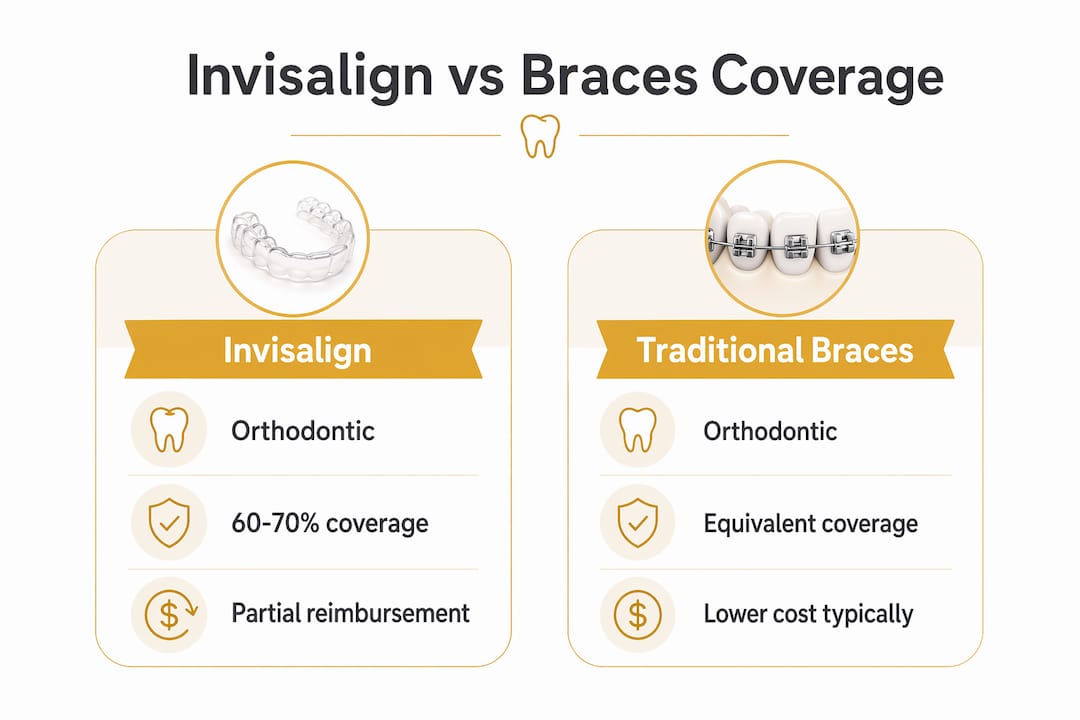
Sun Life treats Invisalign and traditional braces equivalently under orthodontic benefits. Both fall into the same reimbursement category, meaning the coverage percentage and lifetime maximum apply identically to either treatment. Choosing Invisalign over metal braces does not reduce your insurance benefit, and choosing braces does not increase it.
This equivalence matters because some patients assume Invisalign is classified differently, perhaps as a cosmetic procedure, and therefore excluded. That assumption is wrong for most Sun Life group plans. Orthodontic benefits cover medically appropriate teeth straightening regardless of the appliance used. The clinical suitability of each treatment for your specific case should drive your decision far more than insurance differences.
| Factor | Invisalign | Traditional braces |
|---|---|---|
| Coverage category | Orthodontic benefit | Orthodontic benefit |
| Reimbursement rate | 60 to 70% of fee guide amount | 60 to 70% of fee guide amount |
| Lifetime maximum | Same cap applies | Same cap applies |
| Waiting period | Same waiting period applies | Same waiting period applies |
| Cosmetic exclusion risk | Low for group plans | Low for group plans |
| Clinical suitability | Best for mild to moderate cases | Handles complex cases well |
The one practical difference is cost. Invisalign treatment often costs more than traditional braces at the provider level. Since Sun Life reimburses based on a fixed lifetime maximum, a higher total treatment cost means a larger out-of-pocket balance for Invisalign patients. Reviewing the Invisalign versus braces decision with your orthodontist alongside your insurance details gives you the clearest picture of total cost.
What practical steps maximize your Invisalign coverage with Sun Life?
Getting the most from your Sun Life dental benefits requires preparation before treatment starts, not after. Most reimbursement problems are preventable with the right steps taken in the right order.
- Verify your plan includes orthodontics. Log into Sun Life’s member portal or call member services to confirm your specific plan has orthodontic benefits and check the current lifetime maximum balance.
- Check your waiting period status. If you enrolled recently, confirm whether your two-year orthodontic waiting period has passed. Starting treatment one month too early can cost you thousands.
- Get a predetermination of benefits. Have your orthodontist submit a treatment plan to Sun Life before any work begins. Sun Life responds with a written estimate of what they will pay, which you can use to plan your budget.
- Submit preauthorization and all required records. Orthodontic claims require documentation including X-rays, photos, and a treatment plan. Missing records are the most common reason for delayed or denied reimbursements.
- Track your lifetime maximum usage. If you are covering a child and yourself, each person has a separate lifetime maximum. Knowing each balance helps you time treatment phases strategically.
- Save every receipt and explanation of benefits. Sun Life sends an explanation of benefits after each claim. Keep these records to reconcile payments and catch any processing errors.
- Consider a Health Spending Account or FSA. If your employer offers a Health Spending Account or Flexible Spending Account, you can use pre-tax dollars to cover the out-of-pocket portion that Sun Life does not reimburse.
For families with multiple members needing orthodontic treatment, timing matters. Staggering treatment start dates across plan years can sometimes allow you to maximize annual benefit resets, depending on how your specific plan is structured. A detailed look at insurance coverage for Invisalign can help you map out the most cost-effective sequence.
Key takeaways
Sun Life dental insurance covers Invisalign under orthodontic benefits at roughly 60 to 70% of the fee guide amount, subject to a lifetime maximum and waiting period that vary by plan.
| Point | Details |
|---|---|
| Coverage is plan-dependent | Only Enhanced or orthodontic add-on plans include Invisalign benefits; Basic plans typically do not. |
| Reimbursement has two limits | Sun Life pays 60 to 70% of the fee guide amount, capped by your lifetime orthodontic maximum. |
| Waiting periods are real | A two-year waiting period applies to many plans; starting treatment early means paying the full cost yourself. |
| Invisalign and braces are equal | Sun Life reimburses both treatments identically under the orthodontic category. |
| Preauthorization is required | Submitting a predetermination before treatment starts protects you from claim denials and surprises. |
What I’ve learned about Sun Life Invisalign coverage after working with patients
The most common mistake I see is patients who assume their dental plan covers Invisalign because they have “dental insurance.” Sun Life dental coverage is not a single product. It is a spectrum of plans with wildly different orthodontic benefits, and the difference between a Basic plan and an Enhanced plan can mean the difference between $2,000 in reimbursement and zero.
The second misconception is that 60% coverage means paying 40% of the treatment price. It does not. It means paying 40% of whatever the provincial fee guide says the treatment is worth, plus 100% of any amount above that guide rate. For Invisalign, where provider fees frequently exceed fee guide benchmarks, the real out-of-pocket figure is often closer to 60 to 70% of total cost, not 40%.
What actually works is treating insurance verification as step one of the treatment process, not an afterthought. Patients who come to us having already confirmed their Sun Life orthodontic benefits, checked their waiting period status, and requested a predetermination have a far smoother experience. They know their numbers before committing to treatment, and they are not blindsided by the gap between what they expected and what Sun Life actually paid.
Clinical needs should still lead the decision. If Invisalign is the right treatment for your bite and lifestyle, the insurance math should inform your budget planning, not override your orthodontist’s recommendation. The coverage and cost details for Sun Life families are worth reviewing carefully before your first appointment.
— Juiced
Start your Invisalign journey with Gloworthodontics
Gloworthodontics works with Sun Life dental plans every day and understands exactly how to navigate orthodontic claims, preauthorization requirements, and reimbursement timelines. If you are ready to find out what your specific Sun Life plan covers for Invisalign, the team at Gloworthodontics can review your benefits with you during a consultation and help you build a clear picture of your out-of-pocket costs before treatment begins.

Book a consultation at Gloworthodontics in Langley, British Columbia, and get a personalized Invisalign coverage review based on your actual Sun Life plan details. The team handles the insurance paperwork so you can focus on your treatment. Visit gloworthodontics.ca to schedule your appointment today.
FAQ
Does Sun Life dental cover Invisalign for adults?
Yes. Sun Life covers Invisalign for adults under orthodontic benefits when the plan includes that category. Coverage is not age-restricted in most group plans, though lifetime maximums and waiting periods still apply.
What is the Sun Life lifetime maximum for orthodontic treatment?
Sun Life orthodontic lifetime maximums typically range from $1,500 to $3,500 per person, depending on the specific group plan. This cap applies once per lifetime and covers both Invisalign and traditional braces.
Do I need preauthorization for Invisalign under Sun Life?
Yes. Orthodontic claims require preauthorization and supporting documentation including X-rays and a treatment plan. Starting treatment without insurer review risks partial or full claim denial.
How long is the waiting period for Sun Life orthodontic benefits?
Many Sun Life group plans include a two-year waiting period for orthodontic benefits. Treatment started before this period ends will not be reimbursed, even if the plan includes orthodontic coverage.
Are Invisalign braces covered the same as metal braces under Sun Life?
Yes. Sun Life reimburses Invisalign and braces equally under the orthodontic benefit category. The same reimbursement rate and lifetime maximum apply to both treatments.