Emergency Braces: What to Do Right Now (2026 Guide)
July 26, 2026
Emergency Braces: What to Do Right Now (2026 Guide)
Not every problem with your braces is a crisis. But some are. Knowing the difference is the first thing that protects both your treatment and your health.
According to the American Association of Orthodontists, true orthodontic emergencies are situations involving severe facial trauma, difficulty breathing, uncontrolled bleeding, or signs of infection. These require a trip to the emergency room, not a call to your orthodontist. Your orthodontist is not equipped to manage a broken jaw or a spreading dental abscess.
Below that threshold sits a second category: urgent orthodontic issues. A broken bracket, a poking wire, a lost aligner tray — these need timely attention, but they are rarely life-threatening. Most can be managed at home for a day or two while you arrange professional care.
Then there is normal soreness. Aching teeth and tender gums in the first few days after an adjustment are not emergencies. They are expected.
Emergency symptoms (go to the ER or call 911):
- Difficulty breathing or swallowing
- Uncontrolled bleeding from the mouth
- Severe facial swelling spreading toward the eye or neck
- Suspected broken jaw or significant facial trauma
- Signs of infection: fever, pus, extreme swelling
Urgent orthodontic issues (call your orthodontist):
- Broken or loose bracket
- Poking or broken wire
- Lost or cracked aligner tray
- Band that has come loose
- Persistent pain beyond normal soreness
The clearest way to think about it: if the problem threatens your airway, your blood supply, or involves spreading infection, that is a medical emergency. If it involves your appliance and causes discomfort but no systemic symptoms, it is an orthodontic urgency. One goes to the ER; the other goes to your orthodontist.
Table of Contents
- How to handle common emergency braces issues at home
- Managing orthodontic emergencies when you are traveling
- When and how to contact your orthodontist for urgent care
- What the AAO says about orthodontic emergency care
- What happens if you ignore an orthodontic urgency
- What to do immediately after an accident involving your braces
- Emergency handling by appliance type
- Gloworthodontics is ready when you need urgent orthodontic support
- Key Takeaways
How to handle common emergency braces issues at home
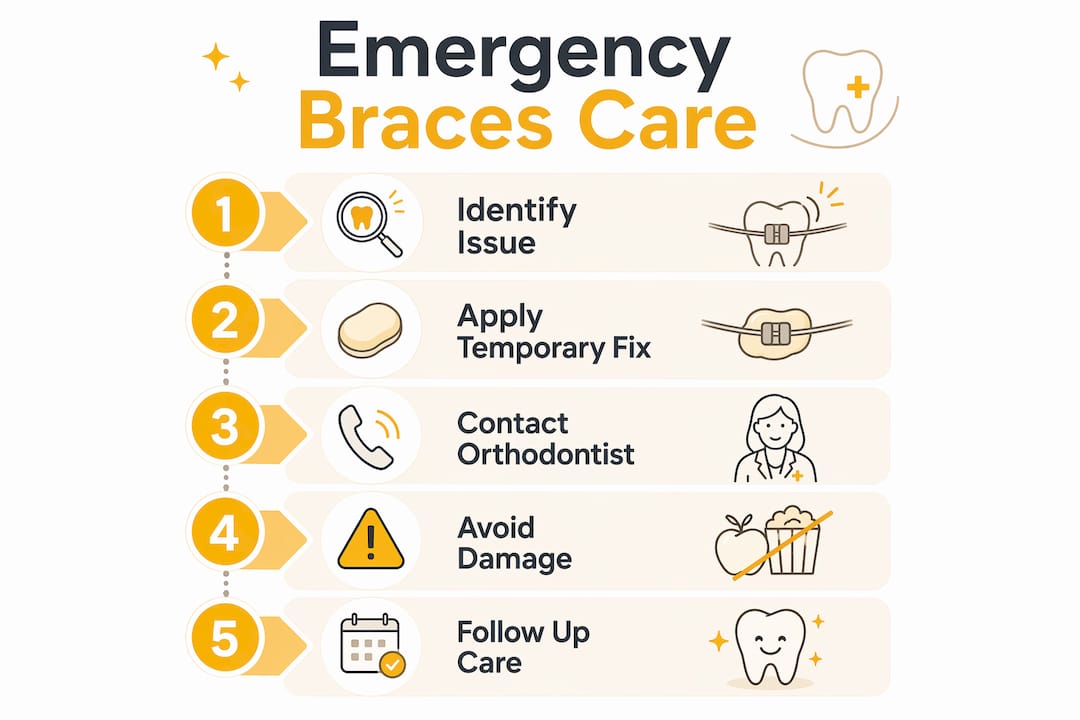
Most urgent braces problems have a workable temporary fix. The goal is to reduce discomfort and prevent further damage until you can get into the office.
Poking wire
A wire that has shifted and is jabbing your cheek is one of the most common complaints. Try gently pushing the wire flat against the tooth using a clean pencil eraser or a cotton swab. Once it is repositioned, cover the tip with orthodontic wax to cushion the area. If the wire is sticking out far enough to clip safely, sterile nail clippers can work as a last resort, but only if you can do it without swallowing the piece.

Pro Tip: Dry the bracket or wire surface completely before pressing wax onto it. Wax will not stick to a wet surface, and most people skip this step and wonder why it falls off in minutes.
Broken or loose bracket
A bracket that has detached from the tooth will often slide along the wire. Do not try to pull it off. If it is spinning and irritating your cheek, use wax to hold it in place temporarily. Save any pieces that come off completely and bring them to your appointment.
Lost or cracked aligner tray
If a tray cracks but still fits, you can continue wearing it while you wait for a replacement. If it is lost entirely, wear your previous tray to prevent teeth from shifting. Contact your provider immediately so a replacement can be ordered.
Mouth sores and irritation
Saltwater rinses (about half a teaspoon of salt in eight ounces of warm water) reduce inflammation and help tissue heal. Topical anesthetics like Orajel can numb a sore spot for short-term relief. For general soreness after an adjustment, ibuprofen or acetaminophen taken as directed works well.
Normal soreness timeline: Soreness in the first few days after an adjustment is expected. Pain that is unbearable or that lasts beyond a week is not normal and needs professional evaluation.
Recommended items for your home orthodontic kit:
- Orthodontic wax
- Sterile tweezers
- Interproximal brushes
- Dental floss
- Topical anesthetic (Orajel or similar)
- OTC pain relievers (ibuprofen or acetaminophen)
- Small mirror and flashlight
Managing orthodontic emergencies when you are traveling
Being away from your orthodontist when something breaks is stressful, but it is manageable. The key is preparation before you leave and clear communication once something goes wrong.
What to pack in a travel orthodontic kit:
- Orthodontic wax (several strips)
- Dental floss and interproximal brushes
- Sterile tweezers
- OTC pain reliever
- Salt packets for rinses
- Your orthodontist’s phone number and after-hours contact
Steps to take on the go:
- Assess the problem. Is this a true medical emergency or an orthodontic urgency?
- Apply a temporary fix using wax, a saltwater rinse, or repositioning a wire with a clean tool.
- Contact your orthodontist by phone or through their patient portal. Many offices offer virtual consultations to triage the issue remotely.
- If you are traveling for an extended period, ask your orthodontist to recommend a colleague in the area who can see you.
- Avoid attempting repairs beyond your ability. Forcing a wire or trying to reattach a bracket yourself can cause more damage.
Virtual triage has become standard practice. Your orthodontist can often assess severity from a clear photo or short video call and tell you whether the issue can wait until you return or needs same-day attention locally. Good oral hygiene during travel also matters more than usual when you cannot get into the office quickly.
When and how to contact your orthodontist for urgent care
The rule is simple: when in doubt, call. Waiting to see if a problem resolves on its own is the most common mistake patients make, and it often extends treatment time.
Call your orthodontist immediately for any of the following:
- Severe or worsening pain not relieved by OTC medication
- A wire that cannot be controlled with wax and is cutting tissue
- A bracket that has fully detached and cannot be stabilized
- Any injury to the mouth, face, or jaw involving your appliance
- A lost aligner with no backup tray available
When you call, describe the problem clearly: which tooth is affected, what the appliance is doing, your pain level on a scale of 1 to 10, and whether you have already tried any home remedies. This helps the office triage your visit accurately.
Most orthodontic practices schedule same-day or next-day comfort visits for urgent issues. After hours, check your provider’s voicemail for an emergency line or on-call instructions. Cost should never be a barrier to reporting a problem: many emergency repairs are included in your original treatment fee.
What the AAO says about orthodontic emergency care
The American Association of Orthodontists draws a clear line between orthodontic emergencies and general medical emergencies. Orthodontists are trained for appliance-related problems, not for managing abscesses, airway compromise, or major trauma. Those situations belong in an emergency room first.
The AAO’s position: “If you notice a bracket is loose or if a wire has worked itself out of place, or if there is unusual discomfort, notify your orthodontist.” Patients are partners in their own care, and timely communication is the single most important factor in keeping treatment on track.
The AAO also emphasizes that virtual consultations are now a standard triage method. Orthodontists use them to determine whether an in-office visit is necessary before scheduling one, which reduces unnecessary trips and helps patients get faster guidance. If your office offers this option, use it.
For anything involving heavy bleeding, breathing difficulty, or a broken jaw, the ER is the right first call. Your orthodontist can address the appliance damage after the medical situation is stabilized.
What happens if you ignore an orthodontic urgency
Skipping a call because a broken bracket “doesn’t hurt that much” is a gamble with your treatment timeline. A detached bracket means that tooth is no longer being moved by the wire. Leave it long enough and your teeth can shift in the wrong direction, requiring additional correction time.
A poking wire that goes unaddressed can cause open sores on the cheek or tongue. Those sores can become infected, turning a minor appliance issue into a genuine medical problem. Untreated dental infections can spread to surrounding structures of the neck and facial sinuses, and in serious cases, compromise the airway.
Lost aligner trays that are not replaced promptly allow teeth to drift. Even a few days without a tray can undo recent progress, and your provider may need to reorder trays or adjust your treatment plan. The longer you wait, the more complicated the fix.
What to do immediately after an accident involving your braces
Accidents happen. A fall, a sports collision, or even biting into something hard can damage your appliance suddenly. Here is the order of operations:
- Check for injury first. Look for cuts, swelling, or loose teeth. If a tooth has been knocked out, place it in milk or saline and get to a dentist within 30 minutes.
- Assess the appliance. Identify what is broken: a bracket, a wire, a band, or the aligner itself.
- Control bleeding. Apply gentle pressure with clean gauze. If bleeding does not stop within 10 minutes, go to urgent care.
- Stabilize what you can. Use wax to cover sharp edges and prevent further soft tissue injury.
- Call your orthodontist. Describe the accident and the damage. Bring any broken pieces to your appointment.
- Document the damage. Take clear photos of the affected area before applying wax. Your orthodontist will want to see the extent of the problem.
Do not try to reattach a bracket with household glue or bend a wire back into shape with pliers. Both can cause damage that is harder to fix than the original problem.
Emergency handling by appliance type
The right response depends on what you are wearing.
Traditional metal or ceramic braces are the most common source of urgent issues. Broken brackets and poking wires are the typical culprits. Wax is your first tool. Keep your braces hygiene routine consistent even when something is broken, since food trapped around a loose bracket accelerates decay.
Clear aligners (Invisalign and similar) crack less often than brackets break, but a cracked tray that no longer fits properly should not be worn. Forcing a misshapen tray can move teeth incorrectly. Wear your previous tray and contact your provider for a replacement. If you are between trays and lose the current one, your orthodontist may instruct you to move to the next tray early depending on where you are in the sequence.
Retainers are often overlooked because treatment is technically complete, but a broken or lost retainer is still urgent. Teeth shift faster than most patients expect once retainer wear stops. A cracked retainer should be replaced within days, not weeks. In the meantime, wear it if it still fits without sharp edges.
Gloworthodontics is ready when you need urgent orthodontic support
When something goes wrong with your braces or aligners, you need a provider who responds quickly and knows your case. Gloworthodontics offers personalized orthodontic care with a team that treats urgent issues as a priority, not an afterthought.

Whether you are dealing with a broken bracket, a lost aligner, or just not sure whether what you are experiencing counts as urgent, the Gloworthodontics team gives you a clear answer fast. Patients have access to guidance on managing everything from minor discomfort to appliance damage, with a warm, professional approach that keeps your treatment moving forward. For families navigating teen orthodontic care, the complete teen orthodontic guide covers emergency situations alongside everyday treatment support. If you are dealing with an urgent issue right now, visit the orthodontic emergencies page to get specific guidance and reach the team directly.
Key Takeaways
True orthodontic emergencies involving bleeding, breathing difficulty, or severe trauma require the ER first; appliance-related urgencies require your orthodontist promptly.
| Point | Details |
|---|---|
| True vs. urgent emergencies | Airway, bleeding, and infection go to the ER; broken brackets and wires go to your orthodontist. |
| Wax works best dry | Dry the bracket or wire surface completely before applying orthodontic wax for it to hold. |
| Travel kit matters | Pack wax, tweezers, floss, pain relievers, and your orthodontist’s contact before any trip. |
| Ignoring issues costs time | A detached bracket stops tooth movement and can reverse progress if left unaddressed. |
| Gloworthodontics | Offers responsive, patient-centered care for urgent orthodontic issues and ongoing treatment support. |