Essential Orthodontic Care Tips for Parents in Langley
May 9, 2026
Essential Orthodontic Care Tips for Parents in Langley
TL;DR:
- Most children benefit from an orthodontic assessment around age 7 to monitor development rather than begin treatment immediately. Early evaluations help identify issues like crossbites and crowding, with active treatment usually delayed until age 11 to 13 unless urgent concerns arise. Proper daily home care and selecting a qualified, child-friendly orthodontist ensure effective treatment and healthier smiles in the long term.
Most parents assume the moment their child’s teeth start looking crowded, it’s time to book braces. That assumption leads to rushed decisions, unnecessary stress, and sometimes treatment that starts before a child’s jaw is ready. The AAO recommends evaluation by age 7, but that first visit is about observation just as often as it is about treatment. This guide walks Langley parents through the real timeline for orthodontic care, daily habits that protect your child’s smile during treatment, and how to choose the right local provider for your family.
Table of Contents
- When should children start orthodontic care?
- What to expect at the first orthodontic evaluation
- Daily care tips for kids with braces or other orthodontics
- Smart eating and handling emergencies
- Choosing the right orthodontist in Langley
- What most parents get wrong about early orthodontic treatment
- Expert orthodontic care for your child in Langley
- Frequently asked questions
Key Takeaways
| Point | Details |
|---|---|
| Start early evaluation | Book your child’s first orthodontic visit by age 7 to catch any issues early. |
| Not all need treatment | Most young children are monitored, not given braces right away. |
| Hygiene is crucial | Help your child brush and floss daily to prevent staining, decay, and treatment delays. |
| Choose the right provider | Look for certified, child-friendly orthodontists in Langley for the best experience. |
| Know what to avoid | Keep kids away from hard and sticky foods, and address emergencies promptly with wax or a call to your orthodontist. |
When should children start orthodontic care?
The timing question trips up a lot of parents. You hear “age 7” and immediately picture metal brackets and a mouth full of wires. But the purpose of an early visit is far more nuanced than that.
Both the AAO and Canadian Association of Orthodontists recommend that children receive their first orthodontic assessment around age 7. At this age, your child has a mix of baby teeth and permanent teeth coming in, which gives an orthodontist a meaningful look at how the bite is developing, how the jaw is growing, and whether any habits or structural issues need attention.
Here’s what an early evaluation can reveal:
- Crossbites: When upper and lower teeth don’t meet correctly, affecting jaw symmetry
- Crowding: Not enough room for permanent teeth to come in straight
- Spacing issues: Gaps that may signal missing or extra teeth
- Oral habits: Thumb-sucking or prolonged pacifier use that affects jaw shape
- Overjet: Upper front teeth that protrude significantly, increasing injury risk
The good news? Early evaluation doesn’t mean immediate braces. Many children are simply monitored every 6 to 12 months until their permanent teeth are fully in. Active treatment is typically reserved for situations where waiting would make the problem harder to fix, such as a crossbite that affects jaw growth, or prominent upper teeth that increase the chance of a tooth being chipped during a fall.
Families in Langley have several excellent options for that first evaluation. Comparing kids orthodontist options nearby is a worthwhile step before booking, especially if you want a provider who specializes in child development rather than general dentistry. When you do move toward treatment, understanding the full range of braces options for kids helps you ask smarter questions at that first appointment.
Stat to know: The AAO estimates that 1 in 5 orthodontic patients is under the age of 18, yet most of those children did not start active treatment until age 11 or older.
What to expect at the first orthodontic evaluation
Knowing whether your child needs immediate treatment or monitoring, let’s look at what actually happens during that initial orthodontic visit.
The first appointment is mostly an assessment. It typically includes X-rays, photographs of the teeth and face, and a hands-on examination of the bite and jaw. An orthodontist will look at how the upper and lower jaws relate to each other, the spacing between teeth, and whether any permanent teeth appear to be impacted (blocked from coming in properly).
Here is a general overview of what the first visit involves:
| Step | What happens | Why it matters |
|---|---|---|
| X-rays | Full panoramic and bitewing images | Checks for impacted teeth and bone structure |
| Photographs | Facial and intraoral photos | Tracks growth and treatment progress over time |
| Clinical exam | Bite assessment, jaw movement | Identifies functional issues like crossbites |
| Treatment plan | Monitoring or Phase I recommendation | Sets expectations and next steps |
| Follow-up schedule | Every 6 to 12 months if monitoring | Ensures timely action when teeth are ready |
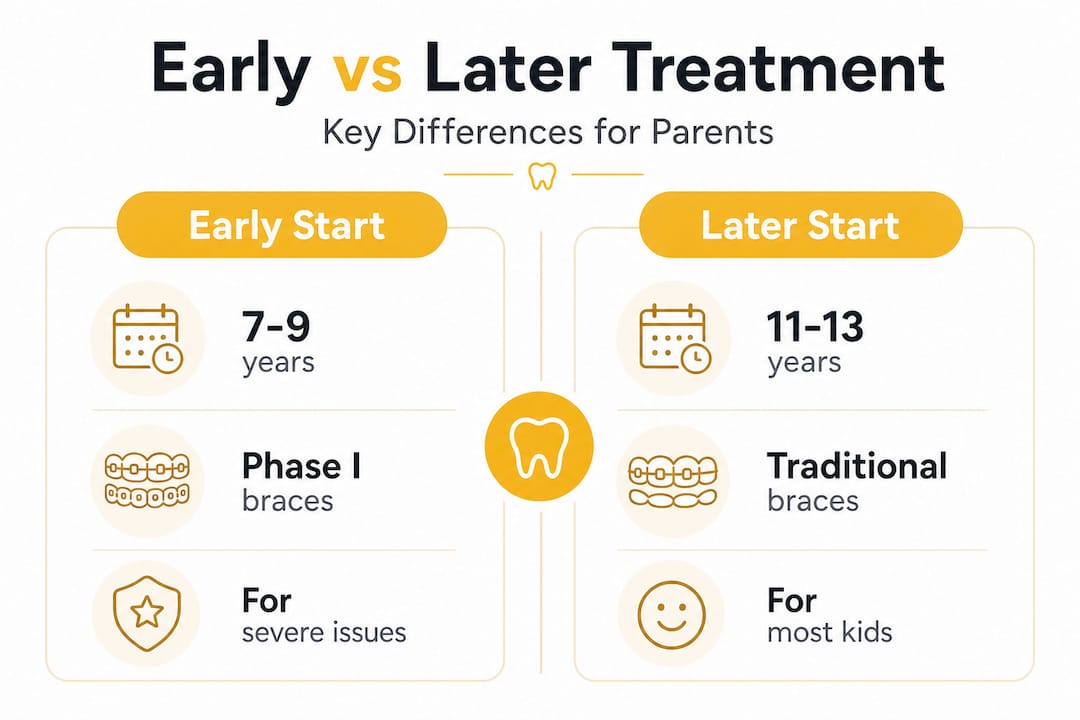
Early evaluation allows detection of issues like crossbites, crowding, and overjet, and can lead to what orthodontists call Phase I treatment. Phase I refers to treatment that happens while a child still has some baby teeth, often using a palatal expander to widen the upper jaw, or a space maintainer to hold room for incoming permanent teeth. Phase I is not a shortcut to finish braces sooner; it is a targeted response to specific developmental concerns.
A common misconception is that two-phase treatment (Phase I in childhood, Phase II with full braces later) is better for every child. Research from Cochrane found that the primary evidence-backed advantage of early treatment is reducing the risk of trauma to prominent upper front teeth. Beyond that specific scenario, most children with other concerns achieve similar outcomes whether treatment starts early or later.
Here is how to make the most of your child’s first orthodontic visit:
- Bring any relevant dental X-rays from your family dentist to save time and reduce radiation exposure.
- Write down any habits you’ve noticed, such as mouth breathing, snoring, or thumb-sucking.
- Ask specifically whether monitoring is an option and what signs would trigger the need for active treatment.
- Ask about the estimated timeline and cost if Phase I treatment is recommended.
- Request a written summary of the findings so you can review it at home.
Booking with child-friendly orthodontists in Langley makes a significant difference in how comfortable your child feels from visit one. A relaxed child who trusts their orthodontist is a far more cooperative patient throughout a multi-year process. If you are curious about long-term options, browsing smile makeover pathways can help you visualize where treatment is ultimately headed.
Pro Tip: Bring your child to the consultation without framing it as a big or scary event. Call it a “teeth check” and let the orthodontist do the work of building rapport with your child.
Daily care tips for kids with braces or other orthodontics
Once your child begins orthodontic treatment, daily home care habits make all the difference in outcomes and comfort.

Braces create small spaces around brackets and wires where food and plaque collect easily. Without consistent care, this leads to white spot lesions (permanent marks left on enamel by acid from bacteria), cavities, and even gum disease. The habit loop you build in the first few weeks of treatment tends to stick for the entire treatment period.
Here are the core daily habits that protect your child’s smile during treatment:
- Brush after every meal, not just morning and night. Even a rinse with water right after eating at school helps.
- Use a soft-bristle toothbrush held at a 45-degree angle toward the gum line. An electric toothbrush is even better for kids who rush.
- Use interdental brushes (tiny bottle-brush shaped tools) to clean under the wire between brackets.
- Floss every single day using a floss threader or orthodontic flosser to navigate around the wire.
- Rinse after sugary drinks whenever brushing isn’t possible immediately.
AAO guidelines for care between visits emphasize multiple daily brushings with a soft or electric toothbrush, consistent flossing using threaders, and rinsing after meals and sugary drinks. These are not suggestions; skipping them creates real consequences that can extend treatment time and damage enamel permanently.
| Tool | Best for | Frequency |
|---|---|---|
| Soft-bristle toothbrush | General cleaning around brackets | After every meal |
| Electric toothbrush | Kids who brush too quickly | Morning and night minimum |
| Floss threader | Daily flossing under wire | Once daily |
| Interdental brush | Cleaning under archwire | Daily |
| Fluoride mouthwash | Extra cavity protection | Once daily before bed |
Parents play a crucial supervisory role throughout treatment. Children between 7 and 10 generally need direct help brushing and flossing. Children 10 to 12 need spot checks and reminders. Packing a travel hygiene kit for school (a small toothbrush, toothpaste, and a few interdental picks) makes post-lunch brushing practical rather than aspirational.
For a step-by-step walkthrough, our brushing with braces guide breaks down the technique in a way that’s easy to show your child. You will also find practical strategies in our braces hygiene tips resource for the full treatment period.
Pro Tip: Set a timer for 2 minutes during brushing. Kids consistently underestimate how long they’re brushing, and most need the full two minutes to properly clean around every bracket. A fun song or a timer app makes this routine feel less like a chore.
Smart eating and handling emergencies
A big part of successful orthodontic care is managing what your child eats and knowing how to handle any problems between appointments.
Food choices during treatment are not about restriction for its own sake. Hard and sticky foods can pop brackets off teeth, bend wires, and make the mouth sore in ways that set back the treatment schedule. A broken bracket that goes unaddressed for a week or two can mean losing weeks of tooth movement progress.
Foods to avoid with braces include anything hard, chewy, or sticky:
- Hard candy, lollipops, and jawbreakers
- Caramel, toffee, and gummy bears
- Chewing gum (even sugar-free)
- Bagels, hard rolls, and crusty bread
- Popcorn (hulls can wedge under wires painfully)
- Raw carrots and apples (cut into small pieces instead of biting in)
- Corn on the cob (cut the kernels off)
- Ice chewing
After adjustment appointments, teeth are typically tender for 24 to 48 hours. During this window, soft foods are a relief, not just a rule. Think yogurt, smoothies, mashed potatoes, scrambled eggs, pasta, and soup.
Here is a step-by-step plan for managing common orthodontic problems at home:
- Irritated cheek from a wire or bracket: Roll a small piece of orthodontic wax and press it gently over the sharp spot to create a smooth barrier.
- Mouth sore from irritation: Rinse with a warm salt water solution (1/4 teaspoon of salt in 8 oz of water) two to three times a day.
- Loose bracket but still attached to wire: Do not pull it off. Cover with wax if it’s irritating and call your orthodontist.
- Poking wire end: Use a clean pencil eraser to gently push the wire back into place, then cover with wax.
- Completely broken wire or bracket that is swallowed: A swallowed bracket is rarely dangerous, but contact your orthodontist same-day for guidance.
“Not every issue requires an emergency visit, but every broken bracket or poking wire deserves a same-day call to your orthodontist to determine the right next step.” Understanding orthodontic emergencies helps you tell the difference between a true emergency and a manageable inconvenience.
Orthodontic wax, salt water rinses, and timely communication with your provider handle the majority of between-appointment discomforts. Having a small emergency kit at home (wax, a dental mirror, salt, and your orthodontist’s after-hours number) saves a lot of panic. Check our first week of braces guide for a full breakdown of what to expect right after braces go on.
Choosing the right orthodontist in Langley
After learning how to manage home care and emergencies, your choice of orthodontist completes the picture for smooth, supportive treatment.
Langley has a growing number of orthodontic providers, and local options include practices offering braces, Invisalign, and even airway-focused orthodontics, which addresses breathing issues related to jaw structure. The variety means you can find a practice that matches your child’s specific needs and your family’s comfort level.
Here is what to look for when comparing providers in Langley:
- CAO certification: The Canadian Association of Orthodontists credential confirms your provider completed a full orthodontic specialty residency, beyond general dental school
- Complimentary consultations: Many CAO-certified Langley orthodontists offer free first visits, which lets you compare multiple providers without financial commitment
- Experience with children: Ask how many pediatric patients the practice sees and whether the staff has specific training in child behavior management
- Treatment variety: A practice offering both traditional braces and Invisalign can adapt the plan as your child grows
- Office environment: A welcoming, calm office matters enormously for anxious kids who will be visiting every 6 to 8 weeks for two or more years
If you’re weighing your options, our comparison of braces versus Invisalign for younger patients breaks down which treatment tends to work better for specific bite and spacing issues.
Pro Tip: Ask the front desk during your consult call how the practice handles appointment delays and urgent calls. Their responsiveness before you’re a patient tells you a lot about how they’ll treat you once you are.
What most parents get wrong about early orthodontic treatment
Parents in Langley regularly come in worried they’ve “waited too long” because their 9-year-old hasn’t started braces yet. Others arrive convinced their 7-year-old needs immediate treatment because their family dentist mentioned crowding. Both reactions are completely understandable, and both are usually premature.
The most important thing to understand is this: evidence for early treatment benefits is largely limited to specific clinical scenarios, not every crooked tooth or slightly crowded smile. The orthodontic community’s guidance to evaluate by age 7 is about gathering information, not about starting treatment on a schedule.
Rushing into treatment because crowding looks worrying can mean your child spends more time in braces overall, pays for two phases of treatment when one well-timed phase would have been enough, and experiences more stress than necessary. There is no award for finishing orthodontic treatment young. There is, however, real value in starting treatment at exactly the right time for exactly the right reason.
The orthodontic journeys that go most smoothly share a few things in common: a personalized diagnosis rather than a routine protocol, clear communication between the provider and the family, and a child who is emotionally ready to participate in their own care. If you’re thinking ahead to the teenage years, our resource on orthodontic care for teens shows how treatment strategy often shifts as the jaw finishes growing.
Expert orthodontic care for your child in Langley
You now have a clear picture of what early orthodontic care actually involves, how to build strong daily habits at home, and what to look for in a Langley provider. The next step is putting that knowledge to work.

At Glow Orthodontics, we take a patient-centered approach to every child who walks through our doors. Whether your child is 7 and due for a first evaluation, or 12 and ready to start treatment, our team is here to guide your family at every step. We offer complimentary consultations so you can ask every question without pressure. Read our family orthodontic care guide for a deeper look at what treatment timelines typically look like, or explore our Invisalign tips for families to see if that option fits your child’s needs. We’d love to meet your family.
Frequently asked questions
How early should my child get braces if they need them?
Most children are evaluated by age 7, but many only need monitoring at first; active braces treatment is typically recommended between ages 11 and 13 unless a specific early issue like a crossbite requires earlier action.
What foods should kids avoid with braces?
Kids should avoid hard, sticky, and chewy foods like caramel, gummy candy, hard nuts, and chewing gum, as these can break brackets or bend wires and extend treatment time.
How can I manage a braces emergency at home?
Orthodontic wax and warm salt water handle most minor irritations, but always call your orthodontist same-day for broken brackets or poking wires to prevent treatment setbacks.
Do all children need braces after an early orthodontic assessment?
No, many children are simply monitored after their first evaluation and never require braces unless a specific issue develops later in development.
How do I choose a child-friendly orthodontist in Langley?
Look for CAO-certified providers with dedicated experience treating children, take advantage of free consultations to evaluate the office environment, and ask directly about their approach to anxious or younger patients.