Head Braces for Teeth: A Parent’s 2026 Guide
July 8, 2026
Head Braces for Teeth: A Parent’s 2026 Guide
TL;DR:
- Orthodontic headgear guides jaw growth and corrects bite problems in children with developing jaws. It works by applying external force to influence bone growth, often alongside braces, to treat overbites, underbites, and skeletal malocclusions. Success depends on consistent wear during the active growth years, usually between ages 7 and 14.
Orthodontic headgear, the clinical term for what parents commonly call head braces for teeth, is defined as an external appliance that guides jaw growth and corrects bite problems that braces alone cannot fix. Orthodontists prescribe it primarily for children whose jaws are still developing, making it a time-sensitive treatment. Common targets include severe overbites, underbites, and skeletal malocclusions. Wear time runs 12–16 hours daily, depending on the type prescribed. If your child’s orthodontist has recommended headgear, this guide gives you the full picture on how it works, what to expect, and how to help your child succeed.
What are head braces for teeth and how do they work?
Orthodontic headgear applies external force to the jaw and upper teeth to redirect growth. Unlike braces, which push and pull teeth within the mouth, headgear anchors to metal bands on the molars and connects to a strap worn outside the face or head. That external force is what gives headgear its unique ability to influence bone, not just tooth position.

The appliance works because children’s jaws are still growing. Bone in a developing jaw responds to sustained pressure by slowing, redirecting, or accelerating growth in the targeted direction. This is the core mechanical principle behind every type of orthodontic headgear. Adults have fused jaw bones, which is why headgear is rarely prescribed after the growth years end.
Headgear also serves as an anchor point for braces. When orthodontists need to move back teeth without letting front teeth shift forward, headgear provides the resistance braces cannot generate on their own. The two work together as a system, not as alternatives.
What are the main types of orthodontic headgear?
Three primary types of headgear exist, each designed to move the jaw in a specific direction. Choosing the wrong type for a patient’s bite problem would produce no benefit, which is why a professional evaluation always determines the selection.
| Type | Target problem | Strap location | Daily wear |
|---|---|---|---|
| Cervical-pull | Excessive overbite | Back of neck | 12–14 hours |
| High-pull | Overjet and vertical growth | Top of head | 12–14 hours |
| Reverse-pull (facemask) | Underbite | Forehead and chin | 14–16 hours |
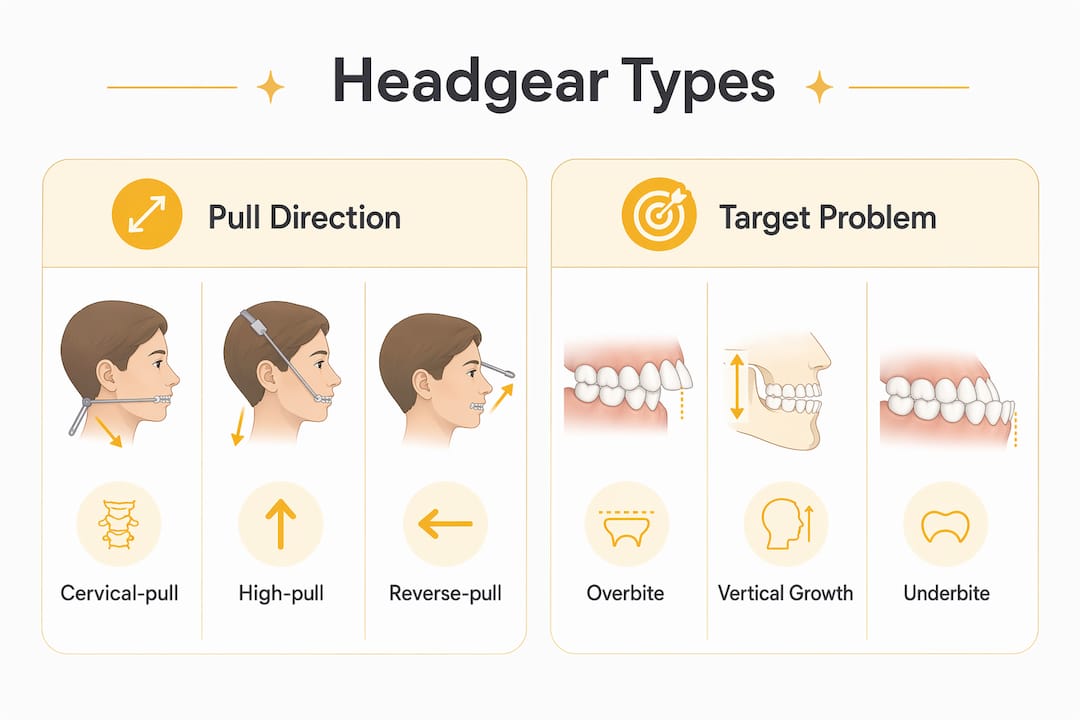
Cervical-pull headgear uses a strap around the back of the neck to pull the upper jaw backward. It is the most common type and targets children with a significant overbite caused by an upper jaw that protrudes too far forward.
High-pull headgear attaches to a strap that goes over the top of the head. It controls both the forward and vertical growth of the upper jaw, making it the preferred choice when an overjet is combined with a deep bite or excessive vertical growth.
Reverse-pull headgear, also called a facemask, works in the opposite direction. It pushes the upper jaw forward to correct an underbite where the lower jaw sits ahead of the upper. The reverse-pull type requires 14–16 hours of daily wear, more than the other two, because correcting an underbite demands greater sustained force.
Pro Tip: Ask your child’s orthodontist to show you exactly how to attach and remove the headgear at home. Incorrect attachment is the most common reason children experience discomfort or fail to get the expected correction.
How effective are head braces at correcting bite and jaw problems?
Headgear corrects skeletal problems, not just tooth position. That distinction matters because braces move teeth within the existing bone structure, while headgear actually changes the bone structure itself. A 2026 clinical study found that the Van Beek headgear activator improved sagittal jaw relationships, transverse discrepancy, airway function, and growth parameters in adolescents compared to untreated controls. Airway improvement is a benefit most parents do not anticipate, but it has real quality-of-life implications for children who snore or breathe through their mouths.
Headgear is not a standalone treatment. It works as an adjunct to braces, with the metal molar bands providing the anchor point for the external force. Removing headgear from the treatment plan for a complex skeletal case typically means the braces cannot fully correct the problem, and more invasive options like jaw surgery become necessary later.
Compliance is the single variable that determines whether headgear works. The appliance only applies force when it is being worn. Missing wear time does not just slow progress. It can actively reverse corrections already made, requiring the treatment timeline to extend.
Key factors that determine headgear success:
- Consistent daily wear. The prescribed hours are a minimum, not a target range.
- Active jaw growth. Headgear works best when the jaw is still developing, typically between ages 7 and 14.
- Correct fit. A loose or improperly attached appliance delivers reduced force and unpredictable results.
- Combination with braces. Headgear addresses skeletal issues; braces handle tooth alignment. Both are needed for full correction.
- Regular orthodontist check-ins. Adjustments every 6–8 weeks allow the orthodontist to monitor progress and modify force levels.
Headgear is less commonly prescribed today than it was two decades ago. Advances in other dental appliances have addressed some cases that previously required headgear. However, for specific skeletal corrections, it remains the most effective non-surgical option available.
How can parents help children manage comfort and daily wear?
Headgear is uncomfortable at first. That is not a flaw in the appliance. It is a sign the force is working. Most children adapt within one to two weeks as the jaw and surrounding tissues adjust to the pressure. The discomfort is typically described as soreness or pressure, not sharp pain. If your child reports sharp pain, contact the orthodontist immediately.
The wear schedule is designed to minimize social disruption. Headgear is worn primarily at home and during sleep, which means most children do not need to wear it at school or in public. This removes the biggest source of social anxiety for kids and teenagers. Framing headgear as a “home appliance” helps children accept it more readily.
Practical strategies that improve compliance:
- Set a consistent routine. Putting headgear on immediately after dinner builds a habit that reduces missed nights.
- Use a tracking chart. Visual progress motivates children and gives parents an easy way to monitor wear time without nagging.
- Keep the appliance clean. Rinse it with water after each use and brush the inner tubes gently to prevent buildup.
- Maintain oral hygiene carefully. Braces and headgear together create more surfaces for plaque to accumulate. A braces hygiene routine becomes more important, not less, during headgear treatment.
- Communicate openly. Children who understand why they are wearing headgear comply better than those who are simply told to wear it.
Pro Tip: Missing even a few nights of headgear wear can undo a week’s worth of correction. If your child skips a night, do not try to compensate by wearing it longer the next day. Just resume the normal schedule and inform the orthodontist at the next visit.
What age is right for head braces, and does timing matter?
Timing is the most critical factor in headgear treatment. The appliance works by influencing bone growth, so it must be used while that growth is actively happening. Orthodontists evaluate growth stages using X-rays of the hand and wrist or the cervical vertebrae to determine whether a child’s bones are still growing and how much growth remains.
The typical window for headgear treatment follows this progression:
- Ages 7–9 (early intervention). Orthodontists may recommend headgear at this stage for severe underbites or significant jaw discrepancies. Early treatment takes advantage of maximum growth potential.
- Ages 10–12 (peak growth phase). This is the most common window for headgear prescription. Jaw growth is active, and the appliance produces the most predictable results.
- Ages 13–14 (late growth phase). Headgear can still work, but the window is narrowing. Orthodontists move quickly at this stage to capture remaining growth.
- Ages 15 and older. Jaw growth has typically slowed or stopped. Headgear is rarely effective for skeletal correction at this age. Orthodontists may recommend other dental appliances or, in severe cases, refer for surgical evaluation.
Missing the growth window has real consequences. A child who needed headgear at age 10 but did not receive it may face a more complex treatment plan as a teenager, potentially including tooth extractions or jaw surgery to achieve the same result. Headgear works best in children with actively developing jaws, and that window closes faster than most parents expect.
A professional evaluation determines which type of headgear fits the child’s specific jaw movement needs and growth stage. The type and timing of treatment depend on clinical assessment, not age alone. Two children of the same age can have very different growth stages and therefore very different treatment needs.
Key Takeaways
Orthodontic headgear corrects skeletal jaw problems that braces alone cannot address, and it works only during the active growth years of childhood and early adolescence.
| Point | Details |
|---|---|
| Headgear targets bone, not just teeth | It redirects jaw growth, making it effective for overbites, underbites, and skeletal malocclusions. |
| Three types serve different problems | Cervical-pull, high-pull, and reverse-pull headgear each apply force in a specific direction for a specific bite issue. |
| Compliance determines success | Missing even a few nights of wear can reverse a week of correction, making consistent daily use non-negotiable. |
| Timing is everything | Headgear works during active jaw growth, typically ages 7–14. Missing this window limits non-surgical options. |
| Headgear works alongside braces | It is an adjunct treatment, not a replacement. Braces handle tooth position while headgear addresses jaw structure. |
What I’ve learned from watching families navigate headgear treatment
The parents who struggle most with headgear treatment are the ones who treat it as the orthodontist’s problem to solve. The parents whose children succeed are the ones who treat it as a family project.
Compliance is not a medical issue. It is a behavioral one. A child who understands that skipping headgear tonight means wearing it longer next month will make different choices than a child who just knows it is uncomfortable. Explaining the mechanics in simple terms, even to a 9-year-old, changes the dynamic entirely.
The social anxiety around headgear is almost always worse in the parent’s imagination than in the child’s reality. Most children adapt quickly once they realize the appliance stays home. The few who struggle socially usually do so because a parent’s visible worry signals to the child that something is wrong.
Headgear is also one of the most misunderstood tools in orthodontics. Parents often ask whether it is outdated. It is not. It is simply more targeted than it used to be. Orthodontists now prescribe it for the cases where nothing else produces the same result, which means the children who receive it genuinely need it. That is a better outcome for patients, even if the appliance itself looks the same as it did 30 years ago.
If your child has been recommended headgear, the most useful thing you can do is ask the orthodontist to walk you through exactly what the appliance is correcting and what happens if treatment is delayed. That conversation will tell you everything you need to know about whether to proceed.
— Juiced
Gloworthodontics’ approach to children’s orthodontic care
Children who need headgear also need an orthodontic team that explains the treatment clearly, monitors progress consistently, and adjusts the plan as the child grows. Gloworthodontics specializes in exactly this kind of personalized care for families in the Langley, British Columbia area.

The team at Gloworthodontics builds treatment plans around each child’s growth stage and bite profile, including headgear when it is the right clinical choice. Parents can explore the full range of options in the orthodontic care guide for teens, which covers headgear, braces, and other appliances in plain language. Scheduling an evaluation early gives your child the best chance of treatment during the optimal growth window. Book a consultation at Gloworthodontics to get a clear picture of your child’s needs.
FAQ
What are head braces for teeth used to treat?
Head braces, or orthodontic headgear, treat severe overbites, underbites, and skeletal jaw discrepancies that braces alone cannot correct. They apply external force to guide jaw growth in children who are still developing.
How many hours a day does a child need to wear headgear?
Cervical-pull and high-pull headgear require 12–14 hours of daily wear, while reverse-pull headgear requires 14–16 hours. Most of this time occurs at home and during sleep.
Does orthodontic headgear still work in 2026?
Yes. A 2026 clinical study confirmed that headgear appliances effectively treat complex malocclusions and improve airway function in adolescents. It remains the most effective non-surgical option for specific skeletal corrections.
At what age should a child start headgear treatment?
Most orthodontists recommend headgear between ages 7 and 14, when jaw growth is active. Starting treatment outside this window reduces effectiveness and may require more invasive interventions later.
Can a child wear headgear to school?
Most children do not need to wear headgear to school. The prescribed wear schedule focuses on evenings and nighttime, which limits public visibility and reduces social concerns for both children and parents.