How Braces Adjustment Works: A Clear Patient Guide
July 23, 2026
How Braces Adjustment Works: A Clear Patient Guide
What is a braces adjustment and why does it matter?
Every few weeks during orthodontic treatment, you sit in the chair for what most people casually call a “tightening.” The clinical term is a braces adjustment, and it is more precise than tightening suggests. Your orthodontist is not simply cranking a wire tighter. The visit is a carefully planned appointment where the archwire, elastic ligatures, and sometimes additional components are assessed and modified to maintain the controlled pressure your teeth need to keep moving.
Teeth move because of bone remodeling, a biological process where sustained pressure causes bone to dissolve on one side of a tooth root and rebuild on the other, allowing the tooth to shift gradually. Once your teeth have moved enough to meet the current wire’s tension, that wire stops providing enough force. The adjustment reapplies the right amount of pressure and keeps treatment from stalling.
The American Association of Orthodontists emphasizes that consistent, gentle, persistent pressure is the key to successful tooth movement. Skip or delay appointments, and that pressure fades, progress slows, and treatment can extend by weeks or months.
Key purposes of regular braces adjustments:
- Reapply controlled pressure as teeth respond and shift
- Allow the orthodontist to assess progress and catch problems early
- Replace worn elastic ligatures that have lost their grip
- Advance wire type or gauge as treatment stages progress
- Address specific issues like rotations, spacing, or bite correction
- Keep the overall treatment timeline on track
What actually happens during a braces adjustment appointment
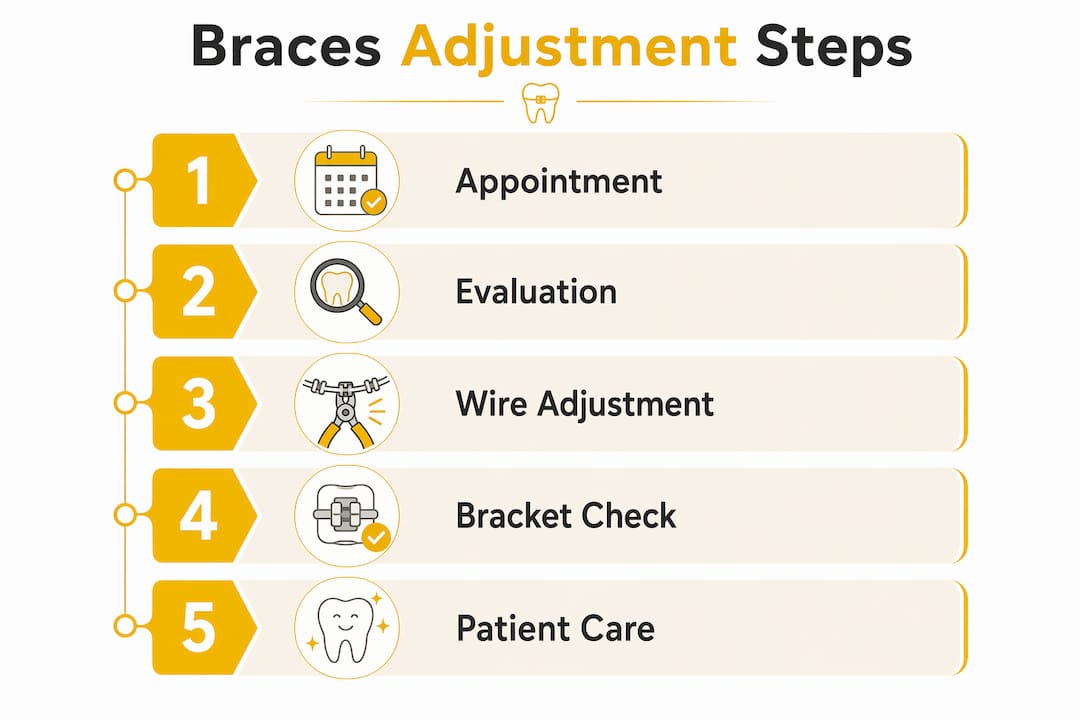
The typical adjustment visit runs 20–30 minutes, though complex visits can run a bit longer. Knowing the sequence makes the whole thing feel routine rather than mysterious.
- Progress review. Your orthodontist examines how your teeth have moved since the last visit, checks your bite, and asks about any soreness, loose brackets, or concerns.
- Elastic ligature removal. The small colored bands holding the archwire to each bracket are taken off. They stretch and weaken over time, so fresh ones go on at every visit.
- Archwire assessment. The wire is inspected and, if needed, removed. Your orthodontist evaluates whether the current wire has done its job or whether a different gauge or material is required.
- Minor repairs. Loose brackets or broken components are addressed during this step so nothing disrupts the planned force distribution.
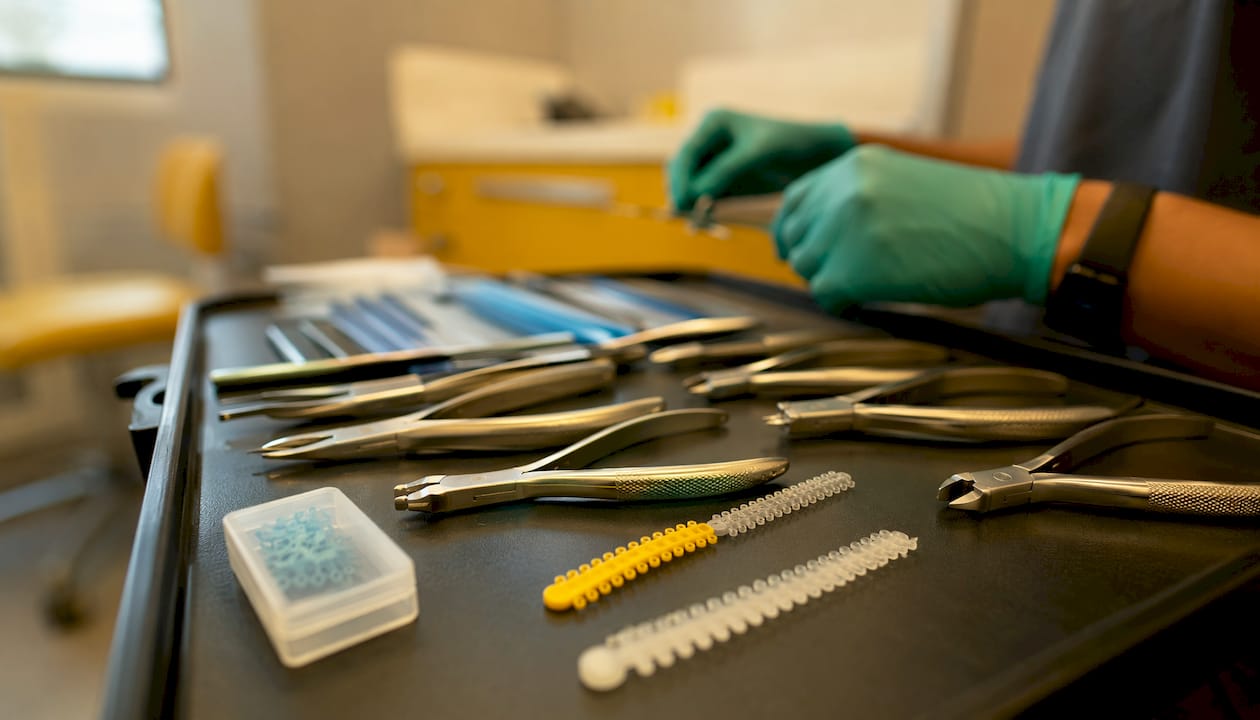
- Wire modification or replacement. The archwire may be reshaped with orthodontic pliers, or swapped for a new one. Modern archwires use shape-memory alloys that return to a programmed arch form, applying gentle force without anyone cranking tension manually.
- Re-tying with new elastics. Fresh ligature ties or elastic modules are placed to secure the wire. If closing spaces is part of your plan, a power chain (a continuous elastic loop) may replace individual ties across several brackets.
- Interarch elastics review. If you wear rubber bands between your upper and lower teeth to correct your bite, your orthodontist reviews whether the configuration needs to change and confirms how to wear them.
- Bite check and next appointment. Before you leave, your bite is tested for comfort, and your next visit is scheduled to maintain the correct interval.
Pro Tip: Fear about adjustment visits usually comes from not knowing what to expect. The actual procedure involves no drilling, no injections, and no cutting. Most patients describe it as mild pressure and clicking sounds, nothing more.
What to expect after an adjustment and how to manage soreness
Soreness after an adjustment is normal, and it actually signals that the braces are working. As your teeth respond to new forces, you will likely feel a dull pressure or aching that typically lasts a few days. It peaks within the first 24 hours and then fades on its own.
The discomfort is manageable with a few straightforward strategies:
- Take an over-the-counter pain reliever such as ibuprofen or acetaminophen as directed, ideally about an hour before your appointment so it is already working when you leave the office
- Eat soft foods like yogurt, mashed potatoes, soup, and smoothies for the first day or two
- Apply a cold compress to your cheeks for 10–15 minutes at a time to reduce inflammation
- Use orthodontic wax on any bracket or wire that rubs against the inside of your cheeks or lips
- Rinse with warm saltwater (about half a teaspoon of salt in a cup of water) to soothe tender gums
Pro Tip: Schedule your adjustment for late afternoon on a Thursday or Friday. Soreness peaks within 24 hours, so you can rest over the weekend instead of pushing through a school or work day.

Care and lifestyle habits to follow after each adjustment
Good habits between appointments protect your braces and keep your mouth healthy. Post-adjustment care does not require anything complicated, but consistency matters.
- Oral hygiene: Brush after every meal using a soft-bristled toothbrush, angling the bristles toward the gumline and around each bracket. A proper braces brushing routine removes plaque that collects around brackets and wires, where cavities form fastest.
- Foods to avoid: Sticky candies, hard foods like raw carrots or popcorn, and chewy items like bagels can pop brackets off or bend wires. Avoid them throughout treatment, not just after adjustments.
- Elastics compliance: If your orthodontist prescribed rubber bands, wear them exactly as instructed. Inconsistent wear is one of the most common reasons bite correction falls behind schedule.
- Keep your appointments: Missing or delaying visits lets wire tension drop and teeth drift. Rescheduling promptly when life gets in the way keeps treatment moving.
- Watch for loose brackets: If a bracket feels loose or a wire pokes your cheek, contact your orthodontist rather than waiting for the next scheduled visit.
Expert insights on the systematic nature of braces adjustments
Orthodontic adjustments follow a deliberate, stage-based progression, not a one-size-fits-all routine. Early in treatment, orthodontists use thin, flexible nickel-titanium archwires that apply light, continuous force to align crooked or rotated teeth. These wires are forgiving and gentle as the mouth adapts to braces. As alignment improves, the wire gauge increases and the material shifts to stainless steel or copper-titanium for more precise control over gap closure and bite correction. Toward the end of treatment, finishing wires make fine, targeted adjustments to seat each tooth in exactly the right position.
Most patients attend adjustments every several weeks, with the exact interval set by how quickly their teeth are responding. Spacing visits too far apart allows wire tension to drop below the threshold needed for active bone remodeling. The biology requires sustained pressure, and the schedule is built around that biological reality.
Potential complications during adjustments and how they are handled
Most adjustment visits are uneventful, but problems do come up. Knowing what they are and how orthodontists address them removes a lot of worry.
Loose or broken brackets. A bracket that has debonded from the tooth surface cannot transmit force properly. The orthodontist cleans the tooth, re-bonds the bracket with fresh adhesive, and checks the surrounding brackets to confirm nothing else has shifted.
Poking wire ends. As teeth move, the archwire can slide to one side and poke the back of the mouth. The orthodontist trims the wire end or bends it back. In the meantime, orthodontic wax covers the sharp spot.
Excessive soreness or unusual pain. Mild soreness is expected, but sharp or severe pain after an adjustment warrants a call to the office. It can indicate a wire that is pressing incorrectly or a bracket that has shifted position.
Stalled tooth movement. If a tooth has not moved as expected, the orthodontist may change the wire configuration, add a spring or coil, or reposition a bracket to redirect force. Treatment plans are adjusted in real time based on what the teeth are actually doing.
Allergic reactions to latex elastics. Some patients react to latex rubber bands. Non-latex alternatives are available and work just as effectively.
How your orthodontist decides what changes to make at each visit
Every adjustment is a clinical decision, not a routine swap. Your orthodontist arrives at each visit with a treatment plan but reads the actual state of your teeth before touching anything.
The assessment covers tooth position relative to the target, bite alignment, any signs of gum irritation or root stress, and whether the current wire has been fully expressed (meaning the teeth have caught up to the wire’s shape). X-rays taken periodically give a view of root position and bone response that the clinical exam alone cannot provide. For families navigating this process, the orthodontic consultation guide explains how treatment planning works from the first appointment forward.
Based on that assessment, the orthodontist decides whether to advance the wire, add auxiliaries like springs or power chains, modify elastic configurations, or hold the current setup for another cycle. The decision is specific to your teeth on that day.
Long-term effects and goals of repeated braces adjustments
Each individual adjustment moves teeth a fraction of a millimeter. Repeated over months or years, those small increments add up to a fully corrected bite and aligned smile. The cumulative effect of consistent adjustments is bone that has remodeled around each tooth’s new position, which is what makes the result stable rather than temporary.
Beyond aesthetics, properly aligned teeth are easier to clean, reducing the risk of gum disease and decay. Corrected bites reduce uneven wear on tooth surfaces and can relieve jaw strain. The long-term goal is not just a straighter smile but a healthier mouth that functions well for decades. For teens going through this process, the orthodontic care guide for teens covers what to expect at each stage of treatment.
Key Takeaways
Braces adjustments work by reapplying controlled pressure at regular intervals, triggering bone remodeling that moves teeth gradually into their correct positions.
| Point | Details |
|---|---|
| Adjustment frequency | Most patients are seen every 4–8 weeks, depending on individual treatment response. |
| Appointment length | A typical adjustment visit runs 20–30 minutes, covering examination, wire changes, and elastic replacement. |
| Soreness is normal | Discomfort after an adjustment lasts a few days and is managed with over-the-counter pain relief and soft foods. |
| Wire progression matters | Treatment advances through wire types, from flexible nickel-titanium to stainless steel, for increasingly precise control. |
| Skipping visits stalls treatment | Wire tension fades over time; missing appointments slows bone remodeling and extends the overall treatment timeline. |