How clear aligners transform your smile discreetly
May 12, 2026
How clear aligners transform your smile discreetly
TL;DR:
- Invisible aligners use 3D imaging and custom thermoplastic trays to straighten teeth discreetly. Their success depends on consistent wear, proper case selection, and professional guidance for complex movements. Families in Langley can expect a modern, minimally invasive orthodontic experience with careful planning and committed cooperation.
Most people assume straightening teeth means a mouth full of metal that everyone around you notices immediately. That assumption is outdated. Today, invisible aligners in Langley use 3D scanning and custom clear thermoplastic trays to gradually shift teeth without advertising the fact to the world. For families and individuals in Langley who want real results without the visual disruption of traditional braces, clear aligner therapy has changed the conversation entirely. This guide walks through exactly how these treatments work, what they can realistically achieve, and what the research actually says about outcomes.
Table of Contents
- What are invisible orthodontic treatments?
- How invisible aligners move teeth: mechanics and essentials
- Factors affecting invisible aligner outcomes
- Common edge cases and challenges: vertical control, extractions, and real-world tips
- Invisible orthodontics in Langley: local perspectives and what to expect
- Our take: what most families overlook about invisible orthodontics
- Considering invisible orthodontics in Langley? Your next steps
- Frequently asked questions
Key Takeaways
| Point | Details |
|---|---|
| Clear aligners are discreet | Invisible orthodontic treatments allow tooth movement with minimal impact on appearance. |
| Success relies on compliance | Wearing aligners at least 22 hours daily is critical for achieving planned results. |
| Adjuncts aid complex cases | Attachments, IPR, or elastics are often necessary for more difficult tooth movements. |
| Results depend on case complexity | Clear aligners work best for mild to moderate corrections, while special cases may need extra steps. |
| Local options in Langley | Families in Langley can access advanced digital planning and expert care for invisible orthodontics. |
What are invisible orthodontic treatments?
To understand how these treatments fit into your life, let us start with what makes them unique compared to traditional orthodontics.
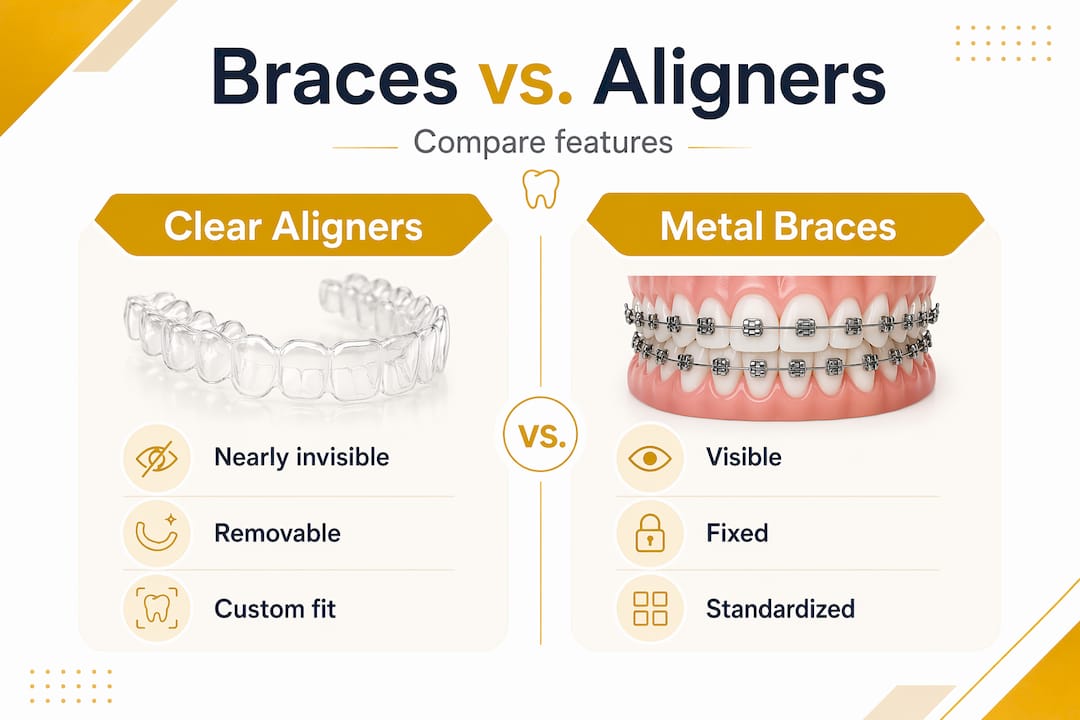
Invisible orthodontic treatments are removable, clear plastic trays custom made to fit over your teeth. Unlike metal braces, which use brackets bonded to each tooth and connected by wires, clear aligners apply gentle, consistent pressure using a series of slightly different trays. Each tray in the sequence nudges your teeth a fraction of a millimeter closer to their target position. The whole system relies on digital scanning and staged thermoplastic trays, replaced approximately every two weeks, to complete the treatment journey.
The technology behind this process is genuinely impressive. During your first visit, a digital scan of your mouth creates a precise 3D model. Specialized software then maps out exactly where each tooth needs to move and plots a series of incremental steps to get there. This is what makes the treatment so different from older approaches. Nothing is adjusted by hand at every appointment. The movement is engineered in advance and built into the trays themselves.
Here is how invisible aligners compare to metal braces at a glance:
| Feature | Clear aligners | Metal braces |
|---|---|---|
| Visibility | Nearly invisible | Clearly visible |
| Removable | Yes | No |
| Cleaning ease | High | Moderate |
| Food restrictions | None | Many |
| Adjustment visits | Less frequent | Every 4 to 6 weeks |
| Attachment hardware | Sometimes needed | Always |
| Average treatment time | 12 to 18 months | 18 to 36 months |
A few common misconceptions are worth clearing up. Many people assume “invisible” means zero attachments or procedures beyond just wearing a tray. In practice, most full treatment plans involve more than the trays alone. Also, clear aligner effectiveness depends heavily on consistent wear. Clinical trials show that patients wore their aligners 22 hours per day, changing trays every one to two weeks. That discipline is baked into the success of every plan.
Key differences that set invisible aligners apart from traditional braces:
- No dietary restrictions: Remove the trays to eat anything you like.
- Easier oral hygiene: Brush and floss normally without navigating around brackets.
- Fewer emergency visits: No wires to snap or brackets to come loose.
- Discreet appearance: Most people around you simply will not notice them.
- Predictable digital planning: You can see a simulation of your final result before starting.
Understanding the difference between clear braces vs Invisalign is also useful when deciding which path fits your lifestyle and case complexity best.
How invisible aligners move teeth: mechanics and essentials
Now that you know what invisible aligners are, it is time to see how they actually move your teeth behind the scenes.

Moving teeth is not magic. It is biology. Your teeth are held in place by a network of ligaments connecting each root to the surrounding bone. When consistent, controlled force is applied to a tooth, the bone on one side begins to break down while new bone forms on the other side. The tooth shifts. Clear aligners create this force by being manufactured slightly smaller than your current tooth position, so wearing them applies that gentle, targeted pressure at all times.
For straightforward cases, the trays alone may be enough. But achieving complex tooth movements often requires additional tools called adjuncts. The three main ones are:
- Attachments: Small tooth-colored bumps bonded onto specific teeth. They give the tray something to grip, allowing it to apply rotational or vertical forces that a smooth surface could not achieve on its own.
- IPR (interproximal reduction): A tiny amount of enamel is carefully removed between adjacent teeth to create space for movement. This is painless, done with a small tool, and rarely noticeable.
- Elastics: Rubber bands worn between upper and lower teeth to correct bite relationships, similar to how elastics work with traditional braces.
Research confirms that attachments are widely used in aligner therapy, and their precise design affects treatment efficiency and patient experience. The shape, size, and placement of each attachment is calculated during the digital planning phase, so nothing is improvised.
Here is a simplified look at how a clear aligner treatment sequence progresses:
- Digital scan and 3D model creation.
- Treatment plan mapped using specialized software.
- Custom trays fabricated and delivered in batches.
- Attachments placed at the start appointment if needed.
- Patient wears each tray set for approximately two weeks.
- Periodic check-ins confirm teeth are tracking as planned.
- Refinement trays ordered if minor adjustments are needed.
- Retainers provided once active treatment is complete.
Understanding how ClearCorrect aligner costs are structured can also help families budget for treatment options beyond just one brand.
Pro Tip: Ask your orthodontist to show you the digital simulation of your final result before committing. Seeing the projected outcome helps you understand the treatment plan and gives you realistic expectations from day one.
Factors affecting invisible aligner outcomes
Understanding mechanics is key, but many families wonder what really separates successful cases from disappointments.
The single biggest factor in any clear aligner outcome is patient compliance. Wearing your trays for the full 22 hours every day is not a suggestion. It is the foundation everything else is built on. Miss even a few hours a day consistently, and teeth do not track the way the digital plan predicted. A systematic review of Invisalign outcomes concluded that predictability varies significantly by movement type and complexity, and that success hinges on a combination of compliance, careful planning, and appropriate use of adjuncts.
Case complexity is the second major variable. Not all tooth movements are equally predictable with aligners:
- Simple tipping and spacing cases: Highly predictable, fast, and often ideal for aligners.
- Mild to moderate crowding: Well supported by current technology and research.
- Rotations of rounded teeth (like canines): Moderately predictable with good attachment design.
- Vertical movements: More challenging, often requiring additional tools.
- Extraction cases with significant space closure: More demanding and sometimes less predictable.
Research on molar control in extraction cases found that posterior tooth movement is less predictable with Invisalign when moderate anchorage extraction is involved, and that attachment design plays a critical role in maintaining control. This does not mean aligners cannot be used in these situations. It means your treatment plan needs to be designed thoughtfully by an experienced orthodontist.
Pro Tip: If you are considering aligners for a more complex bite issue, ask your provider specifically about their experience with similar cases and what adjuncts they plan to use. A confident, detailed answer is a good sign.
Families comparing options will find it useful to review an Invisalign vs braces comparison alongside practical Invisalign lifestyle tips before deciding.
Common edge cases and challenges: vertical control, extractions, and real-world tips
Let us look at scenarios where invisible aligners are pushed to their mechanical limits, and what that means for complex cases.
Two of the most discussed challenges in aligner therapy are vertical tooth control and extraction cases. Both situations require more clinical creativity than a simple crowding case.
Vertical control refers to moving teeth up or down rather than side to side. Open bites, for example, involve teeth that do not fully close when the jaw is shut. A scoping review of vertical control with aligners found that clear aligners can achieve meaningful improvements, but results depend heavily on auxiliary techniques and the skill of the clinician. Mini screws, sometimes called temporary anchorage devices or TADs, can be placed in the jaw to provide a stable anchor point for more forceful vertical movement. Not every case needs them, but they are a legitimate and effective tool when appropriate.
Extraction cases add another layer of complexity. When a tooth is removed to create space, the surrounding teeth must move into that gap. Moving posterior (back) teeth forward predictably requires significant force control. Specific attachment strategies, like double rectangular attachments on molars, improve the orthodontist’s ability to guide those teeth accurately.
“The clinical reality is that clear aligners have expanded their reach significantly over the past decade. Cases that were once considered impossible for aligners are now routinely managed with the right combination of technology, attachments, and clinical experience.”
Practical things to know if your case falls into a more complex category:
- Expect more attachments, and do not be surprised if they are more visible than you anticipated.
- Treatment timelines may be slightly longer than average.
- More frequent check-in appointments help catch tracking issues early.
- Refinement rounds (additional trays at the end of treatment) are common and normal.
- A detailed conversation about what is and is not achievable protects your expectations.
For families dealing with bite discrepancies specifically, learning how Invisalign fixes overbite gives a clear picture of the step-by-step process involved.
Invisible orthodontics in Langley: local perspectives and what to expect
With the mechanics and challenges understood, here is how the invisible orthodontic journey typically unfolds right here in Langley.
Langley families exploring aligner therapy generally find the process more accessible than they expected. Local providers start with a thorough consultation, often including a digital scan the same day. Here is what a typical treatment journey looks like:
- Initial consultation: Review your goals, examine your teeth and bite, and discuss whether aligners are a good fit.
- Digital scan: A hand-held wand scans your full mouth in minutes, no messy impressions needed.
- Treatment simulation: Software generates a 3D animation of your projected tooth movement.
- Tray fabrication: Custom aligners are manufactured and delivered, typically in batches.
- Attachment appointment: Small tooth-colored attachments are bonded where needed.
- Active treatment: Wear each set of trays for about two weeks, changing sets approximately biweekly over a total average treatment of 12 to 18 months.
- Retention phase: Custom retainers maintain results after active treatment ends.
Families consistently report that the adjustment period is short. Most people stop noticing the trays within a few days. Speech adapts quickly. The biggest reported challenge is simply remembering to put trays back in after meals.
Pro Tip: Keep a travel-size toothbrush and small case with you during the day. Rinsing your aligners and brushing after meals before reinserting takes about two minutes and protects both your trays and your enamel throughout treatment.
For day to day guidance during your treatment, the Invisalign lifestyle tips resource covers everything from handling trays at restaurants to dealing with initial soreness.
Our take: what most families overlook about invisible orthodontics
Here is the honest truth that both marketing materials and some clinical summaries tend to gloss over. Invisible orthodontic treatment is genuinely transformative for most patients. But the families who get the best results are not the ones who picked the most aesthetically appealing option. They are the ones who went in with clear eyes, asked hard questions, and committed fully to the process.
The word “invisible” does a lot of heavy lifting in marketing. In reality, attachments are common and can be somewhat visible depending on tooth color and attachment location. IPR involves removing a small amount of tooth structure. Elastics are sometimes needed and are definitely not invisible. None of this makes clear aligners a bad choice. Far from it. But understanding what you are actually signing up for helps you stay motivated when the process involves more than just swapping trays every two weeks.
We also think the daily discipline piece is underestimated by new patients. Twenty-two hours per day sounds manageable until you are at a birthday dinner, a work event, and a weekend away in the same week. Building a consistent habit around removing and reinserting your trays matters as much as anything your orthodontist does in the clinic.
Finally, the relationship with your orthodontist is not just administrative. When teeth are not tracking as planned, early identification and course correction make a significant difference to your final result. Regular check-ins are not optional extras. Reviewing the pros and cons of braces and Invisalign with your provider gives you a complete picture before you commit to any path forward.
Considering invisible orthodontics in Langley? Your next steps
Ready to take the next step or want more in-depth guidance? Here is how you can continue your invisible orthodontic journey locally.
If this guide has given you a clearer picture of how clear aligner treatment works, you are already better prepared for a meaningful first conversation with an orthodontic provider. Knowledge makes a difference. Knowing to ask about attachments, compliance expectations, and case complexity puts you ahead of most new patients walking through the door.

At Glow Orthodontics, our team in Langley specializes in personalized aligner treatment for all ages. From your first digital scan to your final retainer, every step of your care is designed around your specific smile goals. Read through our detailed Invisalign treatment process guide to understand exactly what each appointment involves, or compare your options with our breakdown of differences between clear braces and Invisalign. When you are ready, booking a consultation is quick and easy through our website.
Frequently asked questions
How long does Invisalign treatment usually take in Langley?
Most Invisalign treatments in Langley last between 12 and 18 months, with each set of aligners worn about two weeks before moving to the next tray in the sequence.
Can invisible aligners fix complex bite issues like open bite or deep bite?
Clear aligners can meaningfully improve open or deep bites, but auxiliary techniques are often required for best results, including elastics, mini screws, or specialized attachments depending on your case.
Do invisible orthodontic treatments really work as well as braces?
Clear aligners are highly effective for a wide range of cases, though outcomes depend on compliance and complexity. For complex cases, traditional braces may offer more predictability in specific movements.
Are attachments or extra procedures always needed with clear aligners?
Not always, but many patients do need attachments or IPR because complex movements require adjuncts that the aligner tray alone cannot reliably achieve.
What happens if I don’t wear my aligners the full 22 hours per day?
Insufficient wear time is one of the most common reasons treatment falls short. Inadequate wear directly causes suboptimal tooth movement and can lead to extended timelines or the need for additional refinement trays.