How Much Does Insurance Cover for Braces in Canada?
July 1, 2026
How Much Does Insurance Cover for Braces in Canada?
TL;DR:
- Private dental insurance in Canada usually covers 30% to 50% of braces costs, with lifetime maximums between $1,500 and $3,000. Most families still pay a significant amount out of pocket due to limits, waiting periods, and fee schedule gaps, but planning ahead can help reduce costs. Public programs like the Canadian Dental Care Plan offer limited coverage based on income and medical necessity, complementing private plans.
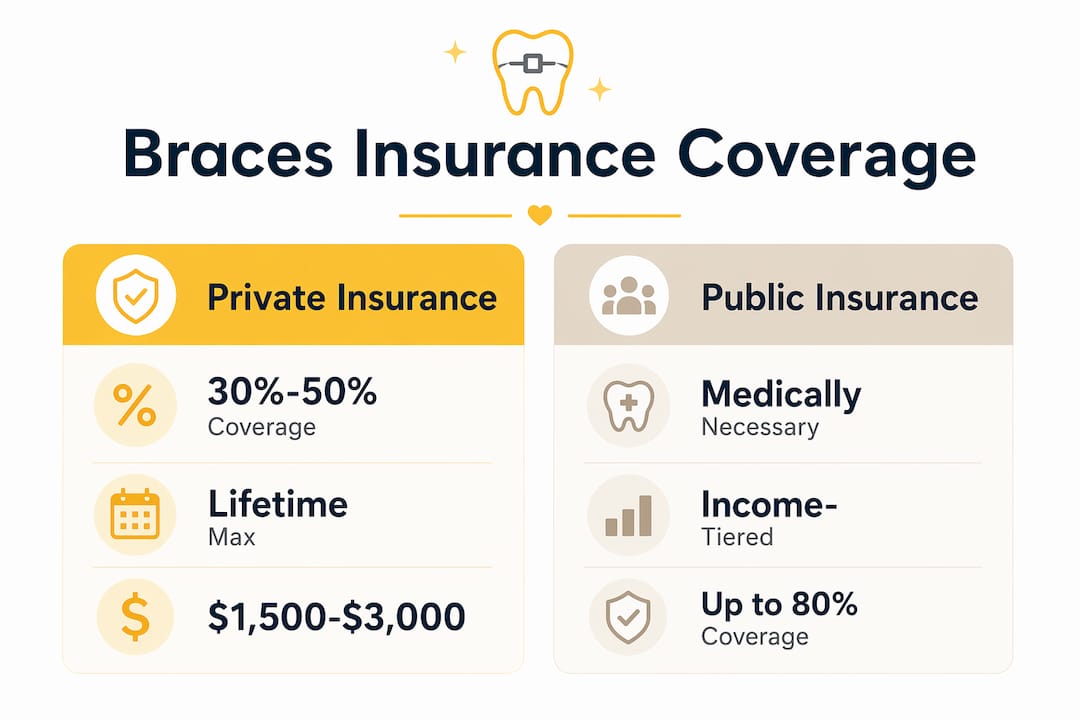
Private dental insurance in Canada typically covers 30% to 50% of the cost of braces for children, with lifetime maximums between $1,500 and $3,000. That coverage helps, but it rarely eliminates your out-of-pocket costs. How much does insurance cover for braces depends on your specific plan, your child’s age, whether a waiting period has passed, and whether the treatment qualifies as medically necessary. This guide breaks down exactly what Canadian parents can expect from both private and public plans, and how to close the gap between what insurance pays and what treatment actually costs.

How much does insurance cover for braces?
The short answer is partial coverage. Private dental insurance plans in Canada generally pay between 30% and 50% of orthodontic treatment costs. The remaining balance falls to you.
The lifetime maximum is the number that matters most. Most plans cap orthodontic benefits at $1,500 to $3,000 over the life of the policy. If your child’s braces cost $6,000, and your plan covers 50% up to a $2,000 maximum, you pay $4,000 out of pocket regardless of the percentage.
Private dental insurance is not standardized in Canada. Coverage levels, age limits, and lifetime maximums are negotiated per employer contract. Two parents working at different companies can have wildly different orthodontic benefits even if they pay similar premiums.
What factors influence how much insurance covers for braces?
Several variables determine whether dental insurance pays for braces and how much it contributes. Understanding each one helps you read your plan accurately.
- Lifetime maximum. Most plans set a hard cap between $1,500 and $3,000. Once that limit is reached, the plan pays nothing more, regardless of remaining treatment costs.
- Coinsurance percentage. Plans typically reimburse 30%–50% of the orthodontist’s fee. The lower the percentage, the more you pay.
- Waiting periods. Many plans require 6 to 12 months of continuous enrollment before orthodontic benefits activate. Starting treatment before the waiting period ends means paying the full cost yourself.
- Age restrictions. Orthodontic coverage commonly applies only to children under 19 or 21. Adult coverage is less common and usually more limited.
- Medical necessity. Some plans cover braces only when an orthodontist documents a functional or medical need. Purely cosmetic cases may receive reduced or no benefits.
Pro Tip: Request your plan’s orthodontic summary in writing before your child’s first consultation. Ask specifically for the lifetime maximum, coinsurance rate, waiting period end date, and age cutoff. That one document saves you from surprises at checkout.
The interaction between these factors is what catches parents off guard. A plan that looks generous at 50% coverage can still leave you with a large bill if the lifetime maximum is only $1,500 and your provider charges above the insurance fee schedule.
How does public vs. private insurance differ for braces in Canada?
The distinction between public and private coverage is significant. Most Canadian families rely on private employer plans. Public programs exist but serve a narrower population.
The Canadian Dental Care Plan (CDCP)
The Canadian Dental Care Plan covers orthodontic treatment only when it is medically necessary. Elective or cosmetic braces do not qualify. Coverage percentages are tied to family income:
| Annual family income | CDCP orthodontic coverage |
|---|---|
| Under $70,000 | Up to 80% of eligible costs |
| $70,000–$79,999 | Up to 60% of eligible costs |
| $80,000–$89,999 | Up to 40% of eligible costs |
| $90,000–$99,999 | Up to 20% of eligible costs |
| $100,000 and above | Not eligible |
That income-tiered structure means lower-income families can receive meaningful support, but only for cases that meet the medical necessity threshold. The CDCP also requires preauthorization before treatment begins. Skipping that step means the plan will not pay, even if the case qualifies.
Private employer plans
Private plans cover a broader range of orthodontic cases, including cosmetic alignment. The tradeoff is that coverage is capped by the lifetime maximum and coinsurance rate. Because employer plans vary significantly by contract, parents should never assume their coverage matches what a friend or coworker receives under a different plan.
Pro Tip: If your child’s orthodontist documents functional issues like difficulty chewing or breathing, that documentation can support a medical necessity claim under both the CDCP and some private plans. Ask the orthodontist to include clinical findings in the treatment letter.
What are the typical out-of-pocket costs for braces after insurance?
Knowing the math before treatment starts helps you budget without guessing. Here is how the numbers typically work for Canadian families.
-
Determine your total treatment cost. Traditional metal braces in Canada generally range from $3,000 to $7,000 depending on complexity and provider location. Clear aligners like Invisalign often fall at the higher end of that range, though some plans provide partial benefits for Invisalign comparable to traditional braces.
-
Apply your coinsurance rate. If your plan covers 50% and treatment costs $5,000, the plan’s share is $2,500 before the lifetime maximum applies.
-
Apply the lifetime maximum. If your lifetime maximum is $2,000, the plan pays $2,000, not $2,500. Your out-of-pocket cost becomes $3,000.
-
Account for fee schedule differences. Providers who charge above the insurance fee guide create an additional gap. If your orthodontist charges $5,500 but the insurer’s fee schedule allows $4,500, you pay the $1,000 difference plus your regular coinsurance share.
-
Confirm costs before signing a treatment contract. Ask your orthodontist’s office to submit a predetermination to your insurer. This gives you a written estimate of exactly what the plan will pay before treatment starts. It is not a guarantee, but it eliminates most surprises.
The cost of braces for kids can feel steep after insurance, but knowing your numbers upfront puts you in control of the decision.
What financial strategies can help parents cover braces costs beyond insurance?
Insurance rarely covers everything. These tools help you manage the remaining balance without putting treatment on hold.
- Health Spending Accounts (HSAs). HSAs allow tax-free reimbursements for eligible orthodontic costs after insurance pays its share. That means the out-of-pocket portion effectively costs less because you are spending pre-tax dollars. Employers who offer HSAs or Private Health Services Plans (PHSPs) give families a real financial advantage.
- Combining HSAs with insurance. Submit your claim to your dental insurer first. Then submit the remaining balance to your HSA. This stacking approach maximizes reimbursement from both sources.
- Employer flexible spending benefits. Some employer plans include orthodontic coverage or flexible spending components beyond the standard dental plan. Check your full benefits package, not just the dental section.
- Strategic timing around waiting periods. If your child is approaching the age when treatment will be recommended, enrolling in a new plan well before treatment starts lets the 6 to 12 month waiting period expire before you need benefits. Planning 12 to 18 months ahead is not excessive.
- Payment plans with your orthodontic provider. Many orthodontic offices offer in-house monthly payment plans with no interest. Spreading $3,000 over 24 months at $125 per month is manageable for most families and does not require financing approval.
Pro Tip: Ask your employer’s HR department whether your benefits include a PHSP or HSA component. Many employees never use these accounts simply because they did not know they existed. A quick email to HR can reveal hundreds of dollars in available tax-free reimbursement.
Flexible spending options for orthodontics are worth exploring before you assume the out-of-pocket cost is fixed. The combination of insurance, HSA, and a provider payment plan often makes treatment far more affordable than the sticker price suggests.
Key takeaways
Dental insurance in Canada covers a portion of braces costs, but lifetime maximums, waiting periods, and fee schedule gaps mean most families still pay a significant share out of pocket.
| Point | Details |
|---|---|
| Typical private coverage | Plans cover 30%–50% of braces costs, capped at a $1,500–$3,000 lifetime maximum. |
| Public plan eligibility | The CDCP covers braces only for medically necessary cases, with income-based percentages up to 80%. |
| Waiting periods matter | Most plans require 6–12 months of enrollment before orthodontic benefits activate. |
| Fee schedule gaps | Providers charging above the insurer’s fee guide create additional out-of-pocket costs beyond coinsurance. |
| HSAs extend your coverage | Tax-free HSA reimbursements can cover the balance insurance does not pay, reducing your real cost. |
What I have learned from watching parents navigate orthodontic insurance
Parents consistently make the same mistake. They call their insurer, hear “50% coverage,” and assume half the bill disappears. They do not ask about the lifetime maximum. They do not ask whether their provider is within the fee schedule. They do not ask when the waiting period ends. By the time treatment starts, the gap between expectation and reality is often $1,500 or more.
The families who handle this well do one thing differently. They treat the insurance conversation like a job interview. They come with a list of specific questions and they write down the answers. They ask for the orthodontic benefit summary in writing. They request a predetermination before signing anything. That preparation takes about two hours total and can save thousands of dollars.
The other thing worth saying plainly: the CDCP is underused. Many parents assume public coverage does not apply to them because they have private insurance. But if your family income qualifies and your child has a documented functional issue, the CDCP can cover a meaningful portion of costs that your private plan does not reach. The two are not mutually exclusive.
Orthodontic insurance in Canada is genuinely complex. Plans are not standardized, fee schedules vary by provider, and the rules around medical necessity are not always transparent. The parents who come out ahead are the ones who ask more questions earlier, not the ones who have better plans.
— Juiced
Orthodontic care and insurance support at Gloworthodontics
Figuring out what your insurance actually covers is one of the hardest parts of starting orthodontic treatment. Gloworthodontics works with families in the Langley area to make that process clearer from the start.

The team at Gloworthodontics helps parents understand their benefits, submit predeterminations, and build a payment plan that fits their budget after insurance. Whether your child needs traditional braces or you are exploring Invisalign, the teen orthodontic care guide is a strong starting point for understanding your options. Book a consultation to get a personalized treatment estimate and a clear picture of what your plan will and will not cover.
FAQ
Does dental insurance cover braces for children in Canada?
Yes, most private dental plans cover 30%–50% of children’s braces costs, subject to a lifetime maximum that typically ranges from $1,500 to $3,000.
Will my insurance cover braces if my child is over 18?
Most plans restrict orthodontic benefits to children under 19 or 21. Adult coverage exists in some employer plans but is less common and usually more limited.
Does any insurance cover braces without a waiting period?
Most plans impose a 6 to 12 month waiting period before orthodontic benefits activate. Plans with no waiting period exist but are uncommon and typically cost more in premiums.
How does the Canadian Dental Care Plan cover braces?
The CDCP covers braces only for medically necessary cases. Eligible families earning under $70,000 annually may receive up to 80% coverage, with the percentage decreasing at higher income levels.
Can I use an HSA to pay for braces after insurance?
Yes. HSAs and Private Health Services Plans allow tax-free reimbursement for orthodontic costs not covered by your dental insurance, effectively reducing your real out-of-pocket expense.