How Orthodontics Shapes Your Child’s Face and Smile
May 7, 2026
How Orthodontics Shapes Your Child’s Face and Smile
TL;DR:
- Orthodontic treatment in children can reshape facial profile, lip position, and overall appearance, influencing self-esteem. The extent of facial change depends on the type of appliance and whether growth modification or dental alignment is addressed, with early intervention offering more significant structural shifts. Most improvements are subtle but meaningful, emphasizing the importance of realistic expectations and personalized treatment planning.
Most parents book an orthodontic consultation hoping for straighter teeth. What they don’t always expect is a visible shift in their child’s profile, lip position, or overall facial balance. Orthodontic treatment in children aged 7 to 12 can do more than line up teeth. Depending on the type of problem, the timing of treatment, and the appliances used, it may meaningfully reshape how your child’s face looks and feels, with real consequences for self-esteem and long-term dental health.
Table of Contents
- How orthodontics influences facial appearance in children
- Which orthodontic treatments affect facial features the most?
- Timing matters: Early vs. late treatment for best facial results
- What about appliances and soft tissue changes?
- A fresh perspective on orthodontics and facial appearance
- Finding the right orthodontic solution for your family
- Frequently asked questions
Key Takeaways
| Point | Details |
|---|---|
| Orthodontics goes beyond teeth | Treatments can influence a child’s facial profile, lip posture, and self-confidence, not just smile alignment. |
| Treatment impact depends on diagnosis | Major facial changes require early interventions targeting jaw growth, not just braces for tooth alignment. |
| Early treatment isn’t always necessary | Intervening early mainly reduces trauma risk for prominent front teeth, with limited added facial benefits for most kids. |
| Parents’ perceptions matter | What families notice most is often aesthetic satisfaction rather than technical changes only orthodontists would see. |
How orthodontics influences facial appearance in children
Orthodontics works on teeth, but the face is not just teeth. When teeth and jaws are repositioned, the soft tissues around them, including the lips, cheeks, chin, and nose base, shift too. These changes to what specialists call the “facial profile” or “facial convexity” can be subtle or noticeable depending on the case.
Here are the key facial features that orthodontic treatment can influence:
- Lip position: Upper and lower lips may become more or less prominent as teeth move inward or forward.
- Profile convexity: A “convex” profile (where the upper jaw protrudes) can become more balanced as the jaw relationship improves.
- Chin prominence: As the lower jaw develops, the chin can appear more defined.
- Smile line: The way the teeth frame the lips when smiling changes significantly as alignment improves.
One important thing to understand: the degree of change depends heavily on whether the problem is dental (just the teeth) or skeletal (the underlying jaw bones). Dental changes are faster and more predictable. Skeletal changes need more time and the right type of appliance, especially in growing children.
Something that surprises many families is how much perception matters. Aesthetic impact in children is strongly shaped by what people notice and expect, not just by objective measurements from X-rays or clinical tools. Your child may feel dramatically different about their smile after treatment even when the clinical change is modest. This is not a flaw in the science. It reflects how deeply facial appearance connects to identity, confidence, and social interaction.
Orthodontists increasingly focus on what is called macroesthetics, which means looking at how the face, smile, and profile work together as a whole unit rather than focusing only on tooth alignment. A smile that looks perfect on paper but pulls the lips oddly may not satisfy families. This is why a good orthodontic consultation goes well beyond counting crooked teeth.
“The best orthodontic outcomes are the ones the child and family actually recognize and feel good about, not just the ones that score highest on a clinical index.”
Pro Tip: When you visit your child’s orthodontist, ask them to show you photos or diagrams illustrating what facial changes, if any, are expected with the proposed treatment plan. A clear visual explanation is worth a thousand clinical measurements.
Learning more about braces and facial change can help you walk into your first consultation with realistic and informed expectations. You can also review what orthodontic care for teens looks like as your child approaches adolescence.
Which orthodontic treatments affect facial features the most?
Not all orthodontic treatments move the face the same way. The type of treatment chosen makes a big difference in whether your child sees profile changes or just straighter teeth.
Here is a straightforward comparison:
| Treatment type | Teeth effect | Facial/profile effect | Best age range |
|---|---|---|---|
| Functional appliances (Twin Block, facemask) | Moderate | High, especially jaw position | 7 to 11 years |
| Braces alone (camouflage) | High | Low to moderate | 9 to 14 years |
| Clear aligners (ClearCorrect, Invisalign) | High | Low to moderate | 10 years and up |
| Orthognathic surgery | High | Very high | Post-growth (16+) |
The biggest facial changes in children your child’s age come from growth modification, which means using the body’s natural growth window to guide how the jaw develops. For example, a child with a prominent lower jaw (Class III pattern) treated with a facemask and palate expander may show a measurable shift in lip position and facial balance within 12 months.

Research confirms that orthopedic and functional approaches can meaningfully shift soft tissues in growing children with skeletal discrepancies. This is the kind of change that cannot be achieved with braces or aligners alone once growth is complete.
Here are the key steps orthodontists use to decide which treatment approach fits your child:
- Diagnose the problem type. Is the issue dental, skeletal, or both? This determines whether growth modification is needed.
- Assess the growth stage. X-rays of the hand or spine help determine if the child is still in an active growth window.
- Set treatment goals. Is the priority injury prevention, profile improvement, future surgery avoidance, or tooth alignment?
- Choose the right appliance. The mechanism of action, not the brand, determines the facial outcome.
- Plan for phase two. Most children treated early will still need braces or aligners later to finalize alignment.
For children with severe jaw discrepancies, combined orthodontics and orthognathic surgery in adulthood consistently produces better facial outcomes than camouflage treatment alone. However, surgery is only considered when growth modification is no longer possible. This is exactly why early diagnosis at ages 7 to 10 can save families from more complex and costly treatment later.
“Choosing the right treatment approach early is not just about today’s appearance. It shapes what options remain available as your child grows.”
If your child has a significant overbite or underbite, understanding how to fix an overbite and the difference between overbite and underbite is a practical starting point. For families curious about clear aligner options, ClearCorrect aligners are worth exploring for older children in this age range.
Timing matters: Early vs. late treatment for best facial results
One of the most common questions parents ask is: “Should I start treatment now or wait?” The answer depends entirely on what problem your child has.
For children with prominent upper front teeth, early treatment reduces dental trauma risk compared to waiting until adolescence. This is one of the clearest evidence-backed reasons to act before age 10. A child who plays sports or is physically active with protruding front teeth faces a real and preventable risk of tooth fracture or loss.
Here is a quick look at what research shows about timing outcomes:
| Concern | Early treatment benefit | Late treatment outcome |
|---|---|---|
| Prominent upper front teeth | Reduced trauma risk | Similar facial result, higher injury risk |
| Class III jaw pattern | Better facial/skeletal correction | May require surgery |
| Crowding or spacing | No proven early advantage | Comparable with single-phase care |
| Profile and lip position | Modest early gains in some cases | Similar outcomes for most dental cases |
For most other conditions, including general crowding or spacing, the evidence does not support major facial benefits from early treatment over waiting and doing a single comprehensive phase during adolescence. This is important because two-phase treatment is more expensive and takes more of your child’s time. The cost should be justified by a real, condition-specific benefit.
Pro Tip: If an orthodontist recommends early (Phase 1) treatment, ask them specifically which outcomes will be better with early intervention than with waiting. If the answer is only “straighter teeth sooner,” that may not justify two full phases of treatment.
Timing also connects to orthodontic emergencies. Protruding teeth increase the risk of injury during childhood, and early treatment is a legitimate preventative strategy in those specific cases. The Invisalign treatment process is another option families often explore for older children in Phase 2.
What about appliances and soft tissue changes?
Parents often focus on whether to choose braces or aligners. But for children aged 7 to 12, the appliance type matters more than the brand or style when it comes to facial soft tissue outcomes.
Here is what different appliances actually do to the face:
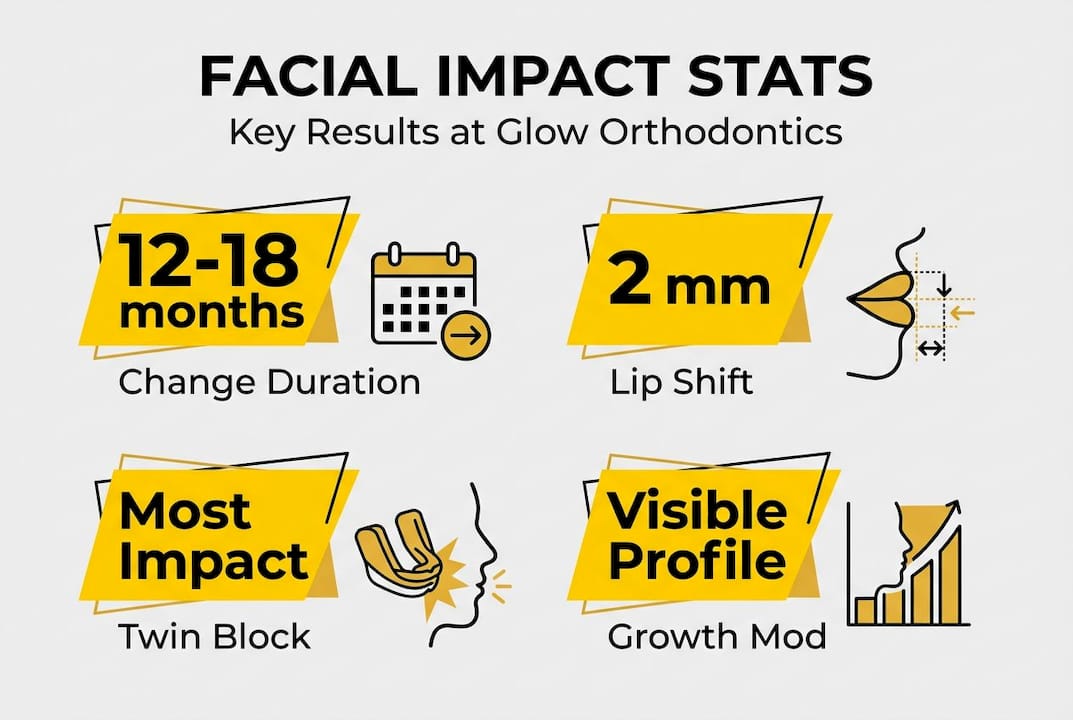
- Twin Block: A removable functional appliance that repositions the lower jaw forward. It can improve lower lip position and overall profile balance, especially in Class II (overbite) cases.
- Facemask (reverse pull headgear): Pulls the upper jaw forward. Used for Class III (underbite) cases. Produces measurable lip and chin shifts when started young.
- Palate expander: Widens the upper jaw. Improves breathing and creates space. It can subtly widen the smile and nasal airway.
- Standard braces or aligners: Primarily move teeth within the jaw. Minimal direct effect on jaw position or profile in most cases.
Recent research highlights that the aesthetic Twin Block produced greater lower lip improvement than conventional versions in early treatment cases. The mechanism of how the appliance moves the jaw matters more than whether it looks modern or uses the latest materials.
For children treated with miniplate-anchored facemask therapy, a systematic review found average upper lip protrusion of +1.82 mm, lower lip retrusion of 3.14 mm, and chin movement of 4.8 mm in pre-pubertal children. These are real, measurable shifts in facial anatomy, not just cosmetic impressions.
Pro Tip: Soft tissue changes from orthodontic appliances are gradual, often taking 12 to 18 months to fully express. Do not judge a treatment’s facial impact at the three-month mark. The real results become visible closer to the end of active treatment.
Understanding appliance options is also useful for children with crowding. The teeth crowding solutions guide walks through practical approaches for different severity levels. If your younger child had early oral habits, it is also worth reviewing how pacifier use affects dental development, since these habits can influence the jaw patterns that orthodontics later addresses.
A fresh perspective on orthodontics and facial appearance
Here is something most orthodontic articles won’t tell you: before-and-after photos are not the whole story.
Social media and clinic waiting rooms are filled with dramatic transformation images. These are real, but they represent the most visually striking cases. They are not the average. Most children treated at ages 7 to 12 see meaningful improvements in dental health, bite function, and self-confidence, but the visible facial change is often subtle rather than dramatic.
That subtlety is not a failure. A two-millimeter shift in lip position or a slightly improved profile may not show up on Instagram. But it can change how a child holds their head in a school photo. It can change whether they smile with their mouth open or closed. These quiet improvements matter enormously to the children living them.
Research confirms that perceived attractiveness after treatment varies widely depending on who is evaluating it and what expectations they brought in. Dissatisfaction often has more to do with unmet expectations than with a poor clinical outcome. This means the most valuable thing you can do before starting treatment is have an honest, detailed conversation about what to realistically expect for your specific child’s case.
Ask about the face, not just the teeth. Ask what the profile should look like at the end. Ask what happens if growth does not cooperate. A confident, clear answer from your orthodontist is one of the best signs that you are in good hands.
There is also something powerful about involving your child in these conversations. Children aged 7 to 12 are old enough to understand goals. When they feel ownership over the process, they tend to wear their appliances better, cooperate more at appointments, and feel more satisfied with outcomes. The emotional investment is part of the treatment.
If you want to explore how braces and appliances affect facial appearance in more depth, that resource walks through the science clearly and is worth bookmarking before your consultation.
Finding the right orthodontic solution for your family
Now that you have a clearer picture of how orthodontics shapes your child’s face and smile, the next step is getting a personalized assessment from an orthodontist who takes the time to explain your child’s unique situation.

At Glow Orthodontics in Langley, we work with families of children exactly in this age range every day. We understand that parents want real answers, not just a treatment plan handed over at the end of a 15-minute appointment. Our consultations are designed to help you understand what is possible, what is realistic, and what approach fits your child’s growth stage and dental needs. The complete family orthodontic care guide is a great resource to read before your visit, and our team can walk through smile makeover options that fit your family’s goals and budget. If you are weighing appliance choices, our comparison of clear braces versus Invisalign can help you start that conversation with confidence.
Frequently asked questions
Can braces really change my child’s face shape?
Braces can shift lip position and improve profile balance, but major facial shape changes require growth modification appliances targeting skeletal discrepancies. Soft tissue profile changes are most significant when treatment is started during the active growth window.
Is early orthodontic treatment always better for my child’s appearance?
No, early treatment primarily helps prevent tooth injury in specific cases like prominent front teeth, but does not consistently produce better facial outcomes than later treatment for most children. The Cochrane review found no overall facial advantage with early intervention beyond incisor trauma reduction.
Which orthodontic appliance has the biggest impact on a child’s profile?
Functional appliances and facemask therapy have the greatest influence on facial profile because they target jaw growth directly. Functional appliances can produce measurable shifts in lip and chin position when used before puberty.
How noticeable will the changes be to my child’s appearance?
Changes are often subtle and more visible to close family members than on objective measurements. Perceived improvements after orthodontic treatment depend largely on the observer’s expectations and relationship to the child, not just clinical outcomes.