How to choose the best time for orthodontic treatment
May 4, 2026
How to choose the best time for orthodontic treatment
TL;DR:
- The optimal timing for orthodontic treatment depends on growth stage, bite severity, and dental development.
- Early treatment reduces injury risk and improves correction success but may extend overall duration.
- Personalized assessments and professional guidance are essential for making effective treatment timing decisions.
Every parent wants to make the right call about their child’s smile, but the question of when to start orthodontic treatment is genuinely one of the trickiest decisions in pediatric dental care. Start too early and you risk unnecessary appliances and a longer road overall. Wait too long and you might miss a window where treatment is faster, simpler, and more effective. This article walks you through what the research actually says, which bite problems respond best to early intervention, and how families here in Langley, BC can make a confident, well-informed decision for their child.
Table of Contents
- Key factors in choosing the best time
- Early vs. late treatment: What does the science say?
- Which age for which bite? Types of malocclusions and timing
- Making the decision: Practical tips and red flags
- Expert perspective: Timing matters, but so does individual growth
- Where to get professional guidance in Langley, BC
- Frequently asked questions
Key Takeaways
| Point | Details |
|---|---|
| Early treatment helps in some cases | Children with prominent front teeth or crossbites often benefit most from early orthodontic care. |
| Timing depends on the problem | Optimal treatment age varies by the type and severity of bite issue and dental development. |
| Work with your orthodontist | Professional assessment ensures you choose the best approach for your child’s unique needs. |
| Not all early treatment is necessary | Some children are better served by waiting until the teen years for orthodontic work. |
Key factors in choosing the best time
To understand when to start, let’s look at what really matters in the timing decision.
Not every 8-year-old needs braces, and not every 12-year-old is “too old.” The right timing depends on several factors working together, and no single checklist covers every child.
The most important factors include:
- Growth stage and skeletal development. Orthodontic treatment works best when it aligns with your child’s natural growth spurts. An orthodontist evaluates bone maturity, not just age.
- Type and severity of the bite problem. A mild spacing issue is very different from a significant jaw misalignment. The malocclusion types your child has will heavily shape the timing recommendation.
- Dental development. The mix of baby and permanent teeth (called “mixed dentition”) creates a window where certain corrections are more practical.
- Child readiness. Compliance matters. A child who won’t tolerate an appliance can undermine even the most well-timed treatment plan.
- Risk of dental trauma. Protruding front teeth carry a real injury risk during sports and play, which can push the timeline forward.
Research reflects genuine complexity here. A scoping review on treatment timing notes that while early treatment can prevent complications for certain bite problems, it may also prolong total treatment time without providing meaningful skeletal benefits for others, particularly for overjet (upper teeth that stick out). The debate in the profession is real, and it depends heavily on malocclusion severity and the child’s growth stage.
Pro Tip: Ask your orthodontist to explain why now is the right time for your specific child, not just what treatment is recommended. A good answer will include reference to your child’s growth stage and bite type.
For children approaching or in their teen years, learning more about orthodontic care for teens can also help you understand what a later treatment phase typically looks like.
Early vs. late treatment: What does the science say?
Armed with these criteria, let’s explore what the latest research tells us about starting early or waiting.
The most studied group is children with Class II Division 1 malocclusion, which is the clinical term for prominent or protruding upper front teeth. This is the “buck teeth” presentation many parents recognize immediately.
| Outcome | Early treatment (ages 7-11) | Late treatment (after age 11) |
|---|---|---|
| Incisal trauma rate | 19-20% | 29-30% |
| Average overjet reduction | 7.0 mm | 4.8 mm |
| Class II success rate | 82% | 65% |
| Overall stability | Higher | Moderate |
| Total treatment duration | Longer (two phases) | Shorter (one phase) |
This data tells a nuanced story. A meta-analysis on early intervention found that starting treatment between ages 7 and 11 significantly reduces the risk of tooth injury (19-20% vs. 29-30% in the late group), achieves greater overjet reduction, and results in a notably higher Class II correction rate of 82% compared to 65% for late starters. That is a meaningful clinical difference.
However, a well-known Cochrane review on prominent upper teeth found that while early treatment reduces trauma risk, the final overjet measurement and jaw angle (ANB angle) after completing full treatment were similar between early and late groups. In other words, both groups ended up in roughly the same place at the finish line.
“Early orthodontic treatment for children with prominent upper front teeth reduces the incidence of incisal trauma but does not lead to measurably different final occlusal outcomes compared to treatment started in early adolescence.”
What does this mean for your family? The case for early treatment is strongest when your child faces a genuine injury risk from protruding teeth, or when the bite problem is severe enough that addressing it now prevents more complex treatment later. For milder cases, a well-monitored wait-and-see approach is often perfectly reasonable.
Signs that early treatment may offer real benefits:
- Upper front teeth that protrude significantly beyond the lower lip
- A bite where the lower jaw visibly shifts to one side when closing
- A crossbite affecting the back teeth
- Early loss of baby teeth causing crowding problems
- Jaw growth patterns that are clearly uneven
For parents also concerned about long-term stability, understanding how teeth shifting after braces happens can help you appreciate why the quality of the original correction matters so much.
If your child has an overbite concern, exploring what’s involved in fixing an overbite gives useful context before your consultation.
Which age for which bite? Types of malocclusions and timing
Not all bite issues follow the same timeline. Here’s what the evidence says about the best age for specific orthodontic problems.
Different bite problems have different “sweet spots” in terms of timing, and this is where generic advice about starting at age 7 can mislead parents. Seven is a common recommendation for a first evaluation, not a universal start date.
| Bite problem | Optimal treatment age | Why |
|---|---|---|
| Class II (overbite/protrusion) | 7-11 or early teen | Reduces trauma; functional appliances use growth |
| Class III (underbite/lower jaw prominence) | 3.5-5 yrs or 8-9 yrs | Growth modification most effective early |
| Posterior crossbite | 7-11 years | Fixed expanders dramatically more effective |
| Anterior crossbite | As soon as identified | Prevents jaw shift and asymmetry |
| Crowding (mild to moderate) | Often teen years | Permanent teeth needed for full assessment |
Class III malocclusion (where the lower jaw juts forward beyond the upper) benefits dramatically from very early action. A study on early Class III treatment found optimal timing is as early as 3.5 to 5 years for children with a crossbite in their baby teeth, and again at 8 to 9 years in mixed dentition. Intervening during these windows harnesses active jaw growth to reduce severity before it becomes a surgical problem.
Posterior crossbite (back teeth biting inside the lower teeth) is another strong case for early action. A Cochrane review on crossbite appliances found that fixed expanders (specifically the quad-helix device) used in children aged 7 to 11 had an odds ratio of 50.59 for success compared to simply observing without treatment. Removable plates also outperformed observation but were less effective than fixed options. Waiting too long on crossbites can lead to functional jaw shifts and facial asymmetry that become much harder to correct.
Here is a practical numbered guide to help you match your child’s situation to the right timeline:
- If your child has a noticeable underbite before age 6, request a referral to an orthodontist immediately. This is the clearest case for very early intervention.
- If your child is 7 or 8 with a crossbite in the back teeth, prioritize a consultation. Fixed expanders at this age are highly effective.
- If your child is 9 to 11 with prominently protruding upper teeth, discuss whether growth is still active enough for functional appliance treatment.
- If the concern is mainly crowding or mild spacing, you can often wait until most permanent teeth have arrived, typically around ages 11 to 13.
- If you are unsure, a comprehensive evaluation with X-rays is the only reliable way to know.
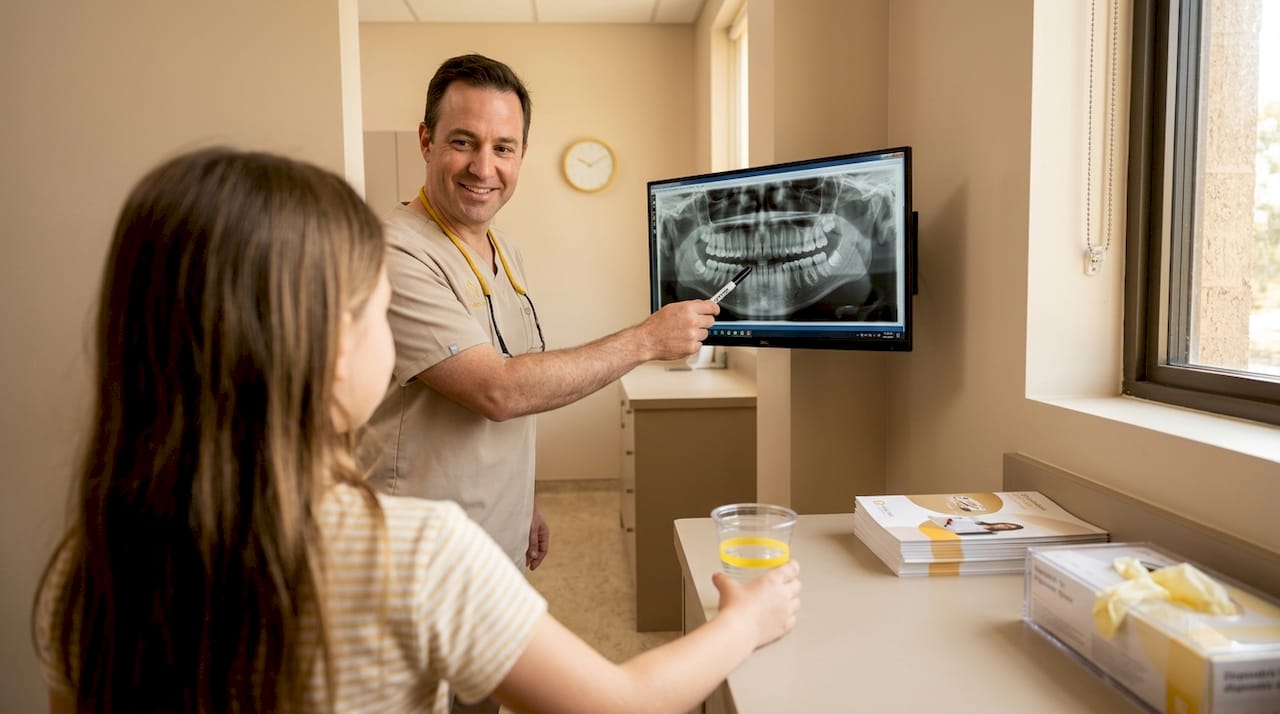
Pro Tip: Ask for a panoramic X-ray (OPG) at your child’s evaluation. It shows all developing teeth and jaw structure at once, giving the orthodontist a far clearer picture than a visual exam alone.
For complex or urgent bite concerns, it helps to know what counts as one of the orthodontic emergencies worth addressing right away versus what can wait for a scheduled appointment.
Making the decision: Practical tips and red flags
With more clarity on specific timing for each bite type, let’s review practical steps you can take to choose confidently.
Research is helpful, but it doesn’t replace the conversation you need to have with a qualified professional who has examined your specific child. Still, there are things you can do right now to move toward that decision with confidence.
Actionable steps for Langley parents:
- Schedule the evaluation first. The American Association of Orthodontists recommends a first evaluation by age 7, not because treatment always starts then, but because problems are far easier to identify while growth is still active.
- Write down your observations before the appointment. Does your child mouth breathe at night? Have you noticed jaw clicking? Does their bite look uneven? These details help the orthodontist ask the right follow-up questions.
- Ask about a phased treatment plan vs. a single-phase approach. Phased treatment means starting with an appliance now and finishing with braces or aligners later. It is more involved, but sometimes clinically necessary. A single phase in the teen years may be simpler and just as effective for your child’s particular issue.
- Request written documentation of the wait-and-see recommendation if no treatment is suggested. This creates accountability for monitoring progress at follow-up visits.
- Consider a second opinion if you feel uncertain. A second evaluation from a different orthodontist is completely normal and a smart move for significant treatment decisions.
Watch for these red flags that suggest you should not delay a consultation:
- Habitual mouth breathing or snoring, which can signal airway issues connected to jaw development
- Difficulty chewing or biting into food
- Teeth that are clearly damaging other teeth due to a bite problem
- Speech issues like lisping that persist past age 5 or 6
- Jaw pain, popping, or discomfort in a child
The scoping review on treatment timing is clear that the severity of the malocclusion and the child’s growth stage must guide the decision, and these are things only a professional assessment can determine accurately.
If your child is entering the teen years and treatment is planned for that phase, reading the full orthodontic care for teens overview can prepare both you and your child for what to expect. For families considering remote or initial consultations, learning about virtual orthodontic consultations can be a convenient first step.
Expert perspective: Timing matters, but so does individual growth
Now that you know the research and recommendations, here’s what many guides won’t tell you about choosing the best time for orthodontic care.
After working with hundreds of children and their families, the pattern that stands out is this: the pressure parents feel to “start early” often comes from anxiety, not clinical need. That is completely understandable. You love your child and want to do everything right. But orthodontic readiness is not a race, and acting before a child’s biology is ready rarely shortens the finish line.
Guidelines from professional bodies are starting points drawn from population-level data. Your child is not a population average. A 9-year-old with a rapidly worsening Class III bite is in a very different situation than a 9-year-old with mild crowding and four healthy baby teeth still in place. The research supports both early and late approaches depending on exactly which condition we’re talking about, and that nuance tends to get lost when advice is simplified to “start at age 7.”
What the data also don’t capture well is family context. A child who is anxious, resistant, or not yet emotionally ready for appliances often does poorly in early treatment even when the clinical timing is theoretically ideal. A few months of preparation, trust-building, and readiness can make the difference between a successful first phase and a frustrating one.
The other overlooked truth is that monitoring without treating is a legitimate clinical choice. Many children benefit most from regular observation, accurate record-keeping with X-rays, and a clearly defined “trigger” that would prompt treatment to start. This is not neglect. It is responsible, personalized orthodontic care.
For parents navigating the teen years specifically, the resource on orthodontic care for teens offers a useful roadmap for what treatment typically looks like when it begins in adolescence, which remains the most common and effective window for the majority of bite problems.
Trust the process, ask good questions, and find an orthodontist who treats your child as an individual rather than a checklist.
Where to get professional guidance in Langley, BC
Ready to put your research into action for your child’s healthiest smile?
Understanding the research is valuable, but the only way to know what your child truly needs and when is a personalized evaluation from an experienced orthodontist. Every child’s jaw, teeth, and growth pattern is unique, and a thorough assessment with proper imaging gives you answers that no article can provide.

At Glow Orthodontics in Langley, we specialize in exactly this kind of individualized, family-focused assessment. Whether your child is 7 and you want to know if anything needs attention now, or they are 11 and you are planning ahead, our team takes the time to explain findings clearly and recommend only what is genuinely needed. You can explore our family orthodontic guide to understand the process, and if you are comparing treatment options, our breakdown of clear braces vs Invisalign can help you think through what might suit your child best. Book a consultation at gloworthodontics.ca and give your child a confident start.
Frequently asked questions
Is it harmful to start orthodontic treatment too early?
Starting too early can lead to longer overall treatment time with little or no measurable skeletal benefit for certain bite problems, particularly overjet, as a scoping review on timing notes. The key is matching the start date to both the bite type and the child’s growth stage.
What age is best for treating a crossbite?
Ages 7 to 11 are generally considered the most effective window, with fixed expanders proving dramatically more successful than removable devices or observation alone, according to a Cochrane review on crossbite appliances. Acting within this range takes advantage of active jaw growth.
Does early treatment always shorten the need for braces later?
No, many children who complete early treatment still need braces or aligners in their teen years, but a meta-analysis on early outcomes shows that early intervention reduces injury risk and improves the success rate for Class II corrections significantly. Think of phase one as reducing severity, not eliminating the second phase.
Can my 7-year-old get Invisalign instead of braces?
Some early treatment cases can use clear aligners, but suitability depends entirely on the specific bite problem and your child’s ability to wear the aligners consistently for 20 to 22 hours a day. An orthodontist’s hands-on evaluation is the only reliable way to determine which appliance makes sense.
What are signs my child shouldn’t wait for an orthodontic evaluation?
Speech difficulties, persistent mouth breathing, visibly protruding teeth, jaw pain, or teeth that appear to be biting into the gum or other teeth are all reasons to book a consultation now rather than waiting for the next routine dental visit.
Recommended
- Braces vs. Invisalign: Langley Options | Glow Orthodontics
- Invisalign Treatment Process: Step-by-Step Guide to a Straighter Smile – RG API
- Understanding Orthodontic Emergencies: What You Need to Know – RG API
- Best Braces for Kids: Langley Comparison | 2025
- Cum alegi implant dentar: ghid complet București 2026
- Coroană dentară vs fațetă: cum alegi cea mai bună opțiune