How to Get Retainers: Your Complete 2026 Guide
July 9, 2026
How to Get Retainers: Your Complete 2026 Guide
TL;DR:
- Retainers are essential for maintaining teeth alignment after orthodontic treatment. They come in removable, Hawley, and fixed bonded types, each suited for different lifestyles. In 2026, they can be obtained through in-office visits, online impression kits, or hybrid digital scans, with costs starting around $149.
Orthodontic retainers are custom appliances that hold your teeth in their corrected positions after braces or aligner treatment ends. Getting retainers is not optional. Without them, teeth begin shifting back toward their original positions within days, a process orthodontists call relapse. The three main retainer categories are removable clear retainers, Hawley retainers, and fixed bonded retainers. Each type suits different lifestyles, budgets, and dental needs. This guide covers every method available in 2026 to obtain retainers, what the process looks like from start to finish, and how to keep them working long-term.
What types of dental retainers are available?
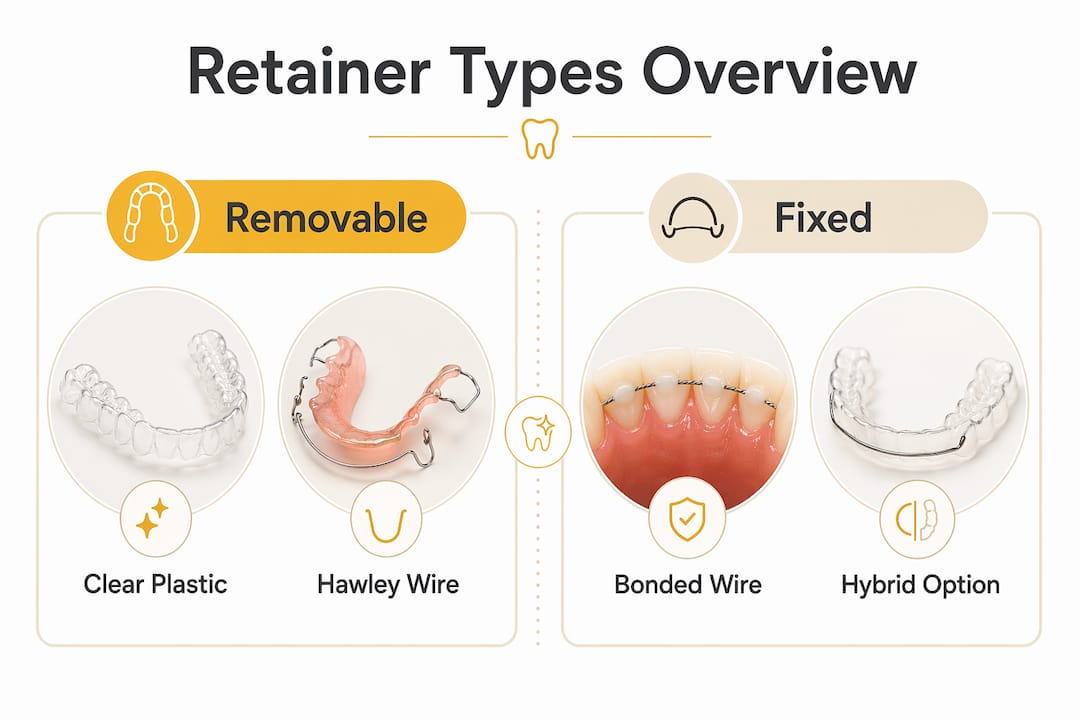
Retainer choice shapes your daily routine for years, so understanding each type before you commit matters. The three main options differ in materials, visibility, maintenance demands, and how long they last.
Removable clear retainers are made from thin, transparent plastic molded to fit your teeth exactly. They are nearly invisible when worn, which makes them popular with adults and teens. The tradeoff is that they rely entirely on you wearing them consistently. Aligner-style retainers work only if worn consistently, and skipping nights adds up fast.
Hawley retainers use a wire that runs across the front teeth, anchored to an acrylic plate that sits against the roof of your mouth or along your lower gum line. They are more durable than clear plastic versions and can be adjusted by your orthodontist if minor tooth movement occurs. The wire is visible, which some patients dislike, but the appliance typically lasts several years with proper care.
Fixed bonded retainers are thin wires cemented directly to the back surfaces of your teeth, usually the lower front six. You never have to remember to wear them. Permanent retainers require meticulous flossing but are compliance-free, while removable retainers are easier to clean but risk being lost. That tradeoff is the central decision most patients face.
| Type | Visibility | Maintenance | Durability | Best for |
|---|---|---|---|---|
| Clear removable | Nearly invisible | Easy to clean, easy to lose | 1–3 years | Aesthetics-focused patients |
| Hawley | Wire visible | Adjustable, very durable | 5–10 years | Long-term wear, active lifestyles |
| Fixed bonded | Hidden behind teeth | Requires floss threader | 10+ years with care | Compliance-challenged patients |
Choosing the right retainer depends on your lifestyle, your risk of shifting, and how committed you are to daily maintenance.
How and where to get retainers in 2026
You can get new retainers from any qualified dentist or orthodontist, or through a reputable online service, by providing fresh impressions or 3D scans. That flexibility is relatively new. A few years ago, an in-office visit was the only option. Now patients have three practical routes.

Option 1: Visit your orthodontist or general dentist
An orthodontist or general dentist takes a new impression of your teeth or uses an intraoral scanner to capture a digital model. Digital intraoral scanning is faster than traditional molds and is widely available in 2026. The scan file goes directly to a dental lab, which typically returns finished retainers within one to two weeks. In-office visits also give you a professional fitting, so any pressure points get adjusted on the spot.
Option 2: Use an online impression kit
Several online services mail you a kit containing putty trays. You press your teeth into the putty at home, let it set, and mail the trays back. At-home impression kits typically take 2–3 weeks after mailing for retainer delivery. That timeline assumes your impressions are clean and usable on the first attempt. Errors in the mold can require a retake, adding another week or more.
Option 3: Get a dental office 3D scan, then order online
Some patients visit a local dental office just for a scan, then use that digital file to order retainers through an online lab. Dental office 3D scans cost about $100–$150 for immediate digital records and faster manufacturing compared to mailing impressions. This hybrid approach combines the accuracy of a professional scan with the lower cost of online ordering.
What does it cost?
Custom replacement retainers generally start around $149, often less through online providers than traditional clinics, and many are HSA/FSA eligible. That price point covers a single set. Ordering two or three sets at once is common practice and usually discounted. Understanding teeth shifting after braces makes the investment easier to justify.
Step-by-step process to order and receive your retainers
The process is straightforward once you know what to expect. Here is how it works from start to finish.
- Decide on your acquisition method. Choose between an in-office visit, an at-home impression kit, or a scan-and-order approach based on your budget and timeline.
- Get your impressions or scan. If visiting a clinic, the staff handles this. If using a mail-in kit, follow the instructions carefully. Press firmly and evenly into the putty, hold for the recommended time, and remove slowly to avoid distortion.
- Submit your impressions or digital file. Mail the trays back in the prepaid packaging, or upload your scan file to the online lab’s portal.
- Wait for manufacturing. In-office orders typically arrive in 1–2 weeks. Mail-in kits take 2–3 weeks from the date the lab receives your impressions.
- Receive and check the fit. Put the retainers in and check for even pressure across all teeth. They should feel snug but not painful. If you ordered through a clinic, your provider adjusts them at the fitting appointment.
- Order a backup set. Multi-set packs allow backup retainers to avoid gaps in wear if one set is lost or damaged. Ordering two sets upfront is almost always cheaper than replacing one set later.
Pro Tip: If your retainer feels tighter than usual after a few nights off, wear it for shorter sessions first. Forcing it can crack the plastic or strain the bonded wire.
How to care for your retainers and handle common problems
Retainer care is simple, but the most common mistakes are surprisingly damaging. Getting this right extends the life of your appliance by years.
Cleaning removable retainers requires gentle soap and lukewarm water, not toothpaste. Do not clean clear retainers with toothpaste because it scratches the plastic, creating tiny grooves where bacteria accumulate. A soft toothbrush with a drop of dish soap, rinsed thoroughly, is all you need. Specialized retainer cleaning tablets are also effective for a weekly deep clean.
Storage is where most retainers meet their end. Always keep removable retainers in their case when not in your mouth. Leaving them on a napkin at a restaurant or on a bathroom counter leads to accidental disposal or damage. Heat is equally destructive. Never leave a clear retainer in a hot car or rinse it with hot water, as the plastic warps permanently.
What to do if your retainer is lost or broken: Act immediately. Use an old retainer right away if the current one is lost, even if it feels slightly tight, to prevent rapid tooth shifting that can start within days without retention. Then order a replacement as soon as possible.
Signs your retainer needs replacement or professional attention include visible cracks, a wire that has shifted or broken, a fit that feels noticeably different from when it was new, or persistent discomfort after wearing it for several consecutive nights. Wearing retainers at night consistently is the single most effective habit for long-term dental stability.
Pro Tip: Take a photo of your retainer next to a ruler when it is new. If it ever warps or cracks, that photo helps your provider match the original dimensions more accurately.
Key takeaways
Retainers are a lifelong commitment, and the method you choose to get them should match your compliance habits, budget, and how much professional oversight you want.
| Point | Details |
|---|---|
| Retainer type determines compliance | Fixed retainers remove the daily decision; removable ones require consistent wear to work. |
| Three acquisition routes exist | In-office, mail-in impression kits, and scan-and-order online each suit different budgets and timelines. |
| Cost starts around $149 | Online providers often cost less than clinics; many retainers qualify for HSA/FSA reimbursement. |
| Backup sets prevent relapse gaps | Ordering two or three sets upfront is cheaper than emergency replacements and keeps wear uninterrupted. |
| Toothpaste damages clear retainers | Use gentle soap or specialized tablets to avoid scratching plastic and harboring bacteria. |
Why I think most patients underplan their retention
The part of orthodontic treatment that gets the least attention is the part that determines whether the results last. Retention must be planned from the beginning of treatment and matched to patient risk, yet most patients only start thinking about retainers when their active treatment ends. That gap in planning is where relapse begins.
What I have seen work consistently is a hybrid retention approach: a fixed retainer bonded to the lower teeth for permanent stability, combined with a removable clear retainer for the upper arch worn nightly. This combination handles the two biggest failure points. The lower front teeth are the most prone to crowding relapse, and the upper arch benefits from the flexibility of a removable appliance that can be replaced without a dental visit.
The other thing patients underestimate is how quickly teeth move. Skipping a week of retainer wear after years of treatment can undo months of progress. Retention is a continuation of treatment, not a finish line. Lifelong nighttime wear is the standard recommendation for stable results, and patients who accept that early tend to have far better outcomes than those who treat retainers as temporary.
My honest recommendation: ask your orthodontist about your personal relapse risk before treatment ends. Some patients have naturally stable teeth. Others have high-risk bite patterns that need more aggressive retention. Knowing which category you fall into changes everything about how you approach the next decade of wear.
— Juiced
Gloworthodontics and your retainer needs
Finishing orthodontic treatment is a milestone. Keeping those results is the work that follows.

Gloworthodontics supports patients in Langley, British Columbia through every phase of orthodontic care, including post-treatment retention planning. Whether you are figuring out which retainer type fits your life or need guidance on replacement options, the team at Gloworthodontics provides personalized advice grounded in your specific treatment history. For families navigating orthodontic aftercare, the orthodontic care for teens guide covers retention in detail alongside broader treatment considerations. You can also explore the full range of orthodontic services at Glow Orthodontics and book a consultation directly through the website.
FAQ
How do I get retainers after braces?
Visit your orthodontist or general dentist for a new impression or 3D scan, then have a custom retainer fabricated. Online mail-in impression kits are also a valid option if in-office visits are inconvenient.
What is the cost of getting retainers in 2026?
Custom retainers typically start around $149 through online providers. In-office retainers cost more but include professional fitting. Many retainers qualify for HSA or FSA reimbursement.
Can I get retainers without seeing an orthodontist?
Yes. Online services provide mail-in impression kits that let you take molds at home and receive custom retainers by mail. A general dentist can also provide retainers without an orthodontist referral.
How long does it take to receive retainers?
In-office orders typically arrive within 1–2 weeks. Mail-in impression kits take 2–3 weeks from the date the lab receives your molds. 3D scans speed up manufacturing compared to physical impressions.
What happens if I stop wearing my retainer?
Teeth begin shifting back toward their original positions within days of stopping retainer wear. Using an old retainer immediately after losing or breaking the current one prevents rapid relapse while a replacement is ordered.