How to Straighten My Teeth Without Braces
July 17, 2026
How to Straighten My Teeth Without Braces
TL;DR:
- Clear aligners effectively straighten teeth for mild to moderate misalignment when worn consistently for 20 to 22 hours daily. Cosmetic methods like veneers and bonding improve appearance without moving teeth, while retainers simply maintain existing alignment. Successful treatment depends on professional assessment, proper method selection, and strict adherence to protocols.
Straightening your teeth without braces is possible through several proven methods, including clear aligners, porcelain veneers, dental bonding, and retainers. Each option works differently and suits different levels of misalignment. Clear aligners, the industry term for removable orthodontic appliances, represent the most clinically effective path for patients who want to move teeth without metal brackets. Cosmetic options like veneers and bonding improve appearance quickly but do not move teeth at all. Knowing which method fits your situation requires understanding what each one actually does, and what it cannot do.
How to straighten your teeth without braces using clear aligners
Clear aligner therapy is the most effective method to straighten teeth without braces for mild to moderate misalignment, with treatment lasting 6–18 months and requiring 20–22 hours of daily wear. That daily wear requirement is the single most important factor in whether treatment succeeds or stalls.
How clear aligners move teeth
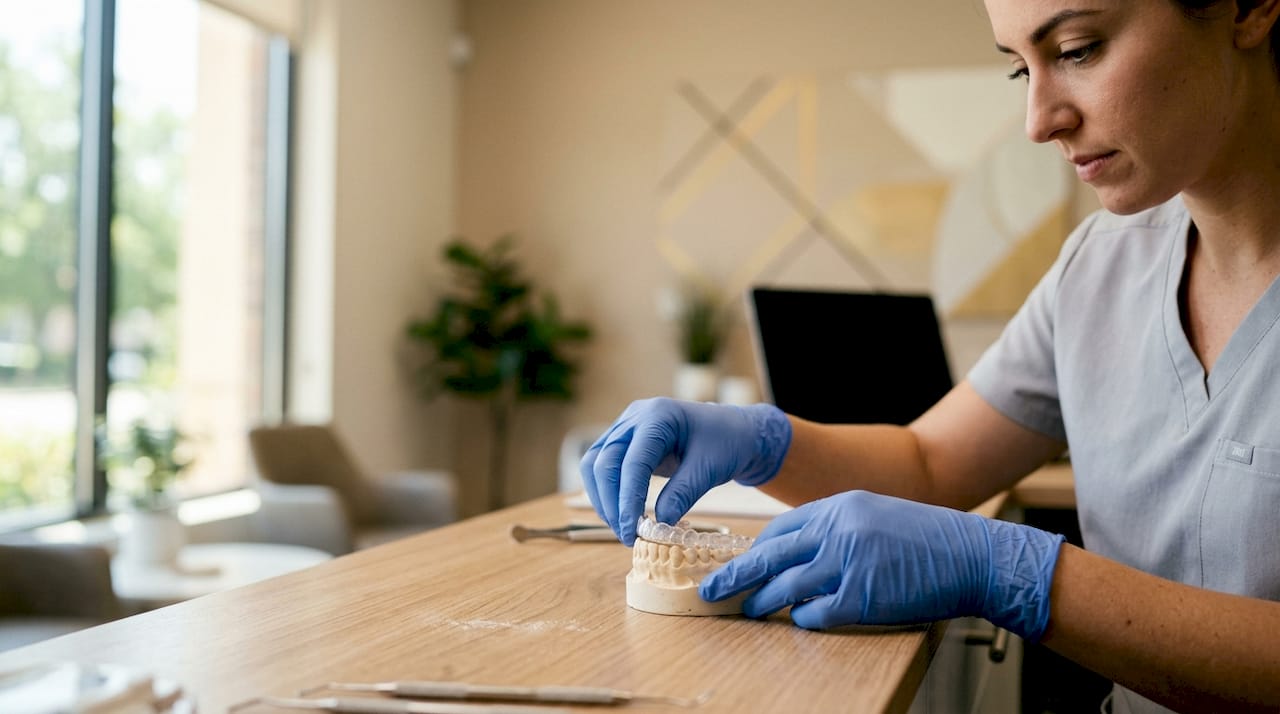
Clear aligners apply gradual, controlled pressure to shift teeth through a biological process called bone remodeling. Each tray moves teeth a fraction of a millimeter. As you progress through a series of trays, your teeth follow a planned path mapped out with 3D scans before treatment begins. Professional supervision using 3D scans and regular monitoring is what makes this process safe and predictable. Without that oversight, there is no way to catch problems early or adjust the plan when teeth respond unexpectedly.
Who is a good candidate?
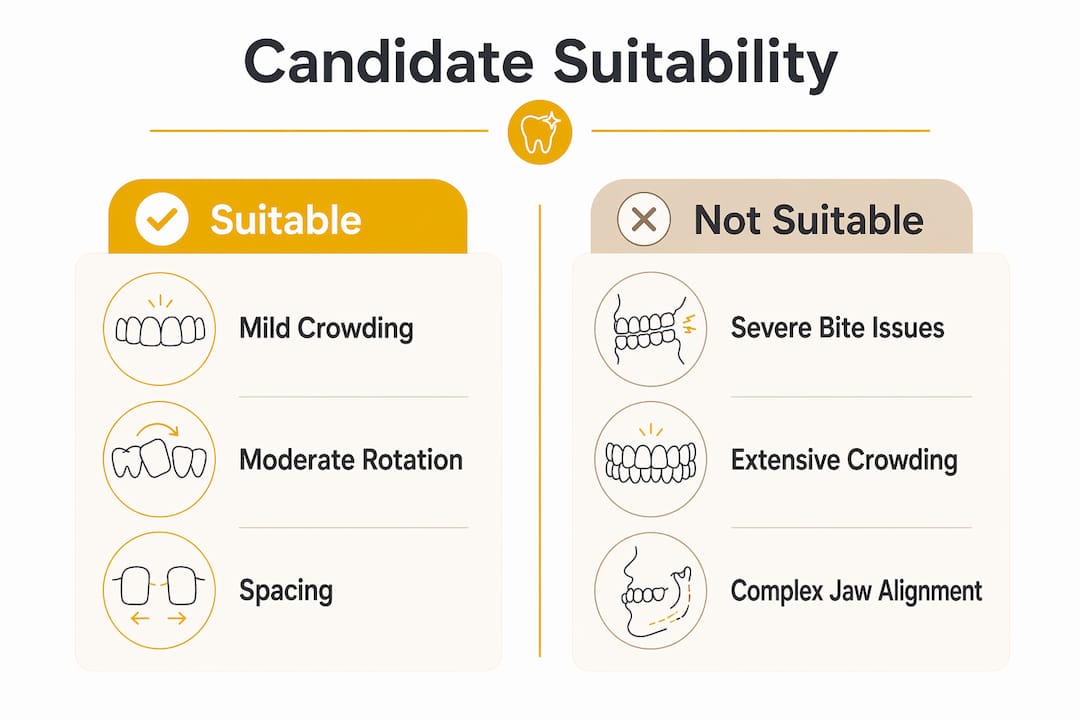
Clear aligners work best for mild to moderate crowding, spacing, and simple rotations. They are not suited for severe bite problems, significant skeletal jaw issues, or complex rotations that require more force than a removable tray can deliver. Severe cases require fixed braces, and a professional orthodontic assessment is the only reliable way to know which category you fall into.
| Candidate Profile | Clear Aligners Suitable? |
|---|---|
| Mild crowding or spacing | Yes |
| Moderate rotation | Yes, with limitations |
| Severe crowding | No |
| Skeletal jaw discrepancy | No |
| Post-treatment relapse (minor) | Often yes |
Pro Tip: Remove your aligners only to eat, drink anything other than water, and brush your teeth. Every extra minute out of your mouth adds up and can extend your treatment timeline.
Missing recommended wear time increases treatment duration and can produce poor results. Patients who treat the 20–22 hour rule as a suggestion rather than a requirement often find themselves repeating trays or needing refinements. Consistency is not optional. It is the treatment.
What cosmetic methods can make teeth appear straighter?
Porcelain veneers and dental bonding are the two main cosmetic options for patients who want a straighter-looking smile without any tooth movement. These methods do not reposition teeth. They reshape the visible surface to create the appearance of alignment.
- Porcelain veneers are thin shells bonded to the front of teeth. They correct the look of gaps, chips, discoloration, and minor shape irregularities.
- Dental bonding uses a tooth-colored resin applied directly to the tooth surface. It is faster and less expensive than veneers but less durable over time.
- Veneers and bonding deliver cosmetic improvement in 2–3 office visits, making them the fastest path to a visually straighter smile.
- Neither option corrects bite alignment, root position, or crowding. They mask the problem rather than fix it.
- Cosmetic treatments can be part of a broader plan, but should not replace orthodontic treatment when underlying bite or alignment issues exist.
Pro Tip: Ask your dentist to photograph your bite from multiple angles before committing to veneers. If your bite is off, veneers placed on misaligned teeth can chip or fail prematurely.
The key distinction is purpose. Veneers and bonding serve patients whose teeth are functionally sound but cosmetically imperfect. If your bite is healthy and your misalignment is minor, cosmetic masking can be a legitimate, fast solution. If you have functional bite issues, cosmetic work alone will not protect your long-term dental health.
Can retainers or natural methods help straighten teeth?
Retainers are designed to hold teeth in position, not to move them significantly. Retainers work best for preventing relapse after orthodontic treatment or correcting very minor shifts. Expecting a retainer to close a gap or fix crowding that developed over years is not realistic.
The category of “natural methods” for straightening teeth includes tongue exercises, facial muscle training, and dietary changes. None of these have meaningful scientific backing for producing measurable tooth movement in adults. Adult teeth drift and crowd over time, and reversing that process requires controlled mechanical force, not lifestyle changes alone.
DIY teeth straightening attempts, including using rubber bands, homemade retainers, or non-professional devices, carry real risks. Skipping professional assessment can cause root damage, gum recession, tooth loss, and bite instability. No online tutorial or at-home kit replaces a clinical evaluation. The risks of unsupervised attempts include incomplete correction and permanent dental damage.
Understanding clear retainer benefits is useful for patients finishing orthodontic treatment. Retainers in that context are a critical maintenance tool. But they are a finishing step, not a starting point for straightening teeth.
How to choose the safest non-brace teeth straightening option
Choosing the right method starts with a professional orthodontic assessment. A bite and jaw evaluation tells you whether your misalignment is cosmetic, functional, or both. A comprehensive bite assessment is critical before selecting any brace-free method, because treating the wrong problem the wrong way can cause bite instability or long-term damage.
Follow this decision framework:
- Get a professional evaluation first. Confirm whether your case is mild, moderate, or severe before comparing options.
- Define your goal. Are you fixing function, improving appearance, or both? The answer changes which method is appropriate.
- Assess your lifestyle. Clear aligners demand daily discipline. If you travel frequently, work long hours, or know you will struggle with compliance, factor that in honestly.
- Consider the timeline. Veneers take 2–3 visits. Clear aligners take 6–18 months. Retainers for minor relapse may take a few months.
- Plan for retention. Straight teeth require long-term maintenance to stay in position. Any treatment plan without a retention phase is incomplete.
| Method | Moves Teeth? | Timeline | Best For |
|---|---|---|---|
| Clear aligners | Yes | 6–18 months | Mild to moderate misalignment |
| Porcelain veneers | No | 2–3 visits | Cosmetic irregularities only |
| Dental bonding | No | 1–2 visits | Minor chips, gaps, shape issues |
| Retainers | Minor only | Varies | Post-treatment maintenance |
Clear aligners vs. fixed braces is a comparison worth reviewing if you are still deciding between the two. The core trade-off is visibility versus compliance. Aligners require 20–22 hours of daily wear while braces apply constant force regardless of patient behavior. For patients who want discretion and can commit to the wear schedule, aligners are the stronger choice.
Key Takeaways
Clear aligners are the most clinically effective brace-free method for mild to moderate misalignment, but success depends entirely on consistent daily wear and professional supervision.
| Point | Details |
|---|---|
| Clear aligners lead brace-free options | They require 20–22 hours daily wear and 6–18 months to complete treatment. |
| Cosmetic options do not move teeth | Veneers and bonding improve appearance in 2–3 visits but do not correct bite or crowding. |
| Retainers have a limited role | They maintain position after treatment but cannot fix significant misalignment on their own. |
| Professional assessment is non-negotiable | Severe cases need fixed braces; only a clinical evaluation can confirm which method fits your case. |
| Retention is part of every treatment | Any straightening method requires a long-term retention plan to prevent teeth from drifting back. |
What I have learned from watching patients choose the wrong method first
The most common mistake I see is patients choosing a method based on how it looks in an ad rather than what their teeth actually need. Someone with a moderate crossbite books a veneer consultation because veneers are fast and painless. Six months later, those veneers are cracking because the bite was never addressed. The cosmetic fix failed because it was applied to a functional problem.
The second mistake is underestimating the compliance demand of clear aligners. Patients hear “removable” and assume that means flexible. It does not. Removable means you are responsible for keeping them in. Patients who wear their aligners 16 hours a day instead of 22 are not getting a slower version of the same result. They are often getting no result at all, or a result that requires expensive refinements.
What actually works is simple: get a proper assessment, pick the method that matches your clinical situation, and follow the protocol exactly. The technology behind clear aligners is genuinely impressive. But the technology only works when you wear the trays. I have seen patients finish treatment in 9 months and patients drag the same case out to 24 months. The difference was almost always compliance, not the severity of the case.
Straight teeth are not just cosmetic. Bite stability and dental health are directly connected to alignment. Choosing a method that looks good but skips the functional evaluation is a short-term decision with long-term consequences. Work with a qualified orthodontist, set realistic expectations, and commit to the process fully.
— Juiced
Gloworthodontics offers personalized brace-free treatment in Langley
Gloworthodontics specializes in clear aligner treatment and personalized orthodontic care for patients in the Langley, British Columbia area. Every treatment plan starts with a thorough clinical assessment, including bite and jaw evaluation, so patients receive the right recommendation from the start.

The team at Gloworthodontics uses 3D scanning technology and professional monitoring to guide clear aligner treatment safely from start to finish. Patients receive a plan built around their specific case, not a one-size-fits-all protocol. If you are ready to learn which brace-free option fits your smile goals, the Invisalign treatment process guide walks through exactly what to expect at each stage. Book a consultation at Gloworthodontics to get a clear picture of your options and a treatment plan designed for your teeth.
FAQ
How long does it take to straighten teeth without braces?
Clear aligner treatment typically takes 6–18 months for mild to moderate misalignment with consistent 20–22 hours of daily wear. Cosmetic options like veneers take only 2–3 office visits but do not move teeth.
Can you fix crooked teeth without braces as an adult?
Yes. Clear aligners are effective for adults with mild to moderate crowding or spacing. Severe cases or significant bite problems may still require fixed braces based on a professional assessment.
Are there ways to straighten teeth without braces that are permanent?
Clear aligner treatment produces permanent tooth movement, but retention is required afterward to prevent relapse. Without a retainer worn as directed, teeth will drift back over time.
Is there any way to straighten teeth without braces at home?
DIY attempts using rubber bands or non-professional devices carry serious risks including root damage and tooth loss. Safe, effective treatment requires professional supervision and a proper clinical evaluation.
Do retainers straighten teeth without braces?
Retainers are designed to maintain tooth position after orthodontic treatment, not to produce significant movement. They can correct very minor shifts but are not a substitute for clear aligners or other active orthodontic treatment.