Ideal Age for Braces: What Parents Need to Know
June 14, 2026
Ideal Age for Braces: What Parents Need to Know
TL;DR:
- The best age for comprehensive braces is between 11 and 14 years when most permanent teeth have erupted and the jaw is still growing. Early evaluation at age 7 helps monitor development, with treatment timing personalized based on skeletal maturity. Structural issues like crossbites or jaw discrepancies may require early intervention, but unnecessary treatment should be avoided to reduce overall treatment time and costs.
The ideal age for braces is typically between 11 and 14 years old, when most permanent teeth have erupted and the jaw is still actively growing. This window gives orthodontists the best conditions to move teeth efficiently and correct bite problems before skeletal development locks in. That said, the right timing for your child depends on their individual dental and jaw maturity, not just their birthday. Understanding the full timeline, from early screening at age 7 through the teen years, helps you make confident decisions without second-guessing every appointment.
Why is age 7 the right time for a first orthodontic check?
The American Association of Orthodontists recommends a first orthodontic evaluation by age 7. That recommendation surprises most parents, because 7-year-olds still have a mouth full of baby teeth. The point of this visit is not to start treatment. It is to give your orthodontist a baseline picture of how your child’s jaw and teeth are developing.
At age 7, the first permanent molars have typically come in, and the front adult teeth are starting to emerge. This combination lets an orthodontist assess bite alignment, jaw width, and tooth spacing with real accuracy. Problems like a narrow palate, a developing crossbite, or crowding that will worsen over time become visible at this stage.
What happens after that first visit? For most children, the answer is monitoring. Initial evaluations most often lead to an observation program rather than immediate treatment. Your orthodontist tracks eruption and jaw growth every 6–12 months until the timing is right for comprehensive care.
Here is what an age 7 evaluation typically covers:
- Bite alignment: Checking for overbite, underbite, crossbite, or open bite
- Jaw width: Identifying whether the upper or lower jaw is too narrow
- Crowding risk: Estimating whether adult teeth will have enough space
- Tooth eruption sequence: Confirming permanent teeth are coming in on schedule
- Skeletal symmetry: Spotting any early asymmetry in jaw growth
Pro Tip: Bring any dental X-rays your child’s dentist has taken to the first orthodontic consultation. They give the orthodontist a head start on assessing root development and bone structure.
What is phase 1 orthodontic treatment and who needs it?
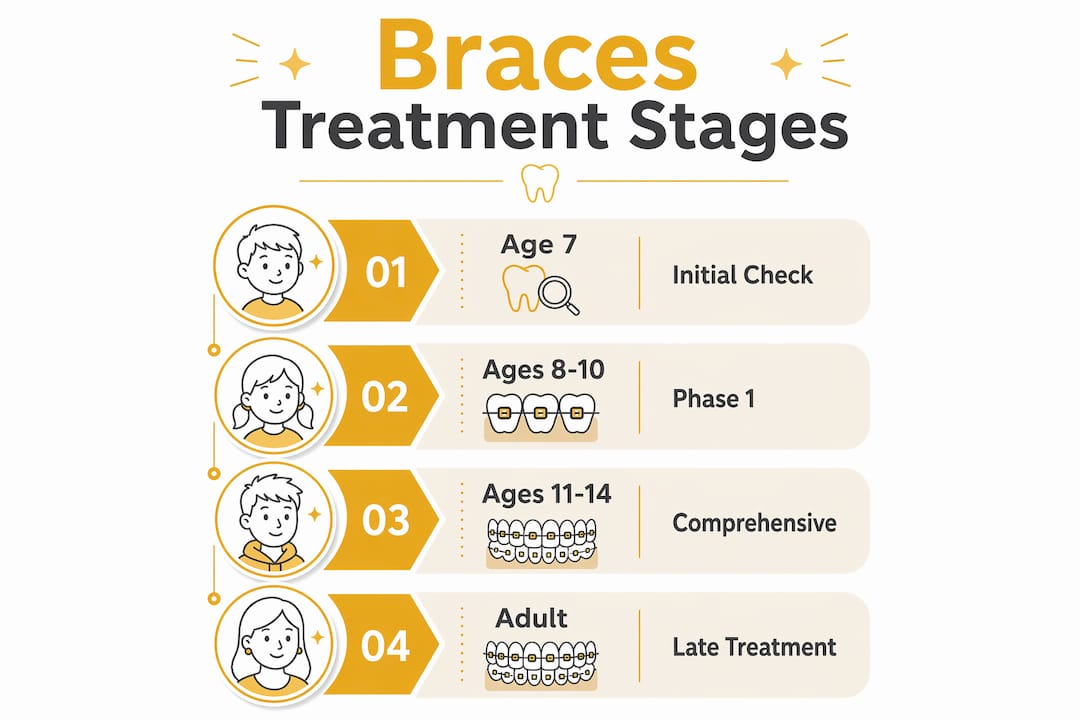
Phase 1 treatment, also called early interceptive orthodontics, is a targeted intervention for children aged 8–10 who have specific structural problems that will worsen without action. The American Association of Orthodontists defines Phase 1 as treatment designed to address functional issues before comprehensive braces begin in adolescence.
Phase 1 is not a shortcut to finishing treatment early. It is reserved for problems where waiting causes real harm. The most common conditions that qualify include:
- Severe crossbite where the upper jaw is too narrow and biting down causes the jaw to shift sideways
- Significant underbite caused by the lower jaw growing ahead of the upper jaw
- Extreme crowding that is blocking permanent teeth from erupting in the correct position
- Thumb-sucking habits that have already deformed the palate or pushed front teeth forward
- Jaw growth discrepancies that are easier to correct while the bones are still forming
The appliances used in Phase 1 include palate expanders, partial braces on select teeth, and space maintainers. These tools address the structural problem, then treatment pauses until the child is ready for Phase 2 comprehensive braces.
Pro Tip: Ask your orthodontist to explain specifically what problem Phase 1 will solve and what happens if you wait. If the answer is vague, a second opinion is reasonable.
The critical caution here is overtreatment. Starting braces too early can increase total treatment time and costs with no improvement in final results. Orthodontists call this “orthodontic burnout,” where a child who has worn appliances since age 8 loses motivation and cooperation by the time comprehensive treatment begins. Phase 1 should be reserved for functional problems like severe crossbite or jaw discrepancies, not cosmetic concerns that can wait.
| Condition | Phase 1 Recommended? | Can It Wait Until Age 11–14? |
|---|---|---|
| Severe crossbite | Yes | No, jaw shift worsens |
| Mild crowding | No | Yes, monitor and reassess |
| Underbite from jaw growth | Yes | No, skeletal window closes |
| Spacing between front teeth | No | Yes, often self-corrects |
| Narrow palate | Yes | No, expansion easier early |
Why ages 11 to 14 are the sweet spot for comprehensive braces
Comprehensive orthodontic treatment most commonly begins between ages 11 and 14, and there are clear biological reasons for that window. By early adolescence, most permanent teeth have erupted and the adolescent growth spurt is actively reshaping the jaw. Those two factors together create the best possible conditions for moving teeth and correcting bite relationships.
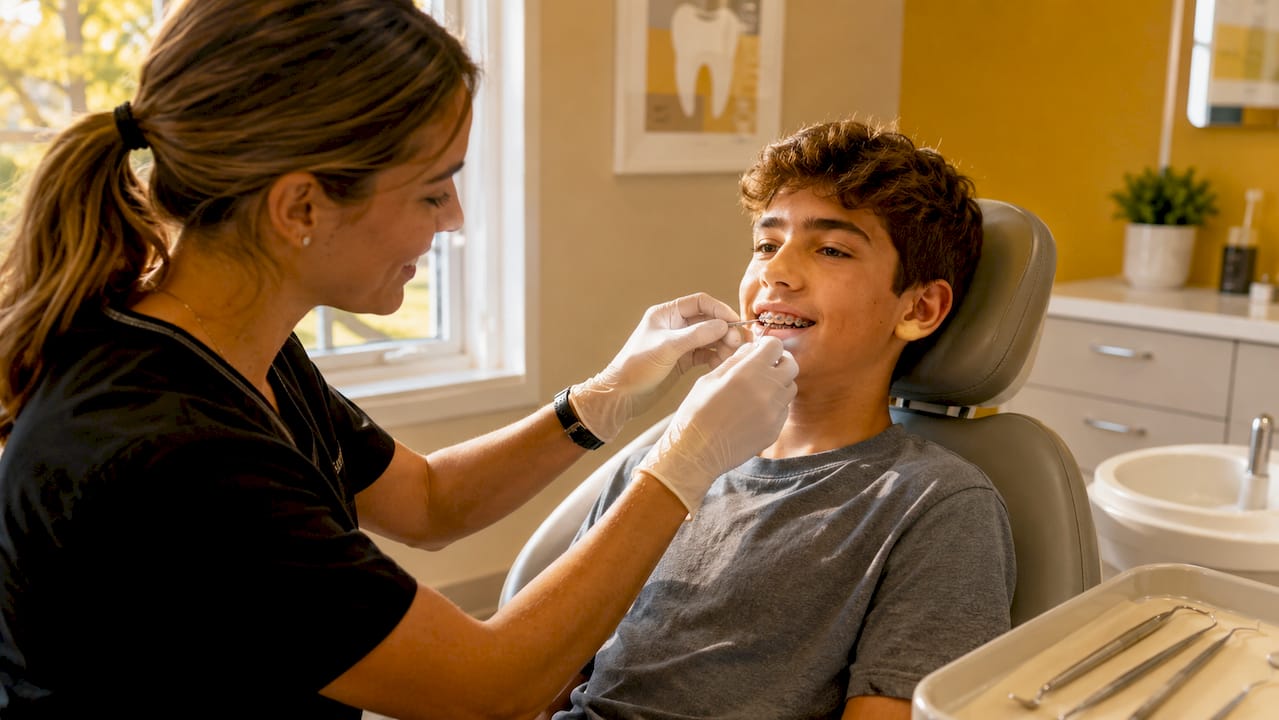
The jaw is more malleable during growth spurts than at any other time after early childhood. Orthodontic forces applied to a growing jaw produce faster tooth movement and better skeletal correction than the same forces applied to a fully mature adult jaw. Treatment that takes 18 months at age 12 might take 24–30 months for the same patient at age 25.
Biological maturity guides ideal treatment timing more than chronological age. Two children who are both 12 years old can be at very different stages of dental development. One may have all permanent teeth in place and be ready for braces. The other may still have several baby teeth and need another year of monitoring. Your orthodontist uses X-rays and clinical exams to assess skeletal age, not just the number on a birthday cake.
Here is how the development timeline typically maps to treatment readiness:
| Age Range | Dental Development Stage | Typical Orthodontic Action |
|---|---|---|
| 6–7 years | First permanent molars erupt | Initial evaluation and baseline assessment |
| 8–10 years | Mixed dentition, some baby teeth remain | Phase 1 only if structural problem exists |
| 11–13 years | Most permanent teeth present, growth spurt active | Ideal window for comprehensive braces |
| 14–17 years | Growth slowing, most teeth fully erupted | Still effective, slightly longer treatment |
| 18 and older | Skeletal growth complete | Treatment works, may require longer duration |
The 11–14 window also has a practical advantage: children this age are generally mature enough to cooperate with treatment. They can manage oral hygiene around brackets, remember to wear elastics, and communicate discomfort to their orthodontist. Those factors matter more than most parents realize.
Early treatment vs. waiting: how do you decide?
The decision between starting treatment early and waiting for the right biological moment is one of the most common questions parents bring to orthodontic consultations. The answer depends on your child’s specific situation, not a general rule.
The case for waiting:
- Comprehensive treatment in the 11–14 window is typically shorter and more efficient
- Fewer total months in appliances reduces cost and reduces the risk of burnout
- Monitoring programs let the orthodontist choose the exact right moment to begin
- Observation every 6–12 months allows optimal timing of comprehensive treatment to reduce both costs and total time in braces
The case for early intervention:
- Structural problems like jaw discrepancies are easier and less invasive to correct during growth
- Severe crowding can damage erupting permanent teeth if left unaddressed
- Some bite problems become surgical cases if not treated during the growth window
- Early treatment can shorten or simplify Phase 2 comprehensive braces later
There is no one-size-fits-all ideal age. Timing should be personalized based on skeletal and dental development. A good orthodontist will not push you toward treatment your child does not need. They will explain what they see, what they are watching for, and when the right moment to act will be.
One more point worth knowing: braces are not exclusively a childhood treatment. About 25% of orthodontic patients are adults, and modern options like Invisalign make treatment practical at any age. If your child misses the adolescent window for any reason, effective treatment is still available. You can also explore invisible braces for kids as an alternative to traditional metal brackets, which some children find easier to manage socially and hygienically.
For parents researching teeth shifting after braces, understanding how jaw growth affects long-term stability is another reason why timing matters so much at the start of treatment.
Key takeaways
The most effective time for comprehensive braces is ages 11–14, when jaw growth and permanent tooth eruption align to produce faster results and shorter treatment.
| Point | Details |
|---|---|
| First evaluation at age 7 | The AAO recommends screening by age 7 to detect bite and growth issues early. |
| Most children just need monitoring | Initial evaluations typically lead to observation every 6–12 months, not immediate braces. |
| Phase 1 is for structural problems only | Early intervention at ages 8–10 is reserved for crossbites, underbites, and jaw discrepancies. |
| Ages 11–14 are the prime window | Jaw malleability and full tooth eruption make this the most efficient time for comprehensive treatment. |
| Biological age beats chronological age | Skeletal development, not the calendar, determines when your child is truly ready for braces. |
What i’ve learned after watching hundreds of families navigate this decision
Parents walk into consultations expecting a clear answer: “Your child needs braces now” or “Come back in two years.” The reality is more nuanced, and I think that nuance is actually good news.
The families who get the best outcomes are the ones who start monitoring early and stay consistent with follow-up appointments. They do not panic when the orthodontist says “let’s watch this for another six months.” They understand that waiting for the right biological moment is a strategy, not a delay.
The families who struggle are usually the ones who either pushed for early treatment because they were anxious, or who waited until age 14 or 15 without any prior evaluation. Both extremes cost more time and money than a well-managed observation program would have.
My honest observation: the age 7 recommendation from the American Association of Orthodontists is one of the most underused tools in pediatric dental care. Most parents do not bring their kids in until a dentist flags a problem, which often means age 9 or 10. By then, some early intervention windows have already closed. A single evaluation at age 7 costs you one appointment. Missing that window can cost you a more complex treatment plan later.
The other thing I tell parents: ask your orthodontist to explain the monitoring plan in plain terms. What are they watching? What would trigger the decision to start treatment? What does the expected timeline look like? A good orthodontist will answer all of those questions clearly. If you leave a consultation without that roadmap, ask again or seek a second opinion.
— Juiced
Ready to find the right timing for your child?
Gloworthodontics serves families in the Langley, British Columbia area with personalized orthodontic care designed around each child’s unique development, not a generic age chart. Whether your child is 7 and due for a first screening or 13 and ready for comprehensive braces, the team at Gloworthodontics builds a treatment plan around their specific dental and skeletal maturity.

The teen orthodontic care guide from Gloworthodontics covers everything from treatment options to what to expect at each stage, written specifically for parents navigating these decisions. Book a consultation with Gloworthodontics to get a clear picture of where your child stands and exactly when treatment will deliver the best results.
FAQ
What is the ideal age for braces?
The ideal age for comprehensive braces is typically between 11 and 14 years old, when most permanent teeth have erupted and the jaw is still growing. Biological development matters more than the exact age, so an orthodontic evaluation determines the right timing for each child.
Should my 7-year-old see an orthodontist?
Yes. The American Association of Orthodontists recommends a first evaluation by age 7, though most children will not need braces at that age. The visit establishes a baseline and allows the orthodontist to monitor development and plan treatment at the right time.
What is phase 1 orthodontic treatment?
Phase 1 is early interceptive treatment for children aged 8–10 who have specific structural problems like severe crossbite, underbite, or a narrow palate. It is not recommended for mild cosmetic concerns, which are better addressed during comprehensive treatment in adolescence.
Can adults get braces if they missed the ideal window?
Braces are effective at any age. Roughly 25% of orthodontic patients are adults, and options like clear aligners make treatment practical for adults who did not receive treatment as children.
How do i know if my child needs braces now or can wait?
An orthodontic evaluation is the only reliable way to answer that question. The orthodontist will assess jaw development, tooth eruption, and bite alignment to determine whether immediate treatment, Phase 1 intervention, or continued monitoring is the right course of action.