Kids’ braces vs aligners: Find the best treatment
May 5, 2026
Kids’ braces vs aligners: Find the best treatment
TL;DR:
- Both braces and clear aligners have high success rates for correcting kids’ teeth, but the right choice depends on individual case complexity and family habits. Early orthodontic treatment guides jaw growth and can prevent more serious issues, with braces being better for severe misalignments and aligners suited for mild to moderate cases. Success ultimately relies on consistent compliance and personalized family considerations, not just appliance choice.
Both braces and clear aligners deliver impressively high success rates for straightening kids’ teeth, yet most parents walk into their first orthodontic consultation feeling genuinely unsure which path makes more sense for their child. That uncertainty is completely understandable. The options look different, feel different, and come with different rules for your child to follow every single day. This guide breaks down what you need to know about braces and aligners for kids aged 7 to 12, so you can walk into any appointment in Langley already knowing the right questions to ask.
Table of Contents
- Why early orthodontic care matters for kids
- Braces versus aligners: Key differences for kids
- Which option is best for your child? Factors to consider
- Frequently asked kid orthodontic questions in Langley
- Our take: What most parents overlook when choosing orthodontic options
- Connect with Langley’s kid-friendly orthodontic experts
- Frequently asked questions
Key Takeaways
| Point | Details |
|---|---|
| Early intervention boosts success | Starting orthodontic treatment early prevents major dental problems and improves outcomes. |
| Braces best for complex cases | Braces offer more stable results for severe misalignment and bite issues than aligners. |
| Aligners are more comfortable | Clear aligners provide greater comfort and higher satisfaction, especially for mild cases. |
| Treatment duration varies | Braces typically require 24 months, while aligners average 18 months for adolescents. |
| Choose based on lifestyle | Success with aligners depends on kids’ compliance, so consider their routine and habits. |
Why early orthodontic care matters for kids
Starting orthodontic treatment at the right age is one of the most impactful decisions you can make for your child’s long-term oral health. Children between 7 and 12 are still growing, and that growth is actually an advantage. When the jaw is still developing, an orthodontist can guide its shape more effectively than is possible once growth has stopped. Waiting too long can turn a manageable issue into a complicated one.
Here is what early treatment can realistically accomplish:
- Jaw guidance: Correcting underdeveloped or narrow jaws while bone is still soft and responsive
- Space creation: Making room for permanent teeth before crowding becomes severe
- Bite correction: Addressing crossbites, overbites, and underbites before they affect chewing or speech
- Injury prevention: Protruding front teeth are significantly more likely to be chipped or knocked out during play
- Confidence building: Children who feel good about their smile tend to be more socially engaged at school
The research supports acting early. A 2024 comparative study found that braces deliver a 90% malocclusion success rate while aligners deliver 88% success in adolescents, meaning both options are highly effective when applied at the right stage of development. Catching a malocclusion (the technical term for a misaligned bite) early puts your child in the best possible position for treatment to work.
Our teen orthodontic care guide goes into greater detail about growth windows and timing, and it is worth reading even if your child is still in the 7 to 12 age range, since planning ahead matters. If you are ever worried about a wire poking, a bracket coming loose, or another unexpected issue, it also helps to know what qualifies as orthodontic emergencies so you can respond quickly.
Braces versus aligners: Key differences for kids
Now that you understand why early treatment is worth pursuing, let’s look closely at what each option actually involves day to day.
Traditional braces use metal or ceramic brackets bonded to each tooth, connected by a wire that your orthodontist tightens at regular appointments. They work continuously, 24 hours a day, because your child cannot remove them. That constant pressure is a strength, not just a limitation.
Clear aligners (such as Invisalign for teens) are removable trays, custom molded to shift teeth gradually over a series of stages. Your child wears each tray for about two weeks before moving to the next set, and the trays must be worn for at least 20 to 22 hours per day to stay on track.

Here is a clear side by side view of the key differences:
| Feature | Traditional braces | Clear aligners |
|---|---|---|
| Visibility | Noticeable metal or ceramic | Nearly invisible |
| Removability | Fixed, cannot be removed | Removable by the child |
| Average treatment time | 24 months | 18 months |
| Best for | Complex misalignment, severe crowding | Mild to moderate cases |
| Comfort | Some irritation from brackets/wires | Smoother plastic, fewer sore spots |
| Oral hygiene | Requires extra brushing effort | Easier to clean teeth |
| Compliance requirement | Automatic | Requires consistent self-discipline |
| Satisfaction in adolescents | Good | Higher reported satisfaction |
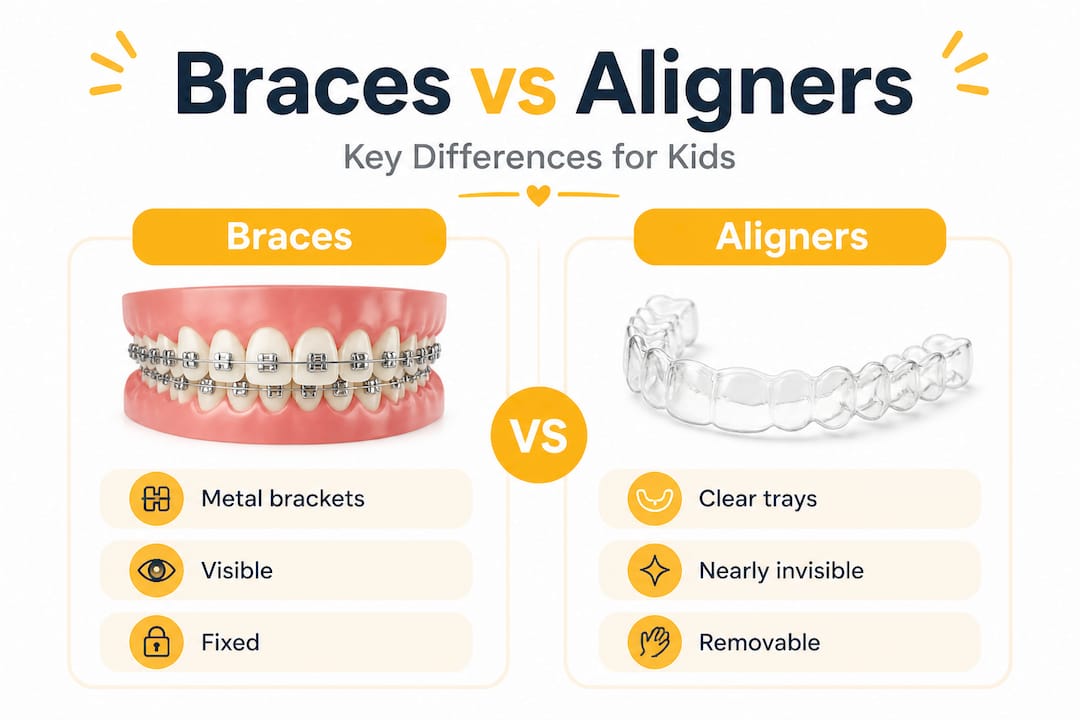
The same comparative research confirms that braces average 24 months of treatment while aligners average 18 months, and braces offer better stability for complex cases while aligners provide higher satisfaction and less discomfort overall.
A few practical points worth knowing:
- Braces require your child to avoid sticky, hard, and chewy foods that could damage brackets
- Aligners must be removed before every meal and snack, then teeth must be brushed before reinserting them
- Aligners can be lost if a child removes them and sets them on a lunch tray or wraps them in a napkin
- Braces appointments are typically every 4 to 6 weeks; aligner check-ins can sometimes be less frequent
“The best treatment is the one your child will actually stick with. Compliance is not a small factor. It often determines the final result more than the appliance itself.”
Pro Tip: Ask your orthodontist to show your child how to place and remove aligners before deciding. If your child struggles with the mechanism or forgets to put them back in, braces may be the more reliable choice.
For a deeper look at how these options compare, the differences Invisalign vs braces for kids page is a strong resource. You can also explore the effectiveness of clear aligners and a thorough breakdown of clear aligners vs braces explained to make sure you’re seeing the full picture.
Which option is best for your child? Factors to consider
After reviewing the differences, most parents find that a few key factors push the decision in one direction. Here is how to think through each one honestly.
1. Severity of the dental issue
This is the most important factor. If your child has significant crowding, a large overbite, a crossbite, or teeth that are rotated significantly, braces are almost always the better tool. The research shows that braces deliver better stability in complex cases, and that stability matters enormously for long-term outcomes. Aligners work exceptionally well for mild to moderate spacing issues and simpler bite corrections.
2. Your child’s level of self-discipline
Be honest about this one. Aligners reward responsible kids who remember to reinsert their trays after every meal and who track their daily wear time. If your child tends to lose things, forgets routines, or resists being reminded, braces eliminate that variable entirely. There is no tray to forget. The treatment keeps working regardless.
3. Lifestyle and social considerations
Many kids in the 7 to 12 age range care deeply about what their peers think. Clear aligners are nearly invisible, which can genuinely reduce self-consciousness at school or during activities. On the other hand, some kids actually enjoy choosing colorful bracket bands with braces and see them as a form of expression. Ask your child directly what matters to them.
4. Oral hygiene habits at home
Kids who struggle to brush thoroughly already may find braces more challenging since food gets trapped around brackets easily. Conversely, aligner wearers need to be meticulous about cleaning their teeth before reinserting trays, or they risk trapping bacteria against their enamel.
Here is a quick numbered checklist to help you assess your situation:
- Get an orthodontic evaluation to understand the complexity of your child’s case
- Discuss your child’s daily routine honestly with your orthodontist
- Ask your child which option they feel more confident about following through with
- Review your insurance plan to understand what is covered for each option
- Consider a trial conversation at home about what the rules for each treatment would look like
For children dealing with crowding specifically, the teeth crowding solutions guide covers the approaches in detail. And once treatment wraps up, knowing the kids’ retainer choices available will help you plan for the next phase.
Pro Tip: If you and your orthodontist are genuinely on the fence between the two options, lean toward what your child will comply with most reliably. A perfectly chosen appliance worn inconsistently will always underperform a good appliance used consistently.
Frequently asked kid orthodontic questions in Langley
Parents in Langley ask us practical, real-life questions every week. Here are the ones that come up most often, with straightforward answers.
How much does treatment typically cost, and does insurance cover it?
Costs vary depending on case complexity and the type of treatment. Braces in British Columbia typically range from roughly $4,500 to $7,000, while clear aligners can range similarly depending on the brand and number of trays required. Many dental insurance plans in Canada cover a portion of orthodontic treatment for children, usually with a lifetime maximum. Always check your plan details before assuming full coverage.
What does daily maintenance look like for each option?
With braces, your child needs to brush carefully around each bracket after every meal, use floss threaders or a water flosser to clean between teeth, and avoid foods that could cause damage. With aligners, the routine involves removing trays before eating or drinking anything except water, brushing both teeth and the trays before reinsertion, and storing trays safely when they are not in use. Neither option is particularly difficult once the routine becomes habit.
What happens if a bracket falls off or an aligner is lost?
A loose or broken bracket is not an emergency in most cases, but it does require an appointment to reattach. If your child loses an aligner tray, contact the orthodontic office promptly so they can advise whether to move to the next tray, go back to the previous one, or order a replacement. Both treatment success rates of 90% for braces and 88% for aligners assume treatment is carried out without major interruptions, so handling these situations quickly matters.
What after-care steps protect the results long-term?
Retainers are non-negotiable. After any orthodontic treatment, your child’s teeth will want to drift back toward their original positions. A retainer worn consistently, especially in the first year after treatment, is what locks in the result. For children dealing with bite-related concerns, you may also want to read about fixing overbite in kids to understand what follow-up care might look like.
Our take: What most parents overlook when choosing orthodontic options
Here is something we have observed repeatedly that most comparison guides never address: parents spend a lot of energy comparing comfort levels and aesthetics, and very little energy thinking about stability over time. Comfort matters during treatment. Stability is what matters for the rest of your child’s life.
A child who wore aligners inconsistently and finished treatment in 20 months is not in a better position than a child who wore braces continuously for 24 months with solid results. The appliance is a vehicle. The destination is a stable, well-aligned bite that holds for decades.
The other factor that almost no one talks about openly is family culture around compliance. Kids do not manage orthodontic treatment in a vacuum. They manage it within a household. If parents treat aligner wear as a serious daily commitment, model good behavior around dental care, and check in on wear time without making it a battleground, outcomes improve. If it becomes a source of conflict or the child learns that skipping a few hours here and there has no visible consequence, drift happens quietly.
This is one of the reasons we encourage families to look honestly at parent tips for braces and aligners before committing to a treatment path. The question is not just “which is better?” It is “which is better for this child in this family right now?”
Experienced orthodontists think about treatment in terms of long-term outcomes, not just short-term convenience. We think you should too.
Connect with Langley’s kid-friendly orthodontic experts
Choosing the right treatment for your child feels a lot less overwhelming once you have expert guidance tailored to their specific needs. At Glow Orthodontics, we work with families across Langley to create personalized plans for children that balance effectiveness with real-life practicality.

Whether you are exploring clear braces vs Invisalign details or ready to understand the full Invisalign treatment guide, our team is here to walk you through every step. We make the consultation process straightforward, welcoming, and focused on what actually works for kids. Book your child’s consultation today and get clarity on the best path forward.
Frequently asked questions
Is it possible for my child to switch from braces to aligners?
Switching is possible depending on case complexity and how your child’s treatment is progressing, but it requires an orthodontic evaluation since braces offer better stability in complex cases where aligners may not be sufficient. Always consult your orthodontist before making any changes.
Are clear aligners as effective as braces for severe crowding or bite issues?
Braces are typically the preferred option for severe cases because they provide greater control and stability throughout treatment. Aligners are most effective for mild to moderate alignment issues where braces offer more stability in complex situations.
How long does orthodontic treatment typically take for kids?
Average treatment duration is about 24 months for braces and 18 months for aligners in adolescents, though individual timelines vary based on case complexity and how well the child follows the treatment plan.
Will my child need a retainer after orthodontic treatment?
Yes, a retainer is essential after any orthodontic treatment to hold the teeth in their new positions and prevent them from drifting back. Consistent retainer use, especially in the first year after treatment, is the most important factor in keeping your child’s results long-term.