Orthodontic Treatment and Confidence: What You Need to Know
July 22, 2026
Orthodontic Treatment and Confidence: What You Need to Know
TL;DR:
- Orthodontic treatment improves self-esteem and social confidence by correcting misaligned teeth and bites. Patients experience lasting psychological benefits, especially when they push through early discomfort and self-consciousness. Feeling better about their smile encourages broader social and professional engagement over time.
How orthodontic treatment directly improves your confidence
Orthodontic treatment improves confidence by correcting misaligned teeth and bite problems, which directly enhances smile aesthetics and creates a more symmetrical facial appearance. The psychological shift that follows is well documented. A PMC study found that 70.6% of adult patients showed measurable self-esteem improvement just six months after starting treatment. Satisfaction with smiles jumped from 14.7% to 97.1% in the same group. Those are not subtle changes.
The confidence gains show up in specific, practical ways:
- Smiling more freely in photos, conversations, and professional settings
- Reduced social anxiety around speaking, laughing, or eating in public
- Greater willingness to engage in new social and professional situations
- Improved self-image that carries into daily decision-making and interactions
- Better oral comfort that removes a constant source of physical self-consciousness
What drives these changes is not just aesthetics. Research published in PMC confirms that orthodontic treatment reduces anxiety and social withdrawal by improving both dental appearance and speech clarity. The physical correction and the psychological benefit reinforce each other.
Why your smile has such a strong hold on your self-image
A smile is one of the first things people notice, and most people know it. That awareness shapes behavior long before any clinical problem develops. People with misaligned teeth often cover their mouths when laughing, avoid photos, or hold back in conversations, not because of pain, but because of how they feel about being seen.
The social stakes are real. Research shows that a well-aligned smile supports positive first impressions in both personal and professional contexts. People with straight teeth tend to be perceived as more approachable and confident by peers, which creates a feedback loop: better social reception leads to more social engagement, which builds genuine confidence over time.
Dental appearance also affects emotional resilience. When someone feels good about their smile, they are less likely to withdraw from situations where they might be judged. That reduced avoidance compounds over months and years into a meaningfully different social life. Braces can change more than teeth alignment; they shift how patients carry themselves in the world.
Key confidence-related behaviors linked to smiling include:
- Making more frequent eye contact during conversations
- Speaking up more readily in group settings
- Pursuing social opportunities previously avoided
- Feeling less preoccupied with how others perceive their appearance
Real patients, real changes: what the transformation actually looks like
The research numbers are compelling, but the lived experience is what resonates. Patients across age groups describe a consistent arc: pre-treatment self-consciousness, an adjustment period, and then a gradual but unmistakable shift in how they feel about themselves.
Adults who start treatment in their 30s and 40s often describe years of hiding their smile in professional settings. Many report that the decision to start treatment was less about vanity and more about finally feeling like their outside matched how they felt inside. Parents of children who complete treatment frequently note that their child became more talkative, more willing to participate in class, and less anxious in social situations.
Common themes that emerge from patient accounts include:
- Overcoming years of anxiety about smiling in photos or public settings
- Feeling more confident during job interviews and workplace presentations
- Children becoming more socially engaged with peers after treatment
- Adults describing treatment as one of the best decisions they ever made for their mental health
- A sense of relief at no longer spending mental energy managing how they appear to others
The specific ways orthodontic treatment builds confidence
Understanding why orthodontic treatment improves confidence helps patients stay motivated through the process. The mechanisms are more layered than most people expect.
Improved dental aesthetics reduce self-conscious behavior. When patients no longer feel the need to hide their teeth, they stop performing the small, exhausting acts of concealment that drain social energy. The mental load of managing how you appear drops significantly.
Speech clarity improves with alignment. Misaligned teeth and bite problems can cause lisping, difficulty with certain sounds, and general speech hesitation. Correcting the bite often resolves these issues, which removes another source of social self-consciousness.
Patients’ own perceptions drive the psychological benefit. Research published in PMC found that subjective perception of malocclusion is a stronger predictor of self-esteem than the clinical severity of the misalignment. In other words, how bothered you are by your teeth matters more than how crooked they actually are. This means that patients who are genuinely motivated by aesthetic concerns tend to experience the greatest psychological gains.
Specific confidence-boosting factors include:
- Reduced avoidance of social situations involving close interaction
- Greater comfort eating in public without worrying about appearance
- Improved posture and body language that follows from feeling less self-conscious
- A sense of personal agency from actively investing in one’s health and appearance
How to take the first practical step toward orthodontic treatment
Starting treatment feels less daunting when you know exactly what the process looks like. Here is how it typically unfolds.
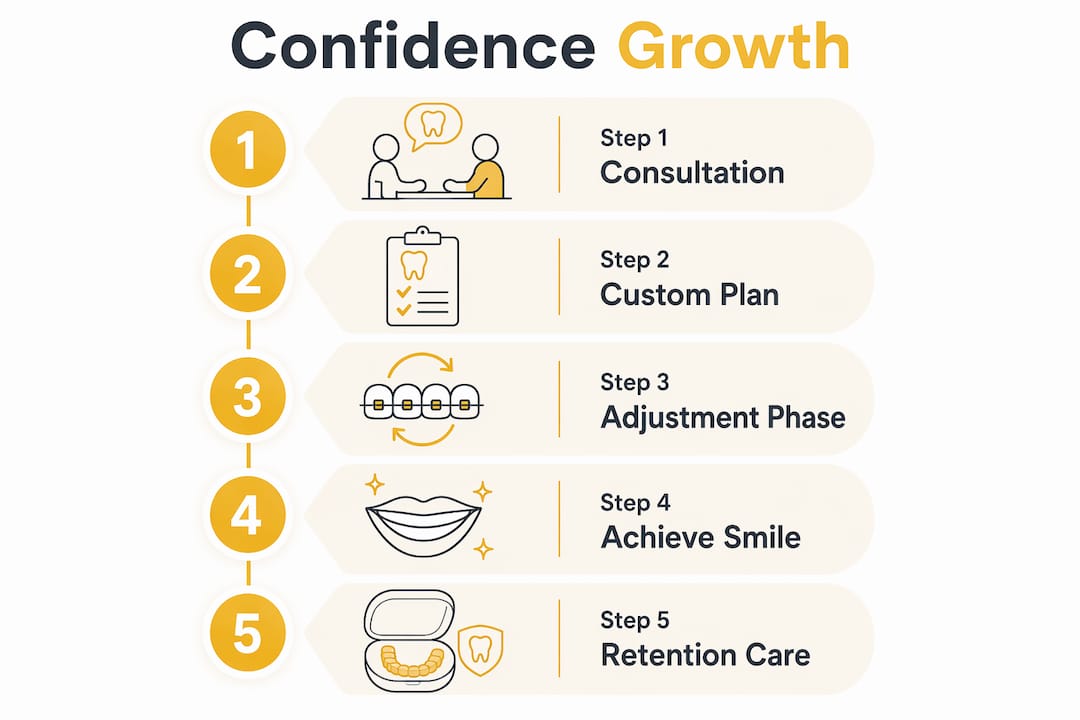
Step 1: Find a qualified orthodontist. Look for a board-certified orthodontist with experience treating your specific concern, whether that is crowding, spacing, bite issues, or a combination. Reading patient reviews and asking your general dentist for a referral are both reliable starting points.
Step 2: Schedule a consultation. Most orthodontists offer an initial consultation to evaluate your teeth, discuss your goals, and outline treatment options. This appointment is also your chance to ask about treatment timelines, appliance types, and costs.
Step 3: Review your personalized treatment plan. After imaging and evaluation, your orthodontist will present a plan tailored to your specific anatomy and goals. This is where you choose between options like traditional braces, clear braces, or Invisalign. The Invisalign treatment process follows a distinct step-by-step path worth understanding before you decide.
Step 4: Prepare mentally for the adjustment period. Knowing that some discomfort and self-consciousness are normal in the first weeks helps patients push through without losing motivation. The early phase is temporary; the results are not.

Step 5: Commit to follow-up appointments. Consistent check-ins with your orthodontist keep treatment on track and give you regular opportunities to see progress.
Pro Tip: Before your consultation, write down the specific situations where your smile makes you feel self-conscious. Sharing these with your orthodontist helps them understand your goals beyond the clinical picture, and that context shapes a better treatment plan.
- Compare appliance options carefully:
- clear braces versus Invisalign have distinct trade-offs in visibility, comfort, and maintenance
- Ask about insurance coverage and flexible payment plans at your first appointment
- Bring a parent or support person to the consultation if you are nervous about the process
What a confident smile actually unlocks in your life
Confidence built through orthodontic treatment does not stay contained to how you feel about your teeth. It spreads.
- Social life: Patients engage more freely in conversations, pursue friendships they previously avoided, and feel less drained by social situations
- Professional life: A confident smile supports stronger first impressions in interviews, presentations, and client-facing roles
- Romantic relationships: Self-assurance in appearance reduces the anxiety that often holds people back from pursuing connections
- Mental health: Reduced social avoidance and improved self-image contribute to lower baseline anxiety and a more positive daily outlook
- Physical health habits: Patients who invest in their smile tend to maintain better oral hygiene and attend dental appointments more consistently
The long-term psychological benefits of orthodontic treatment extend well beyond the active treatment period. Studies suggest these gains are durable, with patients reporting sustained improvements in self-esteem and quality of life years after completing care.
What experts and research say about orthodontics and self-confidence
The research on orthodontic treatment and psychological well-being is more nuanced than the headline numbers suggest, and that nuance is worth understanding.
The strongest finding is timing. Patients experience the greatest self-esteem gains within the first six months of treatment, after which gains tend to stabilize rather than continue growing. This means the early phase of treatment, often the most physically uncomfortable, is also when the psychological payoff is highest.
A second key finding involves what actually predicts psychological benefit. Research consistently shows that patients’ self-assessed satisfaction with their dental appearance is a stronger predictor of self-esteem than the clinical severity of their misalignment. An orthodontist might rate a case as mild, but if the patient is genuinely distressed by it, the psychological impact is real and the treatment benefit will be proportionally significant.
Practitioners also note that the benefits extend across age groups. A systematic review found moderate evidence supporting self-esteem improvements following fixed orthodontic treatment in children, adolescents, and adults alike, though the correlation between oral health quality of life and self-esteem is weaker than many assume. The takeaway for patients: treatment helps, but it works best when paired with realistic expectations about what it can and cannot change.
Challenges and emotional adjustments during treatment
Orthodontic treatment is not a straight line from discomfort to confidence. The middle stretch is where most patients struggle, and being prepared for it makes a real difference.
Physical discomfort is the most common early challenge. Soreness after adjustments, irritation from brackets or aligners, and difficulty eating certain foods are all normal in the first weeks. Most patients adapt within a month, but the initial period can feel discouraging if you are not expecting it.
Self-consciousness about the appliance itself is a separate issue, particularly for adolescents. Research confirms that visibility of orthodontic appliances can cause temporary dips in adolescent self-confidence due to social self-consciousness, though this typically resolves as patients adjust. For children and teens, clear aligners or ceramic brackets can reduce this concern significantly. The invisible braces option for kids addresses exactly this challenge.
Emotional well-being can also dip during active treatment before it improves. Studies show that children wearing fixed appliances may experience a temporary reduction in quality of life during treatment, with meaningful improvement afterward. Knowing this pattern exists helps parents support their children through the harder stretches without panic.
Practical strategies that help patients through the adjustment period:
- Keeping a visual record of progress to stay motivated when change feels slow
- Connecting with other patients going through treatment for peer support
- Communicating openly with your orthodontist about discomfort rather than tolerating it silently
- Reviewing the getting used to braces guide for specific adjustment strategies
How orthodontic treatment changes your social and professional life
The social and professional benefits of orthodontic treatment are well documented, and they go beyond simply looking better.

People with well-aligned smiles are perceived as more approachable, more competent, and more trustworthy in first-impression situations. In professional contexts, this matters. Job interviews, client meetings, and public presentations all involve rapid social judgments, and a confident smile is a genuine asset in those moments.
Socially, the change is often described as a removal of friction. Patients who previously avoided certain situations, group photos, first dates, networking events, stop avoiding them. The energy previously spent managing self-consciousness gets redirected into actual engagement. Speech clarity improvements that come with bite correction also reduce a specific source of professional anxiety for patients who previously struggled with certain sounds.
For children and adolescents, the social stakes are even higher. Peer acceptance during school years has lasting effects on self-concept and social development. Timely orthodontic treatment can reduce the risk of bullying related to dental appearance and support healthier peer relationships during a formative period.
What happens to your confidence after treatment ends
The confidence gains from orthodontic treatment tend to be durable. Research tracking patients over periods ranging from six months to ten years suggests that the psychological benefits established during treatment persist long after the appliances come off.
Self-esteem related specifically to dental appearance remains elevated post-treatment, and patients continue to report greater comfort in social situations years later. The satisfaction with smile appearance, which jumped from 14.7% to 97.1% in the PMC study cited earlier, reflects a shift in self-perception that does not simply reverse when treatment ends.
There is one important caveat: retainer compliance matters. Teeth can shift after braces are removed, and teeth shifting after braces is a real risk if retainers are not worn as directed. Protecting the result protects the confidence that came with it.
Global self-esteem, the broader sense of self-worth beyond dental appearance, tends to remain stable during and after treatment. The gains are concentrated in the subdomains most directly affected: physical appearance satisfaction, social confidence, and comfort in interpersonal situations. That is a meaningful and lasting change.
Common myths about orthodontic treatment and confidence
Myth: Orthodontic treatment is only for teenagers. Adults make up a growing share of orthodontic patients, and the psychological benefits are just as real for adults as for adolescents. The PMC study on adult patients found statistically significant self-esteem improvements across a sample ranging from age 18 to 66.
Myth: You need a severe case to justify treatment. Research shows that patients’ subjective perception of their dental appearance drives the psychological benefit, not the clinical severity of the misalignment. If your teeth bother you, that is reason enough to explore treatment.
Myth: Braces will make you more self-conscious, not less. The temporary self-consciousness during treatment is real but short-lived. The long-term trajectory is strongly positive, with most patients reporting that the confidence gained far outweighs the discomfort of the adjustment period.
Myth: Confidence improvements are just about looks. The benefits include improved speech clarity, reduced social avoidance, better oral health habits, and lower anxiety in social situations. The aesthetic change is the catalyst, but the downstream effects are genuinely psychological and behavioral.
Myth: Clear aligners do not work as well as traditional braces for confidence. For many patients, clear aligners reduce the self-consciousness associated with visible metal brackets, which can actually accelerate the psychological benefit during treatment. The right appliance depends on the clinical case and the patient’s specific concerns.
Key Takeaways
Orthodontic treatment improves confidence by correcting dental misalignment, which drives measurable gains in self-esteem, social engagement, and quality of life for both adults and children.
| Point | Details |
|---|---|
| Self-esteem improves quickly | According to a PMC study, 70.6% of adult patients showed measurable self-esteem improvement within the first six months of starting orthodontic treatment. |
| Perception matters more than severity | Patients’ subjective dissatisfaction with their smile predicts psychological benefit better than clinical misalignment scores. |
| Gains are durable | Research indicates psychological benefits persist well beyond the treatment period. |
| Children and adults both benefit | Fixed orthodontic treatment supports self-esteem improvements across all age groups, with moderate evidence for children and adolescents. |
| Challenges are temporary | Appliance self-consciousness and physical discomfort typically resolve within weeks; the confidence gains that follow are lasting. |
The part of this conversation that usually gets skipped
Most articles on orthodontic treatment and confidence focus on the before-and-after. Crooked teeth, straight teeth, low confidence, high confidence. That framing is not wrong, but it leaves out the part that actually determines whether treatment changes someone’s life: the middle.
The research is clear that the greatest psychological gains happen in the first six months. But those same months are when physical discomfort peaks, when self-consciousness about the appliance is highest, and when the visible results are still minimal. Patients who push through that window without losing motivation are the ones who experience the full benefit. Patients who quit, or who never start because they are waiting for a “better time,” do not.
What the research also shows, and what rarely gets said plainly, is that the clinical severity of your misalignment is almost irrelevant to how much you will benefit psychologically. If your teeth bother you, that is the only qualification that matters. Orthodontists sometimes focus on clinical thresholds for treatment need, but the evidence points in a different direction: subjective distress is the real predictor of psychological gain.
The practical implication is that there is no version of this where waiting makes it better. The confidence that comes from a straighter smile does not arrive on its own. It comes from making a decision and following through on it, which is, in the end, a confidence-building act in itself.