Orthodontics for special needs children: A Langley guide
May 18, 2026
Orthodontics for special needs children: A Langley guide
TL;DR:
- Orthodontic care for children with special needs requires customized assessments that address airway health, behavioral challenges, and oral habits beyond straightening teeth.
- Early screening for airway issues and tailored treatment plans help improve sleep, behavior, and jaw development in these children, emphasizing interdisciplinary collaboration.
Many parents are surprised to learn that orthodontics for special needs children goes far beyond straightening teeth. For kids with autism, Down syndrome, cerebral palsy, or other conditions, an orthodontic visit can uncover airway problems that quietly affect sleep, behavior, and learning. In Langley, BC, families navigating these challenges deserve more than a standard treatment plan. This guide covers what makes orthodontic care genuinely different for special needs kids, how airway health fits into the picture, and what you can do right now to find the right provider and prepare your child for success.
Table of Contents
- The unique orthodontic needs of children with special needs
- Airway-focused orthodontics: Why it matters for special needs kids
- Tailoring orthodontic treatment plans for special needs children
- Practical tips for Langley parents: managing orthodontic care for your special needs child
- Why airway-focused orthodontics should be a priority for special needs families
- Get expert orthodontic care tailored for your special needs child in Langley
- Frequently asked questions
The unique orthodontic needs of children with special needs
Children with special needs frequently arrive at orthodontic offices with a set of oral and structural challenges that go well beyond crooked teeth. Understanding these differences is the first step toward finding care that actually works.
Parafunctional oral habits are highly prevalent in children, with rates between 20% and 60%, and they directly alter muscle balance, tooth position, and jaw development. For special needs kids, these habits are even more common and harder to break. Mouth breathing, tongue thrusting, teeth grinding (bruxism), and prolonged thumb sucking each create force patterns that shift teeth and reshape the jaw over time.
Muscle tone differences are another key factor. Children with Down syndrome, for example, often have low oral muscle tone, which contributes to an open-bite posture and a protruding tongue. This creates specific pressure on the upper and lower arches that a standard orthodontic plan simply does not account for. Getting fixing overbites right for these kids requires understanding the underlying muscle physiology, not just the dental anatomy.
Here are the most common orthodontic presentations in special needs children:
- Mouth breathing and open bites caused by enlarged tonsils, adenoids, or chronic nasal congestion
- Bruxism (teeth grinding) linked to neurological differences or medication side effects
- High-arched narrow palates common in children with genetic syndromes
- Delayed dental eruption or abnormal root development affecting treatment timing
- Tongue-tie or low muscle tone affecting swallowing patterns and arch development
- Dental anxiety or sensory sensitivities that complicate clinical examination
Behavioral comorbidities also shape treatment decisions. A child who cannot tolerate the sensation of impressions or a fixed appliance in their mouth may need an entirely different treatment pathway. Recognizing this upfront prevents frustrating starts and abandoned treatment.
Airway-focused orthodontics: Why it matters for special needs kids
The connection between the airway and orthodontic development is one of the most underappreciated relationships in pediatric health. For special needs children, it is especially critical.
An estimated 10 to 15% of children screened in orthodontic clinics show signs of sleep-disordered breathing (SDB), which includes snoring, mouth breathing, and restless sleep. In children with neurological or craniofacial differences, that rate climbs significantly higher. SDB does not just disrupt sleep. It mimics ADHD, fuels anxiety, and impairs the daytime regulation that makes school and social interaction possible.
Children with sleep-disordered breathing are often misread as having behavioral disorders. Orthodontists who screen for airway issues are in a position to catch what other providers miss.
As a parent, the signs worth flagging during an orthodontic consultation include:
- Snoring more than two nights per week
- Mouth breathing during the day or night
- Restless sleep, frequent waking, or night sweating
- Morning headaches or difficulty waking up
- Behavioral changes like irritability, inattention, or hyperactivity after poor sleep
- Chronic dark circles under the eyes despite adequate bedtime hours
Oral habits and airway health are closely connected. A narrow upper palate, for instance, reduces nasal airflow and forces a child to breathe through their mouth, which in turn shapes the jaw in ways that create further airway restriction. It is a cycle that orthodontic expansion can interrupt when caught early.
Pro Tip: Before your child’s first orthodontic consultation, keep a one-week sleep diary noting snoring, mouth breathing, and morning behavior. This real-world data is far more useful to an orthodontist than a quick parent recall in the office.

Tailoring orthodontic treatment plans for special needs children
Once airway and behavioral factors are identified, the actual treatment plan needs to be built around your child’s specific capacity and needs, not a standard age-based protocol.
Behavioral symptoms overlapping with ADHD and anxiety can directly complicate orthodontic treatment. A child who cannot sit still for 30 minutes or who experiences sensory overload from dental tools needs a provider who adjusts their entire approach, from the length of appointments to the type of appliances they recommend.
Here is how a well-designed treatment plan typically comes together for a special needs child:
- Start with a comprehensive intake. Document all medical diagnoses, current medications, behavioral strategies used at home and school, and any known sensory triggers. This is not routine paperwork. It is the foundation of safe care.
- Include familiarization visits. Before any treatment starts, schedule one or two visits just to explore the office, meet the team, and sit in the chair. For many kids, the unknown is the hardest part.
- Match the appliance to the child’s tolerance. Some kids manage fixed braces well. Others do better with removable appliances they wear only at night. Invisalign can be a good fit for teens who are motivated and have fewer sensory concerns.
- Build in an interdisciplinary support network. Orthodontic care approaches work best when the orthodontist communicates regularly with the child’s pediatrician, occupational therapist, speech language pathologist, or sleep specialist.
- Set realistic timelines. Treatment for special needs children often takes longer. A parent who understands this from day one is a far better partner in the process.
- Schedule shorter, more frequent appointments. A 60-minute adjustment visit may be overwhelming. Two 30-minute visits accomplish the same clinical goal with far less stress.
Pro Tip: Ask the orthodontic office directly whether they have treated children with your child’s specific diagnosis before. A confident, specific answer tells you far more than a general “we welcome all patients.”
Practical tips for Langley parents: managing orthodontic care for your special needs child
Knowing what good care looks like is one thing. Getting your child through it day to day is another. These are the strategies that make the biggest difference.
Choosing the right provider
- Look for orthodontists who explicitly offer inclusive orthodontic care and have experience with sensory-sensitive or behaviorally complex patients
- Ask whether the office has quiet waiting areas, flexible scheduling, or the ability to see your child first in the morning before the office fills with people and noise
- Confirm that the team is trained in trauma-informed and patient-centered communication
- Check that they provide special needs dental services beyond standard orthodontic mechanics, including airway screening and interdisciplinary referrals
Preparing your child
- Use social stories or visual schedules to explain what will happen during each visit
- Practice the sensation of objects near the mouth at home using safe, familiar items
- Celebrate small wins consistently. Getting through an exam is a real achievement worth acknowledging.
Supporting oral health at home
- Brushing with braces is harder for any child, and significantly harder for kids with motor challenges or who resist tooth brushing. Electric toothbrushes with timers often reduce the battle and improve coverage.
- Floss threaders and water flossers are often easier to manage than traditional floss for kids with limited dexterity.
- Keep oral hygiene routines at the same time each day. Predictability reduces resistance.
When things go wrong
- Know what counts as a true orthodontic emergency versus a discomfort that can wait. Handling orthodontic emergencies calmly and quickly prevents them from becoming traumatic events that damage your child’s trust in dental care.
- Keep orthodontic wax on hand at all times. A poking wire at 10pm is stressful for any family. For a sensory-sensitive child, it can derail sleep for the entire household.
Why airway-focused orthodontics should be a priority for special needs families
Here is the uncomfortable reality: most orthodontic care still treats the teeth and leaves the airway for someone else to address. For typically developing children with good access to pediatricians and sleep specialists, that handoff sometimes works. For special needs families, it often falls through the cracks entirely.
Orthodontic settings represent a key opportunity for early recognition of airway dysfunction with real implications for behavior and sleep, yet routine screening is not standard practice at most offices. That gap costs families years of confusion, misdiagnosis, and interventions aimed at symptoms rather than causes.
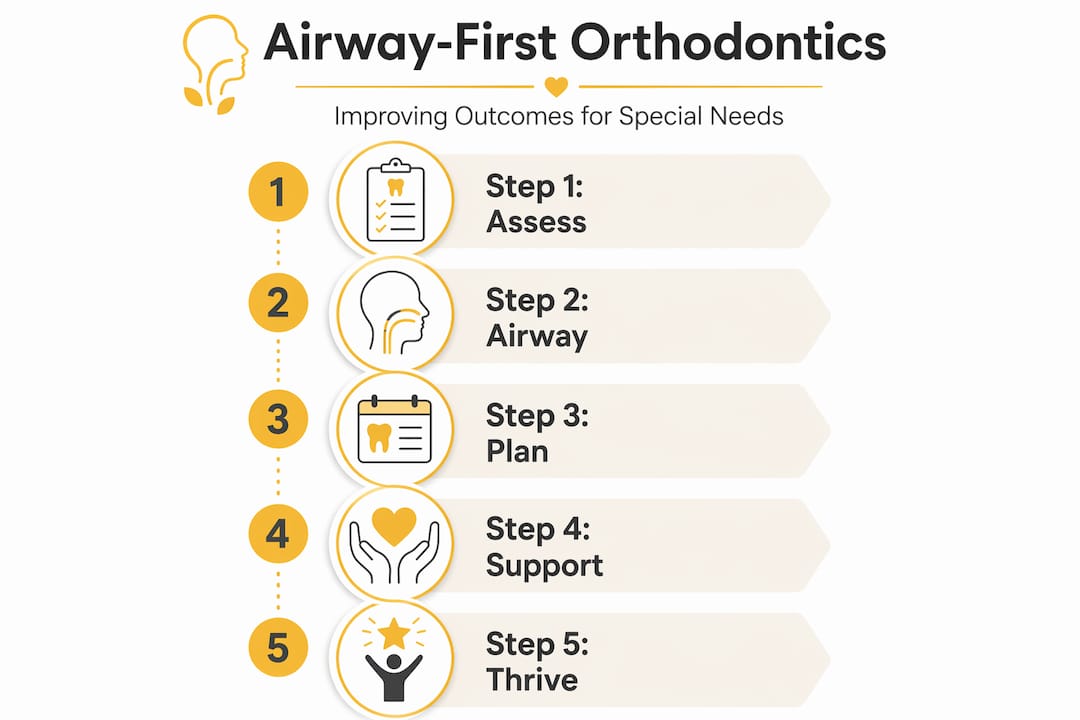
We believe this needs to change. When a child with autism is struggling in school and sleeping poorly, the reflex is to adjust behavioral therapy or medication. Rarely does anyone ask whether that child’s narrow palate is restricting airflow at night and producing the cognitive fog that everyone is labeling as behavior.
The questions families should be asking their orthodontist go well beyond “when will the teeth be straight?” They should include: Does my child have a narrow airway? Is mouth breathing changing their jaw development? Should we be talking to a sleep specialist?
Advocating for this kind of care is not overreaching. It is exactly the right way to use an orthodontic consultation. An orthodontist who sees the whole child, not just the bite, is worth far more to a special needs family than one who produces a technically perfect result while missing the bigger picture entirely.
Get expert orthodontic care tailored for your special needs child in Langley
Navigating orthodontic treatment for a child with unique needs is genuinely complex, and you should not have to figure it out alone.

At Glow Orthodontics in Langley, we work with special needs families every day. Our treatment plans are built around your child’s medical history, behavioral needs, and airway health, not a one-size-fits-all protocol. We conduct airway-focused assessments to catch breathing-related concerns early, coordinate with your child’s wider care team, and pace every visit to what your child can actually manage. Whether you are exploring specialized orthodontic care for the first time or navigating a setback mid-treatment, our team is here to support you with practical guidance and genuine experience. Reach out today to schedule a consultation and get a clear picture of what your child needs.
Frequently asked questions
What makes orthodontic care different for special needs children?
Special needs children often have unique oral habits, muscle tone differences, and behavioral challenges that require customized treatment plans, sensory-aware appointment management, and closer collaboration between providers.
How does airway health relate to orthodontics?
Airway issues like mouth breathing and snoring can influence jaw development and worsen behavioral symptoms; 10 to 15% of children in orthodontic clinics show signs of sleep-disordered breathing, making early screening during orthodontic visits a genuinely valuable step.
Are there special providers in Langley experienced with special needs orthodontics?
Yes, Glow Orthodontics in Langley offers tailored orthodontic care for children with special needs, including airway-focused assessments and individualized treatment planning that accounts for each child’s specific medical and behavioral profile.
When should a special needs child first see an orthodontist?
Most orthodontists recommend an initial evaluation around age 7, but for children with known craniofacial differences or oral habits, earlier is almost always better since intervention during active growth produces the most effective results.
How can parents support their child’s oral hygiene during orthodontic treatment?
Using an electric toothbrush, keeping hygiene routines at consistent times, and asking the orthodontist about adapted tools like water flossers can make a significant difference for children who struggle with traditional brushing and flossing.