Pediatric Orthodontist Near Me: Langley Parents’ Guide
June 10, 2026
Pediatric Orthodontist Near Me: Langley Parents’ Guide
TL;DR:
- Early orthodontic evaluation at age 7 helps identify subtle growth issues and determines if monitor, interceptive, or immediate treatment is needed. Most children leave their first visit without a treatment plan, emphasizing assessment over alarm, with clear explanations of findings and no referral required. Recognizing signs like crowding, crossbite, or thumb sucking beyond age 4 prompts prompt assessment to maximize treatment effectiveness during the crucial growth window.
A pediatric orthodontist is a dental specialist who evaluates and guides tooth and jaw development in children, and the search for an orthodontist pediatric near me is one of the most time-sensitive decisions a Langley parent can make. The American Association of Orthodontists recommends a first orthodontic check-up by age 7, not because braces are imminent, but because this window captures subtle growth issues that are nearly impossible to spot at home. No dental referral is required at most clinics, including family-friendly practices in Langley, BC. The goal is assessment, not alarm.
What does an orthodontist pediatric near me actually do at the first visit?
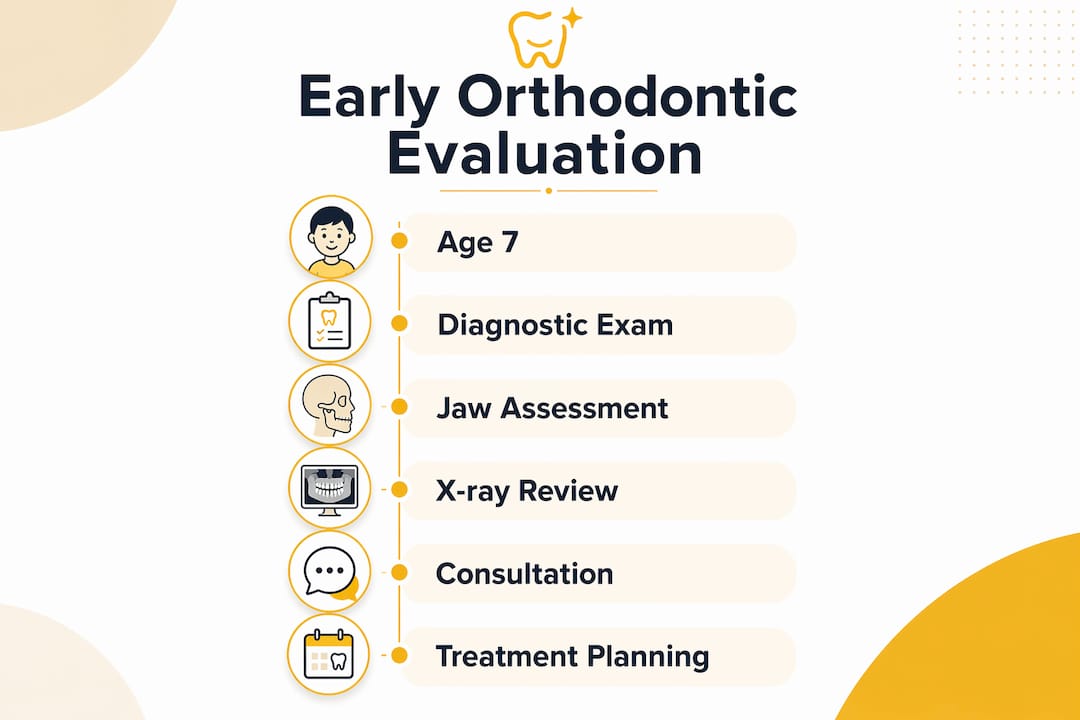
The first appointment is a diagnostic evaluation, not a treatment session. The orthodontist examines your child’s mixed dentition (the phase where baby and permanent teeth coexist), checks jaw alignment, and assesses bite relationships. This age-7 assessment produces one of three outcomes: no treatment needed, periodic monitoring, or early interceptive care.

Most parents are surprised to learn that the majority of children leave that first visit without a treatment plan at all. Most children at their first visit are placed on a follow-and-monitor schedule based on their individual growth patterns. This is reassuring news, not a red flag.
Here is what the typical first visit covers, in order:
- Medical and dental history review. The orthodontist asks about habits like thumb sucking, mouth breathing, and any previous dental work.
- Clinical examination. Teeth count, spacing, and bite alignment are assessed visually and by touch.
- X-rays or photographs. Panoramic X-rays reveal teeth that have not yet erupted and show jaw bone structure.
- Growth assessment. The orthodontist evaluates whether the jaw is growing symmetrically and whether the bite is developing correctly.
- Outcome discussion. You receive a clear recommendation: monitor, begin interceptive care, or return when your child is older.
Pro Tip: Ask the orthodontist to show you the X-ray and explain what they see. Orthodontists who take time to walk parents through the images are demonstrating the kind of transparency that predicts a good long-term relationship.
Many Langley clinics offer complimentary initial consultations, and direct scheduling without a dentist referral is standard practice. You do not need permission to book this appointment.
Signs your child may need to see a children’s orthodontist soon
Certain developmental signals indicate your child should see an orthodontist before the typical age-7 milestone. Early detection of these signs prevents more complicated problems from forming and maximizes the window for effective treatment.
Watch for these specific indicators:
- Crowding: Permanent teeth erupting behind or in front of baby teeth that have not yet fallen out
- Crossbite: Upper teeth sitting inside the lower teeth when your child bites down
- Significant overjet: Upper front teeth protruding far beyond the lower teeth, sometimes called “buck teeth”
- Underbite: Lower jaw jutting forward so lower teeth sit in front of upper teeth
- Thumb sucking or pacifier use past age 4: These habits reshape the palate and push teeth forward
- Mouth breathing: Chronic mouth breathing affects jaw width and facial development
- Asymmetric smile or jaw shift: The jaw visibly shifts to one side when your child opens or closes their mouth
The 7-4 rule is a pediatric dentistry guideline for tracking tooth eruption milestones by age and month count. Deviations from expected eruption timing, such as a permanent tooth arriving significantly late or early, are worth flagging to an orthodontist even if your child’s dentist has not raised concerns.
The Phase 1 treatment window runs roughly from ages 7 to 10. After that, the jaw bones begin to harden and the opportunity to guide skeletal growth narrows considerably. The comparison below clarifies what normal development looks like versus signs that warrant professional evaluation.
| Development sign | Normal | Warrants evaluation |
|---|---|---|
| Tooth spacing | Slight gaps between baby teeth | Severe crowding or overlapping |
| Bite alignment | Upper teeth slightly overlap lower | Crossbite, underbite, or large overjet |
| Jaw symmetry | Even jaw movement when chewing | Jaw shifts or clicks when opening |
| Tooth eruption timing | Within 6 months of average | More than 12 months delayed or early |
| Oral habits | Stopped thumb sucking by age 4 | Persistent sucking past age 5 |
How to choose the best orthodontist for children in Langley, BC
Choosing the right local kids orthodontics provider involves more than proximity. The orthodontist’s experience with pediatric patients, the office environment, and the range of treatment options all shape your child’s comfort and your confidence as a parent.
Key factors to evaluate:
- Pediatric experience and credentials. Look for an orthodontist who regularly treats children aged 6 to 12 and can clearly explain interceptive care options. Board certification through the Canadian Association of Orthodontists signals advanced training.
- Child-friendly office atmosphere. Pediatric-friendly practices prioritize low-stress environments, which directly improves a child’s cooperation and long-term compliance with treatment. A waiting room with age-appropriate distractions and staff trained to work with anxious kids matters more than it might seem.
- No-referral access. Clinics that allow direct booking remove a significant barrier for busy Langley families. You should be able to call or book online without waiting for a dentist’s note.
- Range of treatment options. The best orthodontist for children offers both interceptive Phase 1 appliances and comprehensive adolescent treatment, so your child does not need to switch providers as they grow. Reviewing braces options for kids before your consultation helps you ask sharper questions.
- Clear communication. The orthodontist should explain findings in plain language and give you a written summary of the recommended plan, including what happens if you choose to monitor rather than treat immediately.
Pro Tip: Bring a list of questions to the consultation. The questions to ask your orthodontist before committing to treatment include asking about the specific appliances used for Phase 1 care and what the monitoring schedule looks like if treatment is deferred.
Gloworthodontics serves Langley families with exactly this kind of personalized, growth-based approach, offering consultations designed around your child’s specific developmental stage rather than a one-size-fits-all protocol.
Phase 1 vs. adolescent orthodontics: which does your child need?
Interceptive Phase 1 treatment targets jaw and bite development during mixed dentition, typically between ages 7 and 10, and lasts approximately 9 to 18 months. The appliances used in Phase 1 are not always braces. Palate expanders, space maintainers, partial braces on front teeth, and functional appliances are all common tools. The goal is to correct skeletal problems while the jaw is still growing and responsive to guidance.
Early orthodontic decisions are driven by diagnosis, not age alone. A child with a severe crossbite at age 7 needs Phase 1 intervention. A child with mild crowding and a well-aligned bite at the same age does not. This distinction is what separates a thorough orthodontist from one who recommends treatment too broadly.
The table below compares the two treatment phases directly:
| Feature | Phase 1 (early interceptive) | Adolescent comprehensive treatment |
|---|---|---|
| Typical age range | 7 to 10 years | 11 to 16 years |
| Duration | 9 to 18 months | 18 to 30 months |
| Primary goal | Correct jaw growth and severe bite issues | Align all permanent teeth |
| Common appliances | Expanders, partial braces, space maintainers | Full braces or clear aligners |
| Follow-up needed | Usually requires Phase 2 later | Typically a single treatment course |
| Best candidate | Crossbite, underbite, severe crowding | Mild to moderate crowding, spacing |
One persistent myth is that starting braces early means finishing treatment earlier overall. That is not accurate. Most children who complete Phase 1 still require a Phase 2 course of comprehensive treatment in adolescence. What Phase 1 does accomplish is reducing the complexity and duration of that second phase, and in some cases it prevents the need for tooth extractions or jaw surgery later. For a side-by-side look at treatment formats, the Invisalign vs. braces comparison for kids covers what each option involves at different ages.
It is also worth noting that pediatric dentists can place space maintainers and handle minor interventions, but complex bite or alignment problems require an orthodontist’s evaluation. The two roles are complementary, not interchangeable.
Key takeaways
Early orthodontic evaluation at age 7 is the single most effective step Langley parents can take to protect their child’s long-term dental health, whether or not treatment follows.
| Point | Details |
|---|---|
| Start at age 7 | The AAO recommends a first orthodontic check-up at 7, focused on assessment, not immediate braces. |
| Three possible outcomes | The first visit results in no treatment, monitoring, or early Phase 1 interceptive care. |
| Know the warning signs | Crossbites, underbites, persistent thumb sucking, and crowding all warrant prompt evaluation. |
| Phase 1 reduces complexity | Early interceptive treatment lasting 9 to 18 months can simplify or shorten later adolescent treatment. |
| No referral required | Most Langley clinics, including Gloworthodontics, allow direct booking without a dentist’s referral. |
What I’ve learned watching families wait too long
The most common mistake I see Langley parents make is not the wrong treatment choice. It is the decision to wait until a dentist brings it up. Dentists are skilled at identifying cavities and gum health, but orthodontic growth assessment is a different discipline entirely. A general dentist may not flag a developing crossbite until it has already caused measurable jaw asymmetry.
The no-referral model that many local orthodontic offices now use exists precisely because waiting for a referral costs families months or years of the most responsive growth window. I have seen children who came in at age 9 with a crossbite that would have taken six months to correct at age 7. By 9, the same correction required a more aggressive appliance and a longer timeline.
I also want to push back on the anxiety parents feel about “starting too early.” The orthodontist’s job at that first visit is to tell you honestly whether your child needs anything at all. Most do not. That visit is worth taking because the cost of missing a genuine growth problem far outweighs the inconvenience of a single appointment. Choose a provider who gives you a clear, written outcome from that first visit and does not pressure you toward treatment your child does not need.
— Juiced
Gloworthodontics: pediatric orthodontic care built for Langley families
Gloworthodontics offers no-referral consultations for children in Langley, BC, designed to give parents a clear picture of their child’s orthodontic development without pressure or confusion.

Whether your child needs Phase 1 interceptive care, is ready for comprehensive adolescent treatment, or simply needs a growth monitoring plan, Gloworthodontics tailors every recommendation to your child’s specific jaw and bite development. The team works with children from their first orthodontic visit through to a finished smile, so you never need to start over with a new provider. Explore the orthodontic care guide for teens to understand what comes after Phase 1, and book your child’s first consultation directly at gloworthodontics.ca.
FAQ
At what age should my child first see an orthodontist?
The AAO recommends age 7 for a first orthodontic check-up. This visit focuses on jaw and bite assessment, not on starting braces.
Does my child need a dentist referral to see an orthodontist?
No. Direct scheduling is available at most orthodontic clinics, including those in Langley, BC, and many offer complimentary initial consultations.
What is Phase 1 orthodontic treatment?
Phase 1 is early interceptive orthodontic care for children aged 7 to 10 that targets jaw growth and bite problems. It typically lasts 9 to 18 months and is designed to reduce the complexity of later treatment.
Can a pediatric dentist handle my child’s orthodontic needs?
Pediatric dentists can place space maintainers and manage minor issues, but complex bite or alignment problems require a dedicated orthodontist’s evaluation and treatment plan.
How do I know if my child needs braces now or can wait?
The decision is diagnosis-driven, not age-based. Crossbites, underbites, and significant crowding typically indicate early treatment, while mild spacing issues often allow for monitoring until adolescence.