Post-Braces Dental Care: Your Complete Smile Guide
May 25, 2026
Post-Braces Dental Care: Your Complete Smile Guide
TL;DR:
- Getting your braces off marks a milestone, but ongoing dental care is essential to maintain your results. Consistent retainer use, proper cleaning routines, and regular check-ups prevent relapse, discoloration, and shifting teeth. Long-term commitment to oral hygiene and retainer wear ensures your smile stays straight and healthy for years to come.
Getting your braces off feels like a finish line. It isn’t. Post-braces dental care is where the real work begins, and most patients learn this the hard way when they spot brown marks on their teeth or notice their smile shifting within months of treatment ending. The good news is that with the right tools, habits, and knowledge, protecting everything you worked for is absolutely manageable. This guide covers everything from building a daily oral hygiene routine to preventing relapse, treating discoloration, and knowing when to call your orthodontist.
Table of Contents
- Key takeaways
- Post-braces dental care: the right tools for the job
- Your daily and weekly post-braces hygiene routine
- Handling common post-braces problems
- Long-term maintenance and monitoring your results
- My honest take on why patients struggle with this
- Continue your care with Gloworthodontics
- FAQ
Key takeaways
| Point | Details |
|---|---|
| Retainer wear prevents relapse | Consistent retainer use, especially full-time in year one, drastically reduces the risk of teeth shifting back. |
| Clean retainers the right way | Lukewarm water and mild soap preserve retainer shape; hot water and abrasive toothpaste cause warping and damage. |
| Brown spots need professional care | Enamel staining from braces can require remineralization therapy, microabrasion, or resin infiltration depending on severity. |
| Monitor retainer fit regularly | Any change in fit signals possible tooth movement and warrants a prompt orthodontic check-up. |
| Schedule follow-up appointments | Structured aftercare with defined recall visits by relapse risk level significantly extends your orthodontic results. |
Post-braces dental care: the right tools for the job
You cannot maintain what you have earned without the right equipment. Fortunately, you do not need an elaborate setup. A focused collection of products will cover nearly every aspect of after braces oral hygiene, from cleaning your teeth to caring for your retainer.
| Tool or Product | Purpose | Key Usage Tip |
|---|---|---|
| Soft-bristled toothbrush | Cleans teeth without scratching enamel | Replace every three months or sooner |
| Electric toothbrush | More consistent plaque removal than manual | Use a two-minute timer with pressure sensor |
| Floss threader | Threads floss beneath bonded retainer wire | Use daily around every tooth contact point |
| Water flosser | Flushes debris from around bonded retainers | Set to medium pressure to avoid gum irritation |
| Fluoride toothpaste | Strengthens enamel and prevents cavities | Use twice daily; spit but do not rinse immediately |
| Fluoride mouthwash | Adds extra enamel protection post-brushing | Rinse for 30 seconds after flossing |
| Mild soap or retainer cleaner | Cleans removable retainers safely | Avoid toothpaste; it scratches retainer surface |
| Denture soaking tablets | Deep-cleans retainers weekly | Soak for the time specified on the package |
| Hard-sided retainer case | Protects retainer from damage and loss | Never wrap retainer in a napkin or tissue |
For bonded retainers (the wire glued to the back of your teeth), flossing under the wire is non-negotiable. Traditional brushing cannot reach those contact points, which means plaque builds up silently unless you use a floss threader or water flosser every single day.
Pro Tip: Never leave your removable retainer sitting on a table or wrapped in a napkin. It will end up in the trash. Keep the case on your nightstand and develop the habit of putting the retainer directly from your mouth into the case, with no exceptions.
When choosing a toothbrush, soft-bristled is the rule post-braces. Your gums may still be slightly sensitive after treatment, and medium or firm bristles can aggravate that. Electric toothbrushes with a built-in pressure sensor are especially useful because they prevent you from scrubbing too hard, a surprisingly common habit that wears enamel over time.
Your daily and weekly post-braces hygiene routine
Good intentions without a clear structure rarely hold. Here is a practical routine you can build into your day without overthinking it.
Daily steps:
- Brush for two full minutes after breakfast and before bed using fluoride toothpaste. Angle the brush at 45 degrees toward the gumline and use small circular strokes. Do not saw back and forth.
- Floss once a day. If you have a bonded retainer, thread floss carefully beneath the wire at every contact point using a floss threader. A water flosser for bonded retainers makes this significantly faster.
- Rinse with fluoride mouthwash after flossing to reach areas the brush misses.
- Remove your Hawley or clear retainer before eating anything, including water with flavor or coffee. Rinse it under lukewarm water when you take it out.
- Before reinserting your retainer, rinse or brush it gently with mild soap and a soft toothbrush. Never use regular toothpaste; it scratches the surface and creates grooves where bacteria thrive.
- Store your retainer in its case any time it leaves your mouth.
Weekly steps:
Soak your removable retainer in a denture or retainer cleaning solution once a week. This removes the mineral buildup and bacteria that daily rinsing leaves behind. Follow the product instructions and never use hot water as hot water warps retainer plastic, ruining the fit permanently.

Pro Tip: If your retainer starts to smell even after cleaning, it is usually a sign of bacterial buildup in micro-scratches. Switch to a dedicated retainer cleaner instead of soap, and avoid anything abrasive. A well-maintained retainer should be virtually odorless.
Managing the retainer wear transition
Most orthodontists recommend wearing your retainer full-time for the first several months, then transitioning to nighttime wear. Follow your specific provider’s timeline. The first year after braces is biologically the most sensitive period for tooth movement, and skipping retainer wear, even for a few nights in a row, can allow subtle shifting to begin.
When it comes to diet, avoid deeply pigmented drinks like coffee, red wine, and dark tea during the early post-braces phase, especially if you have existing white spot lesions. These drinks do not cause the spots but they can stain compromised enamel much faster than healthy enamel.
Handling common post-braces problems
Relapse: the biggest risk nobody warns you about
Relapse means your teeth move back toward their original positions after braces come off. It happens because the periodontal ligaments (the tissue anchoring your teeth to bone) have memory and will try to pull teeth back. Studies show that relapse affected 21.3% of patients who did not adhere consistently to retainer wear. Full-time retainer wear reduced relapse odds dramatically compared to no retainer at all.
The solution is consistent retainer use, period. If you notice your retainer feeling tight after a few nights off, that tightness is your teeth telling you they moved. Wear the retainer, but do not force it if it genuinely will not seat. Persistent poor fit is a signal to book an orthodontic appointment before things get worse.
Brown spots and enamel issues
Between 23% and 60% of orthodontic patients develop white spot lesions during treatment. When these spots stain over time, they turn brown and indicate deeper enamel wear. Here is a quick comparison of your treatment options:
| Treatment | Best for | Pros | Cons |
|---|---|---|---|
| Professional cleaning | Surface staining | Low cost, no enamel removal | Limited to superficial discoloration |
| Remineralization therapy | Early white spots | Rebuilds enamel, non-invasive | Takes weeks to show results |
| Microabrasion | Moderate brown spots | Effective, single visit | Removes a thin layer of enamel |
| Resin infiltration | White to light brown spots | Preserves enamel, cosmetically excellent | Higher cost, requires a specialist |
| Whitening treatments | Generalized discoloration | Improves overall appearance | May not match spot color evenly |
Talk to your dentist before choosing any of these. Some discoloration resolves on its own with good hygiene and fluoride use over several months. Jumping to whitening before the enamel stabilizes can make white spots look more pronounced.
Periodontal health after braces
Your gums and bone need attention too. Poor periodontal health increases relapse risk and can lead to tissue damage that no retainer can fix. Watch for bleeding gums, recession, or persistent soreness and report these to your dentist promptly. A professional cleaning every six months is the minimum. If you had any gum issues during treatment, your dentist may recommend quarterly visits initially.
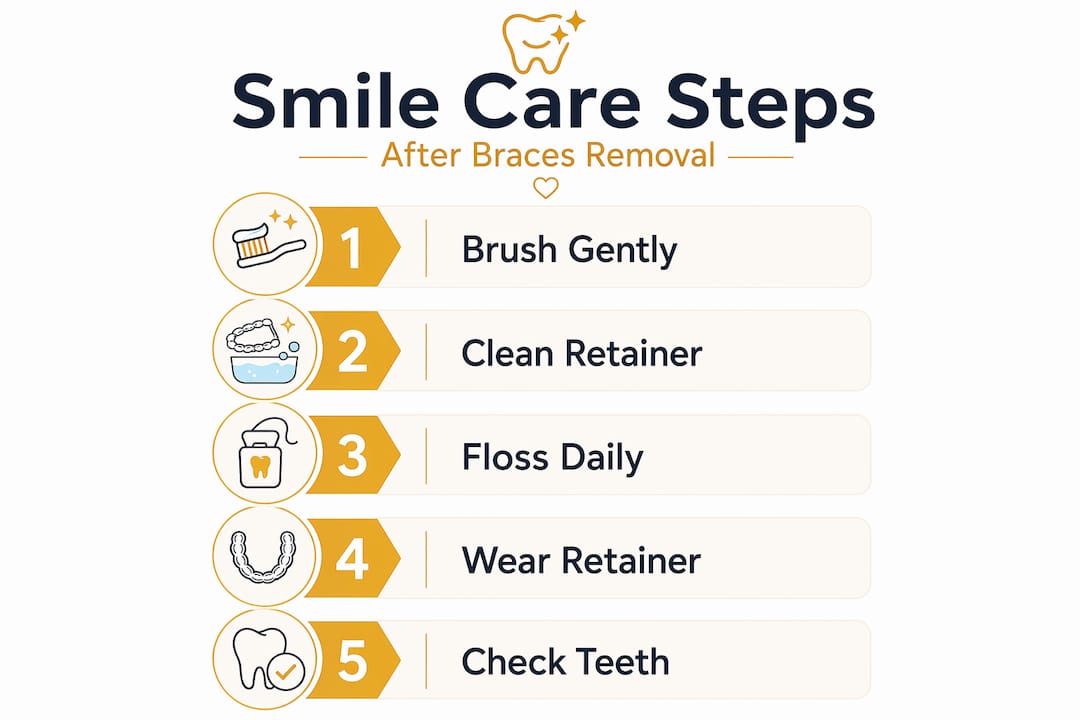
Long-term maintenance and monitoring your results
Finishing orthodontic treatment does not end your relationship with your orthodontist. Structured aftercare programs that stratify patients by relapse risk and set defined recall schedules have been shown to meaningfully extend treatment results and catch problems early.
Here is what good long-term maintenance looks like in practice:
- Check retainer fit monthly. Put it in and note whether it seats fully without force. Any resistance means something shifted.
- Schedule orthodontic check-ups based on your risk level. Lower-risk patients may only need annual visits. Higher-risk patients benefit from check-ups every three to six months, especially in the first two years.
- Plan for retainer replacement. Most retainers last two to five years with proper care. Clear retainers wear faster than Hawley retainers. Budget for replacements and do not wait until a retainer breaks to get a new one scanned.
- Watch for hidden relapse. You may not notice subtle tooth movement until your retainer no longer fits correctly. Forcing an ill-fitting retainer over moved teeth can mask the problem and delay necessary intervention. Retainer fit drift is a recognized clinical issue that requires evaluation, not improvisation.
- Maintain your dental hygiene routine without interruption. Post-orthodontic care is not a short-term project. Your gums, enamel, and bone are in a stabilization phase that takes years, not months.
Pro Tip: Take a photo of your smile every few months under the same lighting. Side-by-side comparisons over a year reveal slow changes you might not catch day-to-day. If you notice differences, bring the photos to your next appointment.
For guidance on wearing retainers at night, including what to expect when transitioning from full-time to nighttime wear, Gloworthodontics has a detailed resource worth bookmarking.
My honest take on why patients struggle with this
I have seen too many people come in for orthodontic assessments two years after finishing treatment, frustrated that their teeth have shifted noticeably. Almost every time, the story is the same. They were diligent for the first few months, then life got busy, the retainer became an afterthought, and by the time they noticed the problem, minor relapse had already set in.
What I have learned is that patients do not fail at post-braces care because they are lazy or uninformed. They fail because nobody ever made the stakes feel real. When your orthodontist says “wear your retainer,” that instruction exists alongside a hundred other things happening in your life. It becomes abstract.
Here is what actually helps: treat retainer wear the same way you treat taking daily medication. Miss one dose and it is not a crisis. Miss a week and you are setting yourself back in ways that are real and measurable. The research on relapse rates without retainer adherence is sobering, and patients who understand the biology tend to take it more seriously.
My other honest observation is that most people underestimate how long they need to wear their retainer. Nighttime wear is often described as a temporary phase. For most people, it is a permanent one. Teeth are alive. They move throughout your entire life in response to chewing forces, bone changes, and aging. A retainer worn at night indefinitely is the single best investment you can make in the smile you worked so hard to achieve.
— Juiced
Continue your care with Gloworthodontics

Getting your braces off is a milestone worth celebrating. What comes next determines how long that smile lasts. At Gloworthodontics, the team supports patients through every phase of their orthodontic experience, including the critical post-treatment period. Whether you want to understand your orthodontic relapse risk or are looking for guidance tailored to younger patients and families, the orthodontic care for teens guide is a great starting point. For personalized aftercare support, you can also review what to expect after braces in the step-by-step recovery guide or book a follow-up consultation directly through the Gloworthodontics website.
FAQ
How long do I need to wear my retainer after braces?
Most orthodontists recommend full-time wear for the first several months, followed by nighttime wear indefinitely. The first year is the highest-risk period for relapse, so consistent wear during this phase matters most.
What is the best way to clean a removable retainer?
Rinse with lukewarm water after removing it, brush gently with mild soap and a soft toothbrush, and soak weekly in denture solution. Avoid hot water, bleach, and abrasive toothpaste, which all damage the retainer’s shape and surface.
Why do brown spots appear on teeth after braces?
Brown spots typically develop from white spot lesions that stained over time due to enamel weakening during treatment. Treatment options range from remineralization therapy for mild cases to microabrasion or resin infiltration for more noticeable discoloration.
How do I know if my teeth are shifting after braces?
The clearest early sign is your retainer feeling tight or not seating properly after a short period of not wearing it. If the retainer does not fit comfortably, schedule an orthodontic evaluation rather than forcing it onto your teeth.
How often should I see my orthodontist after braces?
Frequency depends on your individual relapse risk. Lower-risk patients often do well with annual check-ups, while higher-risk patients benefit from visits every three to six months during the first two years. Structured aftercare with defined recall schedules is the standard recommended approach.