The Role of Elastics in Braces: What You Need to Know
May 30, 2026
The Role of Elastics in Braces: What You Need to Know
TL;DR:
- Elastics in braces create targeted forces needed to correct bite issues that braces alone cannot achieve. They must be worn consistently, replaced daily, and stored properly to maintain their effectiveness. Proper use and understanding of elastics significantly influence orthodontic treatment progress and success.
Most people assume braces do all the work on their own. That’s one of the most common misconceptions in orthodontics. The role of elastics in braces, known clinically as orthodontic intermaxillary appliances or simply “rubber bands,” goes far beyond holding things together. Elastics apply targeted forces that braces and wires physically cannot generate on their own, specifically to correct how your upper and lower jaws relate to each other. If you or your child has been handed a small bag of rubber bands and a confusing diagram, this guide explains exactly what those elastics do, why they matter, and how to use them correctly.
Table of Contents
- Key Takeaways
- The role of elastics in braces and the types used
- How elastics move teeth and adjust jaw alignment
- Wearing and caring for your elastics correctly
- What patients and parents ask most about elastics
- What I’ve seen patients get wrong, and right, about elastics
- Personalized elastic guidance from Gloworthodontics
- FAQ
Key Takeaways
| Point | Details |
|---|---|
| Elastics do what braces cannot | Rubber bands apply jaw-level forces to correct bite issues like overbite, underbite, and crossbite. |
| Type determines function | Class II, Class III, box, and triangle elastics each target a specific bite problem with a different force direction. |
| Wear time drives results | Wearing elastics 20 to 22 hours per day and replacing them frequently is what moves treatment forward. |
| Force decays fast | Elastics lose roughly 40% of their force within 24 hours, making daily replacement non-negotiable. |
| Storage affects performance | Keeping elastics away from light and heat preserves their mechanical strength and prevents early breakage. |
The role of elastics in braces and the types used
Orthodontic elastics, commonly called rubber bands, are small loops of stretchy material placed between hooks on your braces brackets and bands. They are not decorative. They are functional. And their job is specific: to create forces that shift how your jaws align, not just how individual teeth sit.
There are two broad categories. Intra-arch elastics stay within a single jaw, often used to close spaces or manage tooth rotation. Intermaxillary elastics connect the upper and lower jaws and are the ones most patients associate with rubber bands. According to a 2026 narrative review, elastics are fundamental force auxiliaries delivering versatile mechanical action for sagittal, vertical, and midline control.
Within the intermaxillary category, there are several configurations your orthodontist may prescribe.
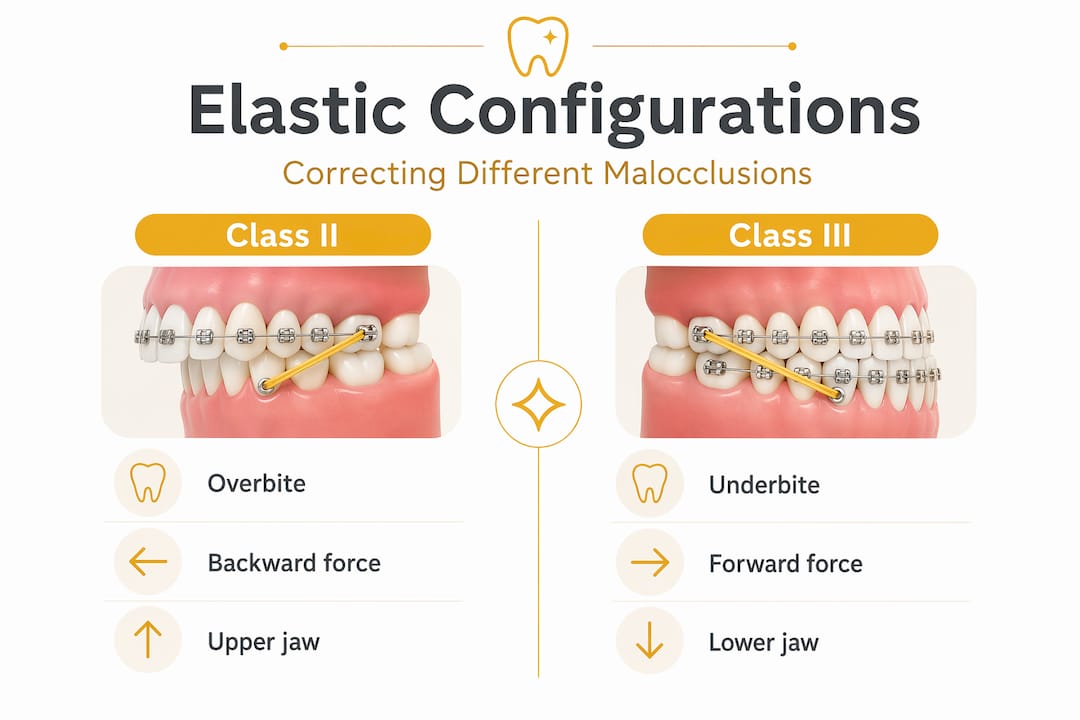
- Class II elastics run from the upper canine to the lower molar. They pull the lower jaw forward and are used to correct overbites, where the upper teeth sit too far ahead of the lower.
- Class III elastics do the reverse: upper molar to lower canine. These push the upper jaw forward relative to the lower and treat underbites.
- Vertical elastics connect upper and lower brackets on the same side to close open bites or improve how teeth meet when you chew.
- Box elastics form a small square pattern across four brackets to address both vertical and horizontal discrepancies simultaneously.
- Cross elastics run diagonally across the midline and are used for transverse correction, typically to fix a crossbite where one jaw sits too far to one side.
| Elastic type | Target issue | Force direction |
|---|---|---|
| Class II | Overbite | Backward on upper, forward on lower |
| Class III | Underbite | Forward on upper, backward on lower |
| Vertical | Open bite | Closing force between arches |
| Box | Combined vertical/horizontal | Multi-directional |
| Cross | Crossbite | Lateral/transverse correction |
The configuration your orthodontist chooses corresponds directly to your malocclusion type. Wearing the wrong configuration, or switching patterns without guidance, can actively work against your treatment.
How elastics move teeth and adjust jaw alignment
Here is the part that surprises most people. Braces and wires are excellent at aligning teeth within a single arch. They can straighten, rotate, and level individual teeth with precision. What they cannot reliably do is generate the forces needed to shift how the upper and lower jaws relate to each other. That requires a different force vector, and that is exactly what elastics deliver.
When you hook an elastic between your upper canine and your lower molar, that band creates a constant pulling force along a diagonal line. Your orthodontist has calculated exactly where that force vector needs to point based on your specific bite. That calculation determines which hooks the elastic attaches to. Correct hook placement by your orthodontist is what defines both the direction and magnitude of movement. Move the hook one bracket over, and the entire vector changes.

Force decay is one of the most clinically significant factors in elastic treatment. Elastics stretch when worn, and that stretch relaxes over time. Research shows elastics retain only about 60% of their force after 24 hours of continuous wear. That means roughly 40% of the force you started with is gone by the next morning, even if the elastic looks intact. This is why your orthodontist tells you to replace them daily or even after every meal.
The material matters too. Latex elastics generally deliver higher initial forces, but latex may cause hypersensitivity in some patients. Non-latex alternatives exist and have comparable function, though they tend to lose force faster than latex over the same period. If you or your child has a known latex allergy, tell your orthodontist before treatment begins.
Pro Tip: Wearing a single elastic all day and replacing it at night is not the same as replacing it every 8 hours. If your orthodontist recommends frequent changes, they mean it. More fresh elastics across the day adds up to significantly more effective force over the full course of treatment.
Wearing and caring for your elastics correctly
Consistency is everything with elastics. The clinical evidence is clear: full-time wear of 20 to 22 hours per day combined with frequent replacement gives the most predictable correction. Skipping even a few hours each day repeatedly can set your treatment back by weeks.
Here is how to wear and maintain them correctly:
- Wash your hands before placing elastics. Bacteria transfer is real, and your fingers go near brackets and hooks with every change.
- Remove elastics before eating. Chewing puts enormous and unpredictable forces on elastics, which can snap them or pull them into unintended positions.
- Replace them after every meal and brushing session. Fresh elastics after you clean your teeth keeps the force consistent throughout the day. Replacing fresh pairs per day maximizes effective force over total wear time.
- Store your elastics in a cool, dark place. Light and heat accelerate degradation. Studies confirm that exposure to light reduces force and increases rupture risk. The original packaging inside a drawer or small pouch is ideal.
- Keep extras in your bag, locker, or backpack. Running out of elastics mid-day means unplanned hours without force. Your orthodontist should give you plenty. Ask for more if you run low.
- Never double up elastics to compensate for missed wear. Two elastics create twice the force, which can damage roots and gum tissue.
Pro Tip: Carry your elastics in a small resealable bag away from windows or sunlight. A few hours in a hot car or on a sunny windowsill can meaningfully degrade their mechanical integrity before you even put them in your mouth.
Common mistakes include putting elastics in only at night (which provides only partial correction), stretching them too far during placement (which causes immediate force loss), and storing them loose in a pocket or purse where they pick up lint, heat, and light exposure.
What patients and parents ask most about elastics
Knowing the mechanics is one thing. Knowing what to expect in real life is another. Here are the questions that come up most often.
Are elastics always required at the end of treatment? Not necessarily. Some patients use elastics early in treatment to manage bite issues before wires begin detailed alignment work. Others use them throughout. The timing depends on the severity and type of malocclusion being treated, which you can learn more about in this overview of correcting bite and jaw problems.
How long do patients typically wear elastics? There is no universal timeline. Mild bite corrections may require a few months of elastic wear. More significant jaw discrepancies can require elastics for most of the active treatment period, which may span one to two years or more.
Does wearing elastics hurt? Mild soreness when elastics are first placed or changed is normal. It usually eases within a day or two as the tissues adapt. Mild discomfort is a normal adaptive response that tends to lessen with consistent wear. Stopping elastics to avoid soreness actually makes the next time you wear them more uncomfortable, not less.
Can you be allergic to orthodontic elastics? Yes. Latex allergies can cause irritation, swelling, or a rash. If you notice these signs, contact your orthodontist. Non-latex elastics are widely available and offer comparable performance for sensitive patients.
What happens if an elastic snaps? A broken elastic is not an emergency. Replace it with a fresh one from your supply. If breakage is happening frequently, it may indicate the elastic gauge is too strong or that the attachment hooks are not positioned correctly. Contact your orthodontist to evaluate.
What I’ve seen patients get wrong, and right, about elastics
In my experience following orthodontic treatment stories and working closely with orthodontic practice communication, the single biggest predictor of whether elastics work is not the type, the force level, or the material. It’s whether the patient actually wears them as prescribed, every day, without making excuses.
I’ve seen patients hit the six-month mark with almost no measurable bite correction, not because the treatment plan was wrong, but because they were wearing elastics only at night or taking them out for social events and forgetting to put them back in. Treatment plans are designed around a moving average of consistent force. When you remove elastics for hours at a time, you reset some of that accumulated work.
What genuinely surprises people is how much the storage step matters. Most patients toss their elastics in a drawer, a makeup bag, or leave them on a nightstand near a lamp. That sounds minor. But photo-oxidative degradation from light exposure is real, and it happens faster than you think. Keeping elastics in their packaging inside a dark drawer costs you nothing and preserves their strength.
My honest take: the discomfort parents and teens fear most is usually manageable within 48 hours of starting elastics. The harder part is the consistency. It takes about two weeks to build the habit of replacing them after every meal. Once that routine clicks, most patients stop noticing the elastics are there at all.
— Gloworthodontics
Personalized elastic guidance from Gloworthodontics
If you have questions about your child’s elastic prescription or you are an adult trying to understand what your orthodontist prescribed, you are not alone. Getting clear answers makes a real difference in how well you follow through with wear, and how fast your treatment progresses.

At Gloworthodontics, the team works with families across the Langley area to make sure every patient understands exactly how their treatment works, including the specific configuration and schedule for their elastics. Their teen orthodontic care guide walks families through every stage of braces treatment, from wire changes to elastic use and beyond. If you are navigating a situation where an elastic snapped or caused irritation, the orthodontic emergencies resource covers what to do and when to call the office. And for families weighing braces against Invisalign, the Invisalign treatment guide explains how elastics integrate with clear aligner therapy as well. Book a consultation at Gloworthodontics to get a personalized treatment plan that leaves nothing to guesswork.
FAQ
What is the main role of elastics in braces treatment?
Elastics create directional forces between the upper and lower jaws to correct bite issues like overbite, underbite, and crossbite that braces and wires alone cannot fix. They are a fundamental part of achieving proper jaw alignment.
How often should orthodontic elastics be replaced?
Most orthodontists recommend replacing elastics at least once daily, and ideally after every meal and brushing session, because elastics lose roughly 40% of their force within 24 hours of wear.
Do elastics hurt to wear?
Mild soreness when you first start wearing elastics is normal and typically fades within one to two days. Consistent wear actually reduces recurring discomfort compared to taking them out and restarting frequently.
Can I use any rubber band as a substitute for orthodontic elastics?
No. Orthodontic elastics are manufactured to precise gauges and force levels calibrated for safe tooth and jaw movement. Regular rubber bands are not biocompatible and can cause serious harm to teeth and gum tissue.
Do clear aligners like Invisalign also use elastics?
Yes. Many Invisalign treatment plans incorporate elastics attached to small tooth-colored buttons bonded to the teeth, serving the same bite-correcting function they perform with traditional braces.