V Clear Aligners: Cost, Benefits, and How They Work
June 12, 2026
V Clear Aligners: Cost, Benefits, and How They Work
TL;DR:
- V clear aligners are custom, nearly invisible trays prescribed and monitored by a licensed orthodontist, ensuring safety and effectiveness. They are suitable for mild to moderate cases and include bite correction, offering a comfortable, affordable, and removable alternative to traditional braces. Professional supervision and patient compliance are essential for optimal results, as unsupervised options carry significant risks and limitations.
V clear aligners are custom-fabricated, nearly invisible orthodontic trays that straighten teeth under direct orthodontist supervision, combining the aesthetics of removable aligners with the clinical precision of in-person care. Unlike at-home aligner kits that operate without professional oversight, V clear aligners are prescribed, monitored, and adjusted by a licensed orthodontist throughout treatment. This distinction matters more than most patients realize. The difference between supervised and unsupervised aligner treatment affects not just how straight your teeth look, but how your bite functions for decades. If you are weighing invisible braces options for yourself or your family, understanding what separates professional-grade aligners from budget mail-order kits is the most important research you can do.
How do V clear aligners compare with other aligners and braces?
V clear aligners sit in a specific position in the orthodontic market: more affordable than Invisalign in many cases, more clinically rigorous than at-home aligner services, and more comfortable than traditional metal braces. Understanding where they land on each dimension helps you make a decision grounded in facts rather than marketing.
Clinical supervision and safety
In-office treatment models like V clear aligners require orthodontist visits every 6 to 8 weeks for monitoring and can use attachments for precise tooth movements. Attachments are small composite bumps bonded to specific teeth that guide complex movements like rotation or gap closure. Remote aligner services cannot apply attachments, which limits the types of cases they can treat safely. The 2024 shutdown of SmileDirectClub illustrated exactly what happens when patients rely on a remote-only provider: thousands of active patients were left mid-treatment with no clinical support and no path forward.
Comparison with Invisalign and traditional braces
| Feature | V Clear Aligners | Invisalign | Traditional Braces |
|---|---|---|---|
| Professional supervision | Yes, in-person | Yes, in-person | Yes, in-person |
| Attachments available | Yes | Yes | N/A |
| Removable | Yes | Yes | No |
| Visibility | Nearly invisible | Nearly invisible | Visible |
| Cost range | Affordable to mid-range | Mid to high range | Mid-range |
| Treats complex cases | Mild to moderate | Mild to severe | Mild to severe |
| Insurance compatibility | Often compatible | Often compatible | Often compatible |
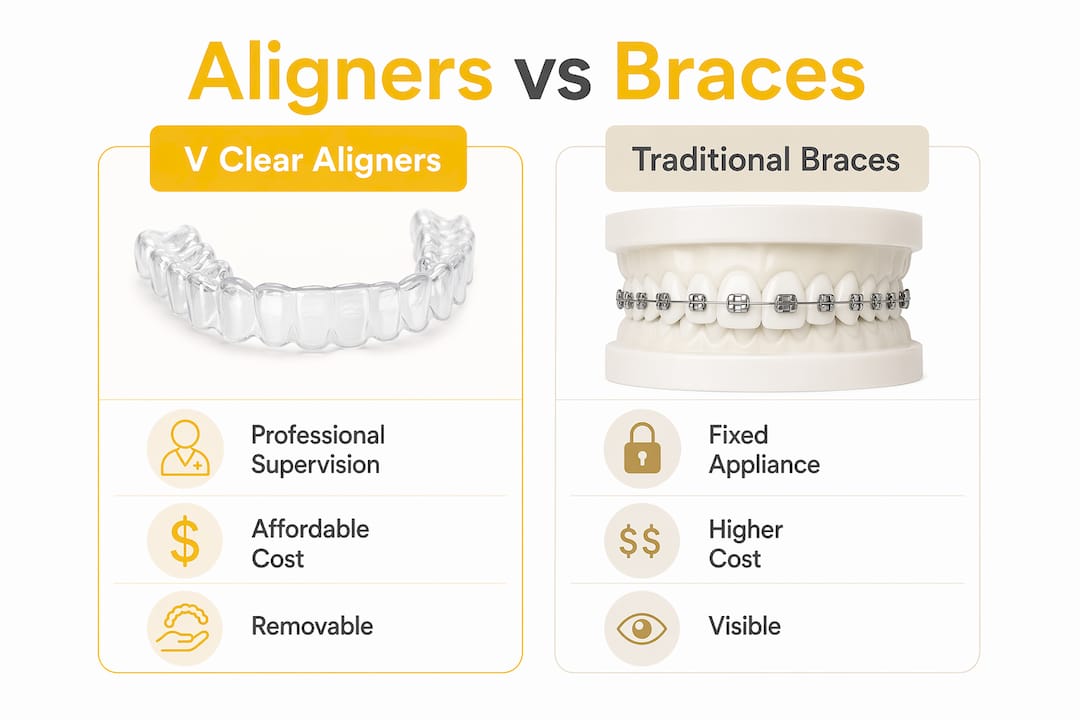
Invisalign, produced by Align Technology, is the most widely recognized clear aligner brand and handles the broadest range of case complexity. V clear aligners are best positioned for mild to moderate cases where patients want professional oversight without the premium Invisalign price. Traditional braces remain the gold standard for severe crowding, significant bite correction, or cases requiring maximum force. For a detailed breakdown of how these options compare on cost and clinical outcomes, the aligners vs braces comparison at Gloworthodontics covers the key differences clearly.
Pro Tip: Ask your orthodontist specifically whether your case requires attachments. If it does, any remote or mail-order aligner service is automatically ruled out as a safe option.
Cost and insurance
Private orthodontic clinics offering in-house aligner systems provide expert supervision and affordable pricing close to remote provider costs by eliminating lab middleman fees. This means you can access clinically supervised treatment at a price point that was previously only available through unsupervised services. Most dental insurance plans that cover orthodontics apply the same benefit to clear aligners as to braces, so your coverage does not change based on which system you choose.
What are the benefits and limitations of V clear aligners?
The case for V clear aligners rests on three pillars: professional safety, physical comfort, and genuine affordability. Each one holds up under scrutiny, but there are real limitations worth knowing before you commit.
Key benefits
- Bite correction included. At-home aligners treat aesthetic alignment but neglect functional bite correction, which can lead to jaw pain and dental complications over time. V clear aligners, prescribed and monitored by an orthodontist, address both visual alignment and bite function together.
- Comfort over braces. Clear aligner trays apply gradual, distributed pressure across the tooth surface rather than the point pressure of metal brackets and wires. Most patients report significantly less soreness, especially after tray changes.
- Affordable through in-house fabrication. Clinics that manufacture aligners in-house or through tightly controlled lab partnerships cut out the middleman markup, passing savings directly to patients without sacrificing clinical quality.
- Removable for eating and hygiene. You remove the trays to eat, brush, and floss, which makes maintaining oral hygiene far simpler than with fixed braces.
Limitations to consider honestly
V clear aligners are not the right tool for every case. Severe crowding, significant skeletal discrepancies, or cases requiring tooth extraction and major repositioning typically need traditional braces or a more complex Invisalign protocol. Patient compliance is also non-negotiable. Wearing aligners 20 to 22 hours daily is the clinical minimum to keep treatment on track. Patients who consistently fall short of that threshold risk poor tray fit, extended timelines, and the need for additional aligner sets.
Hidden costs like refinement aligners can exceed initial savings with budget options that lack unlimited adjustments, which negates the upfront affordability. Before signing any treatment agreement, ask explicitly whether refinements are included in the quoted price or billed separately. A plan that looks affordable at $2,500 can climb past $4,000 if two rounds of refinements are charged at $500 or more each.
Pro Tip: Request a written breakdown of what is and is not included in your aligner fee before treatment starts. Refinements, retainers, and whitening trays are the three most common add-ons that surprise patients at the end of treatment.
Who is a good candidate for V clear aligners?
V clear aligners work best for adults and teens with mild to moderate orthodontic issues. Crowding, spacing, minor overbites, and slight crossbites are all within the treatment scope. Children whose permanent teeth have not fully erupted are generally not candidates yet, though early evaluation is always worthwhile.
Here is what the treatment process looks like from start to finish:
- Initial consultation. Your orthodontist evaluates your teeth, bite, and jaw structure. Digital X-rays and photographs establish a baseline. This visit determines whether V clear aligners are appropriate for your specific case.
- Digital scanning. A 3D intraoral scanner captures a precise digital model of your teeth. This replaces traditional impressions and produces a more accurate fit. The scan feeds directly into the aligner fabrication process.
- Treatment simulation. Your orthodontist shows you a digital preview of how your teeth will move through each stage of treatment. You review the projected outcome before any aligners are made.
- Aligner fitting. Your first set of trays is fitted in the office. The orthodontist checks the fit, places any necessary attachments, and walks you through wear and care instructions.
- Progress check-ins. You return every 6 to 8 weeks for monitoring. Some clinics use DentalMonitoring technology, an AI-powered remote tracking system that cuts physical visit frequency by over 50% while preserving full clinical oversight. This is a meaningful convenience for busy families.
- Refinements if needed. If teeth do not move exactly as planned, refinement aligners are fabricated to complete the treatment. This is normal and expected in a portion of cases.
- Retention phase. Once active treatment ends, you wear retainers to hold your results. Skipping this phase is the single most common reason teeth shift back after treatment.
Teens are strong candidates when they demonstrate the maturity to wear aligners consistently. Gloworthodontics offers orthodontic care guidance for teens that covers compliance strategies and what parents should monitor throughout treatment.
How to choose the right clear aligner system for your family
Choosing between V clear aligners, Invisalign, traditional braces, or any other system comes down to four factors: case complexity, budget, lifestyle, and the level of clinical oversight available.
- Assess case complexity first. No aligner system, regardless of price or brand, can safely treat a case that requires its clinical capabilities. Get an in-person orthodontic evaluation before making any financial decision.
- Balance cost with total value. The lowest upfront price is rarely the lowest total cost. Factor in refinements, retainers, and the potential cost of correcting problems caused by inadequate treatment.
- Prioritize professional oversight. Attachments are vital for complex movements like tooth rotation or gap closure, and they require in-office clinical application. If your case needs them, remote aligner services are not a viable option.
- Ask about financing. Most orthodontic clinics offer monthly payment plans that make professionally supervised treatment accessible without a large upfront payment. Insurance benefits often apply, reducing your out-of-pocket cost further.
- Avoid unsupervised options. The risks of remote-only aligner treatment extend beyond aesthetics. Bite misalignment left uncorrected causes jaw pain, uneven wear, and in some cases, temporomandibular joint issues that are expensive to treat later.
Pro Tip: Bring a list of questions to your consultation: Does my case need attachments? Are refinements included? What happens if my teeth do not move as planned? A confident orthodontist will answer all of these without hesitation.
For a side-by-side look at how professional clear aligners stack up against traditional braces on cost and outcomes, the Invisalign vs braces comparison at Gloworthodontics is a useful starting point.
Key takeaways
V clear aligners deliver the best outcomes when professional supervision, patient compliance, and realistic case selection all align from the start.
| Point | Details |
|---|---|
| Professional supervision is non-negotiable | In-office monitoring enables attachments, bite correction, and timely adjustments that remote services cannot provide. |
| Compliance drives results | Wearing aligners 20 to 22 hours daily is the clinical minimum; falling short extends treatment and risks poor fit. |
| Total cost matters more than sticker price | Refinements and retainers can add significantly to budget plans; confirm what is included before committing. |
| Case complexity determines candidacy | V clear aligners treat mild to moderate cases well; severe issues require braces or a more advanced protocol. |
| Remote-only aligners carry real risks | The SmileDirectClub closure in 2024 left patients mid-treatment with no clinical recourse, a risk supervised care eliminates. |
Why I believe professional supervision is the non-negotiable factor in aligner treatment
Patients come to me having already researched aligners online, and the question I hear most often is some version of: “Can I just do this at home and save money?” My honest answer is that the savings are real in some cases, but so are the risks, and most patients cannot accurately assess which category their case falls into without a clinical evaluation.
What I have seen repeatedly is that bite correction gets overlooked in the rush to straighten teeth visually. A patient whose teeth look straight but whose bite is off will experience wear, sensitivity, and sometimes jaw pain within a few years. Supervised treatment addresses both. The ability to place attachments, monitor progress in person, and course-correct when teeth do not move as planned is what separates a good outcome from a frustrating one.
Technologies like DentalMonitoring have genuinely changed the equation on visit frequency. You do not need to be in the office every month for supervised care to be effective. But you do need a licensed professional reviewing your progress, interpreting the data, and making clinical decisions. That is the line that matters, and it is the line that at-home aligner services cross in the wrong direction.
V clear aligners, when offered through a qualified orthodontic practice, represent what I consider the right balance: accessible pricing, genuine clinical oversight, and a treatment process that respects both your budget and your long-term dental health.
— Juiced
Start your V clear aligner journey with Gloworthodontics

Gloworthodontics offers in-person consultations, personalized treatment planning, and flexible financing options designed to make professionally supervised clear aligner treatment accessible for individuals and families in the Langley, British Columbia area. The team uses digital scanning, progress monitoring, and customized aligner protocols to match each patient’s specific orthodontic needs. Insurance benefits are reviewed at your first visit so you understand your actual out-of-pocket cost before treatment begins. To understand exactly what the treatment process looks like from your first scan to your final retainer, the step-by-step aligner guide at Gloworthodontics walks you through every stage. Book a consultation and find out whether V clear aligners are the right fit for your smile goals.
FAQ
What are V clear aligners?
V clear aligners are custom-made, removable orthodontic trays prescribed and monitored by a licensed orthodontist to straighten teeth and correct mild to moderate bite issues. They combine the aesthetics of invisible braces with the clinical safety of in-person professional care.
How much do V clear aligners cost?
V clear aligner cost varies by case complexity and clinic, but in-house fabrication models allow some practices to offer supervised treatment at prices competitive with remote aligner services. Always confirm whether refinements and retainers are included in the quoted fee.

How do V clear aligners work differently from at-home aligners?
V clear aligners are fitted, monitored, and adjusted by an orthodontist in person, which allows for attachments and bite correction that remote services cannot provide. At-home aligners treat visual alignment only and carry no clinical oversight if problems arise.
Are V clear aligners a good option for teens?
Yes, teens with mild to moderate crowding or spacing are strong candidates, provided they can commit to wearing aligners 20 to 22 hours daily. Gloworthodontics provides compliance support and parent guidance throughout teen aligner treatment.
What happens if my teeth do not move as planned?
Your orthodontist fabricates refinement aligners to complete the movement. This is a normal part of supervised treatment. Confirm before starting whether refinements are included in your plan or billed separately, as costs can add up in plans that do not cover them.