What Are the Best Invisible Braces for Adults in 2025
June 4, 2026
What Are the Best Invisible Braces for Adults in 2025
TL;DR:
- Invisible braces come in two main types: clear aligners like Invisalign and lingual braces fixed behind your teeth for maximum discretion. While aligners offer removability and convenience for mild cases, lingual braces provide superior invisibility and control for complex orthodontic needs, especially when compliance is uncertain. The best choice depends on case complexity, lifestyle, budget, and the importance of adherence to wear schedules.
Invisible braces are orthodontic appliances designed to straighten teeth without the visual impact of metal brackets and wires. The best invisible braces for adults fall into two main categories: clear aligners such as Invisalign, ClearCorrect, and Spark, and lingual braces fixed behind teeth, fully hidden from the front. Adults increasingly choose these options because they combine clinical effectiveness with the kind of discretion that metal braces simply cannot offer. Your best choice depends on case complexity, lifestyle, budget, and how strictly you can follow a wear schedule.
1. What are the best invisible braces options available?
The leading invisible braces include clear aligners and lingual braces, each solving the visibility problem through a different mechanism. Clear aligners are removable transparent trays molded to your teeth. Lingual braces are fixed metal brackets bonded to the back surfaces of your teeth. Both are genuinely invisible in social settings, but they differ sharply in comfort, cost, and the types of cases they handle well.
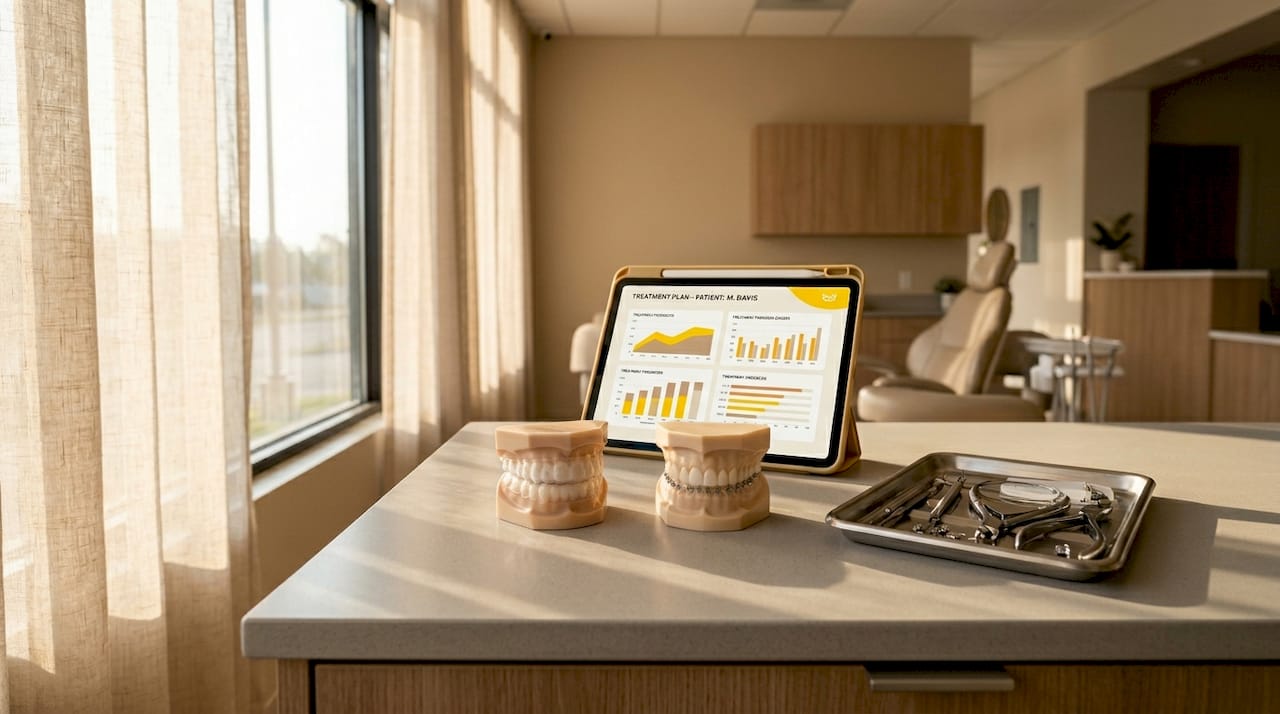
Clear aligners dominate the market because they combine aesthetics with convenience. You remove them to eat, brush, and floss, which means your diet stays unrestricted and your oral hygiene routine stays intact. Lingual braces offer the highest level of invisibility because they are fixed and require no compliance from the patient, but they come with a steeper learning curve for speech and cleaning.
Pro Tip: Ask your orthodontist to show you a digital simulation of your treatment outcome before committing to any system. Both Invisalign and lingual brace providers offer 3D planning tools that let you preview results.
2. How clear aligners work and why adults prefer them
Clear aligners are removable transparent trays worn 20 to 22 hours daily, replaced every one to two weeks as teeth shift progressively. That wear requirement is not optional. Missing hours consistently adds weeks or months to your treatment. The trays apply controlled, incremental pressure to specific teeth based on a digital treatment plan your orthodontist designs before you receive your first tray.
Adult treatment typically runs 12 to 18 months for mild to moderate cases, though complex bite corrections can extend that timeline. Patients wearing clear aligners report fewer oral hygiene issues compared to fixed braces because removability makes brushing and flossing straightforward. That benefit is especially meaningful for adults over 40, where gum health is already a priority.
The main limitation of clear aligners is compliance. If you travel frequently, work long hours, or tend to forget to reinsert trays after meals, your results will suffer. For patients who need fixed appliances due to severe crowding or complex bite issues, Invisalign versus traditional braces is a genuine clinical decision, not just a cosmetic preference.
- Worn 20 to 22 hours per day for effective results
- Replaced every 1 to 2 weeks throughout treatment
- Treatment duration: 12 to 18 months for most adult cases
- Removable for eating, drinking, brushing, and flossing
- Less effective for severe rotations or large vertical movements without attachments
3. How lingual braces differ and who should choose them
Lingual braces attach to the back surfaces of your teeth, making them completely invisible from the front. They are fixed appliances, meaning they work continuously without any compliance requirement from you. That distinction matters enormously for patients who know they will not consistently wear removable trays for 22 hours a day.
The tradeoffs are real. Lingual braces are more expensive than most clear aligner systems, harder to clean because of their position, and can affect speech during the first few weeks of adjustment. The tongue contacts the brackets constantly, which causes temporary lisping for most patients. That typically resolves within two to four weeks as the tongue adapts.
Lingual braces are the strongest choice for complex cases requiring precise control over tooth movement, particularly where fixed anchorage is needed. They handle severe crowding, significant rotations, and bite corrections that clear aligners struggle with. If you need the invisibility of an aligner but the clinical power of fixed braces, lingual braces are the answer.
Pro Tip: If lingual braces affect your speech and you have a client-facing job, schedule placement on a Thursday or Friday. You get the weekend to adapt before returning to work.
- Fully hidden from the front view
- Fixed appliance: no compliance required
- Higher cost than most aligner systems
- Initial speech adjustment period of 2 to 4 weeks
- Best for complex cases needing fixed appliance control
4. Top invisible braces brands and what sets them apart
Choosing between brands requires understanding what each system actually delivers, not just what its marketing promises.
| Brand | Care model | Best for | Price range |
|---|---|---|---|
| Invisalign | Doctor supervised | Mild to complex cases | $3,000 to $8,000 |
| ClearCorrect | Doctor supervised | Mild to moderate cases | $2,500 to $6,000 |
| Spark | Doctor supervised | Mild to moderate cases | $3,000 to $7,000 |
| Byte | At-home with remote check-ins | Mild cases only | $1,895 to $2,245 |
| AlignerCo | At-home, minimal supervision | Mild spacing and crowding | $1,145 to $1,395 |
| Candid | Hybrid: remote and in-person | Mild to moderate cases | $2,400 to $3,300 |
Invisalign is the most clinically validated system on the market. It uses SmartTrack material and a proprietary attachment system that gives orthodontists precise control over tooth movement. Invisalign is recommended for mild to moderate malocclusions and handles a wider range of cases than most competitors. The premium price reflects the depth of clinical support and the sophistication of the digital planning tools.
ClearCorrect is a strong professional alternative to Invisalign, offered through dentists and orthodontists at a slightly lower price point. Spark aligners use Reveal material, which manufacturers claim stays clearer longer than competing plastics. Both are solid choices when supervised by a qualified orthodontist.
Byte and AlignerCo serve the direct-to-consumer segment. Byte includes a HyperByte vibration device that the company claims accelerates tooth movement. AlignerCo is the most budget-friendly option available. Both systems are limited to mild cases and carry the risk that comes with reduced clinical oversight. The difference between supervised and direct-to-consumer aligners is not just about price. It is about who catches problems before they become expensive to fix.
Candid occupies a middle ground with a hybrid model that combines remote monitoring with periodic in-person check-ins, offering more oversight than fully at-home systems.
5. Comparing invisible braces by key treatment factors
Not every factor matters equally to every patient. Here is how the main options stack up across the criteria adults care about most.
| Factor | Clear aligners | Lingual braces | Ceramic braces |
|---|---|---|---|
| Visibility | Very low | Lowest | Low to moderate |
| Comfort | High | Moderate | Moderate |
| Oral hygiene | Easy | Difficult | Moderate |
| Case complexity | Mild to moderate | Mild to severe | Mild to severe |
| Cost | $1,145 to $8,000 | $5,000 to $13,000 | $2,000 to $7,000 |
| Compliance required | High | None | None |
Cost is the most variable factor across all systems. Insurance coverage for clear aligners has improved significantly, with many plans now covering a portion of Invisalign treatment. Checking ClearCorrect aligner costs alongside Invisalign pricing before your consultation gives you a realistic budget range.
Oral hygiene maintenance is where clear aligners win decisively. You remove the trays, brush normally, and reinsert. Lingual braces require specialized flossing tools and more time at the sink. For adults who already manage gum sensitivity or have had periodontal treatment, that difference is clinically significant.
Treatment complexity is where fixed appliances, whether lingual or ceramic, hold the advantage. Attachment design on clear aligners improves control and precision of tooth movement, but there are movements that aligners alone cannot reliably achieve. Composite attachments bonded to teeth during aligner treatment help, but they have limits.
6. Which invisible braces are best for different patient scenarios?
The right system depends on your specific orthodontic situation, not on which brand has the most advertising.
-
Mild to moderate crowding with social confidence as a priority. Invisalign or ClearCorrect supervised by an orthodontist. You get proven results, aesthetic discretion, and the flexibility to remove trays for important events.
-
Complex bite problems including significant overbite, underbite, or severe rotations. Lingual braces or traditional braces. Clear aligners can address some complex cases when TADs complement aligner treatment for stable anchorage, but fixed appliances remain the most predictable choice for severe malocclusions.
-
Budget-conscious patients with mild spacing or crowding. AlignerCo or Byte for mild cases only. Understand the tradeoff: reduced supervision means you bear more responsibility for catching problems early.
-
Patients with compliance concerns. Lingual braces. If you know you will remove trays and forget to reinsert them, a fixed appliance removes that variable entirely.
-
Athletes and frequent travelers. Removable clear aligners. You can remove trays during contact sports, store them safely during travel, and maintain your routine without clinic visits every few weeks.
-
Adults over 40 prioritizing gum health. Clear aligners. The removability advantage for oral hygiene is most meaningful for patients managing existing gum sensitivity or periodontal history.
Every scenario above assumes a consultation with a certified orthodontist who takes digital scans and reviews your full bite. No brand comparison replaces that step.
Key takeaways
The best invisible braces for adults are Invisalign and lingual braces, chosen based on case complexity, compliance ability, and budget.
| Point | Details |
|---|---|
| Clear aligners lead for most adults | Invisalign and ClearCorrect offer proven results for mild to moderate cases with strong aesthetics. |
| Lingual braces win on invisibility | Fixed behind teeth, they require zero compliance and handle complex cases better than aligners alone. |
| Compliance determines aligner success | Wearing trays 20 to 22 hours daily is non-negotiable for achieving planned tooth movements on schedule. |
| Attachments affect aligner performance | Composite attachments and TADs significantly improve what clear aligners can achieve in complex cases. |
| Budget shapes realistic options | Doctor-supervised systems cost more but reduce the risk of undetected problems during treatment. |
Why “best” is the wrong question to start with
Most people searching for the best invisible braces are really asking: “Which one will work for me?” Those are different questions, and conflating them leads to expensive mistakes. I have seen patients arrive at consultations having already purchased at-home aligner kits, only to discover their bite complexity required fixed appliances from the start. The money spent was not recoverable.
The clinical reality is that attachment geometry and digital planning determine whether any aligner system delivers on its promise. Two patients wearing the same Invisalign brand can have dramatically different outcomes depending on how their orthodontist designed the attachment protocol. Brand recognition does not equal treatment quality. Orthodontist skill and planning rigor do.
Lingual braces deserve more credit than they typically receive in consumer articles. Yes, they cost more. Yes, the first two weeks are uncomfortable. But for patients who genuinely cannot maintain 22-hour wear discipline, or whose cases involve significant vertical or rotational movements, lingual braces deliver results that no aligner system can match reliably. The discomfort is temporary. A poorly executed aligner case can require retreatment that costs more than lingual braces would have in the first place.
My honest recommendation: see an orthodontist who offers multiple systems, not just one. A provider who only offers Invisalign will recommend Invisalign. A provider who offers Invisalign, ClearCorrect, lingual braces, and traditional braces will recommend what your case actually needs.
— Juiced
Start your invisible braces journey at Glow Orthodontics

Gloworthodontics offers Invisalign treatment guided by experienced orthodontists serving the Langley, British Columbia area. From your first digital scan to your final retainer, every step is planned with your specific bite and lifestyle in mind. Gloworthodontics provides flexible payment options and personalized care plans so that cost does not stand between you and a confident smile. Explore the full Invisalign treatment process to understand exactly what to expect from consultation through completion. Book a consultation today and find out which invisible braces system is the right fit for your teeth.
FAQ
What are the most invisible braces available?
Lingual braces are the most invisible option because they attach behind your teeth and are completely hidden from the front. Clear aligners like Invisalign are nearly invisible and the more popular choice for adults due to their comfort and removability.
How long does Invisalign treatment take for adults?
Adult Invisalign treatment typically takes 12 to 18 months for mild to moderate cases. Complex cases can extend beyond 18 months depending on the severity of the bite issue and patient compliance with wear time.
Are at-home clear aligners as effective as Invisalign?
At-home aligners like Byte and AlignerCo are limited to mild cases and carry higher risk due to reduced clinical oversight. Doctor-supervised systems like Invisalign offer more precise treatment planning and the ability to catch and correct problems during treatment.
Do clear aligners work for complex bite problems?
Clear aligners can address some complex cases, particularly when TADs provide anchorage support alongside the aligner system. For the most severe malocclusions, fixed appliances such as lingual braces or traditional braces remain the more predictable choice.
How do I choose between clear aligners and lingual braces?
Choose clear aligners if your case is mild to moderate and you can commit to 22 hours of daily wear. Choose lingual braces if your case is complex, you have compliance concerns, or you want the highest possible level of invisibility without relying on self-discipline.