What is an orthodontist? Your guide to braces & Invisalign
May 6, 2026
What is an orthodontist? Your guide to braces & Invisalign
TL;DR:
- Orthodontists undergo extensive specialized training to diagnose and treat misaligned teeth and jaws using appliances like braces and aligners. They differ from general dentists in focus, expertise, and advanced treatment options, especially for complex cases and early interventions. Early evaluations from age 7 and choosing board-certified specialists ensure better outcomes for children and adults seeking orthodontic care.
Most Langley families book a dentist appointment for cavities and cleanings without a second thought. But when teeth are crowded, jaws don’t line up, or a child’s bite seems off, many parents aren’t sure where to turn. An orthodontist specializes in diagnosing, preventing, and treating misaligned teeth and jaws using appliances like braces and clear aligners. That distinction matters far more than most people realize, and this guide walks you through exactly what orthodontists do, how they differ from dentists, which treatments work best, and when to schedule that first visit for your child or yourself.
Table of Contents
- What does an orthodontist do?
- Orthodontist vs. dentist: Key differences for your family
- Popular treatments: Braces and Invisalign explained
- When should your child or teen see an orthodontist?
- Orthodontic care for adults: What you need to know
- The real difference: Why expert-led orthodontics matters in Langley
- Explore the best orthodontic solutions in Langley
- Frequently asked questions
Key Takeaways
| Point | Details |
|---|---|
| Specialized care matters | Orthodontists get years of extra training to deliver the safest, longest-lasting smile results. |
| See an orthodontist early | Children should get checked by age 7 to prevent future dental issues and costly fixes. |
| Understand your options | Both braces and Invisalign have pros and cons—choose what fits your needs and compliance. |
| Adults benefit too | Modern cosmetic braces and aligners now make straightening teeth possible at any age. |
| Choose local expertise | Langley has board-certified orthodontists offering flexible, family-friendly care for all ages. |
What does an orthodontist do?
Let’s be honest: most people assume an orthodontist is just a dentist who puts on braces. That’s a little like saying a cardiologist is just a doctor who checks blood pressure. The reality is much more involved.
Orthodontists go through four years of dental school, just like general dentists. Then they complete an additional 2 to 3 years of residency, clocking over 4,800 hours of focused orthodontic training. That extra time is spent entirely on understanding how teeth move, how jaws develop, and how to plan treatment that lasts for decades, not just a few years.
Here’s what an orthodontist actually handles day to day:
- Diagnosing bite problems, spacing issues, and jaw misalignment through X-rays, digital scans, and clinical exams
- Building personalized treatment plans using braces, clear aligners, retainers, expanders, or other appliances
- Monitoring your progress through every stage of treatment and adjusting as needed
- Catching developmental problems in children before they turn into complex adult cases
“Orthodontists train exclusively in tooth movement and facial development. A general dentist may offer some orthodontic services, but for complex bites or growing children, a specialist changes the outcome entirely.”
Only around 6% of all dentists go on to become orthodontists. That’s a small group for a reason: the training is intensive, the field is specialized, and the results they achieve require a depth of knowledge that takes years to build. When you look at kids orthodontists in Langley, you’ll notice that board-certified specialists consistently deliver better long-term outcomes for younger patients whose jaws are still forming.
Pro Tip: When searching for an orthodontist, look for board certification from the Canadian Association of Orthodontists or the American Association of Orthodontists. This credential means they’ve passed rigorous exams beyond their basic qualifications.
Orthodontist vs. dentist: Key differences for your family
Understanding the role of an orthodontist leads naturally to the next common question: how do they differ from your regular dentist?
Your family dentist is fantastic for cleanings, fillings, gum health, and general oral wellness. But orthodontic cases, especially moderate to complex ones, need a different level of expertise. Here’s a clear side-by-side look:
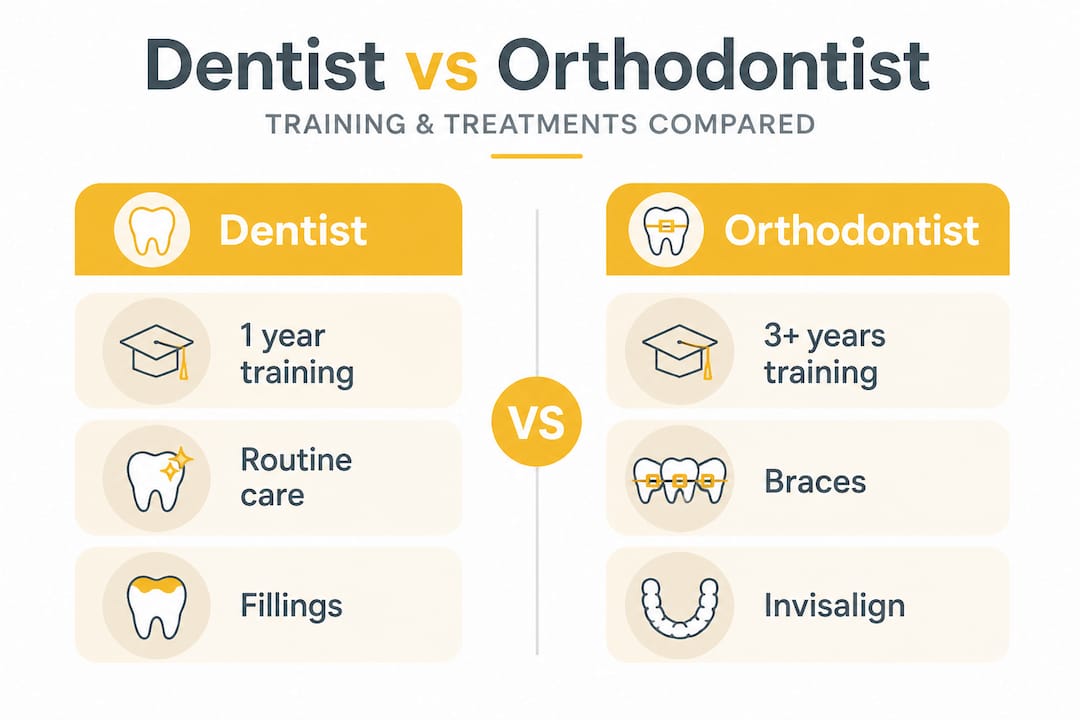
| Feature | General dentist | Orthodontist |
|---|---|---|
| Training after dental school | 0 to 1 years (optional) | 2 to 3 years mandatory residency |
| Focus area | Overall oral health | Tooth and jaw alignment |
| Treats cavities/gum disease | Yes | No |
| Provides braces/aligners | Basic cases only | Full range, including complex |
| Treats bite problems/TMJ | Limited | Yes, specialized |
| Board certification in orthodontics | Rare | Standard |
Only about 6% of dentists specialize as orthodontists, and general dentists who offer Invisalign typically handle mild cases. For anything involving bite correction, crossbites, severe crowding, or jaw growth issues in children, a board-certified orthodontist is the right choice.
Here’s a simple numbered list to help you decide who to see:
- Routine cleaning or cavity: Your general dentist handles this perfectly.
- Mild spacing issues with one or two teeth: Your dentist may offer basic aligner options.
- Crowding, crossbite, overbite, underbite: Book with an orthodontist.
- Child showing early signs of jaw shifting: See an orthodontist immediately, regardless of age.
- Adult seeking braces or Invisalign for a complex case: Orthodontist, not general dentist.
For families exploring child-friendly orthodontists in Langley, finding a specialist who works regularly with children makes the experience far less stressful for kids and parents alike. And if you’re still weighing your treatment choices, a detailed look at braces or Invisalign can help you sort out which path fits your situation.
Pro Tip: If your regular dentist recommends orthodontic treatment, ask for a referral to a board-certified orthodontist for a second opinion. It’s a simple step that can save you from a longer, more expensive correction later.
Popular treatments: Braces and Invisalign explained
Knowing which specialist to see is step one. Next up are the most popular treatments: braces and Invisalign.
How braces work
Traditional braces work by applying gentle, continuous pressure through brackets bonded to teeth, connected by archwires and secured with ligatures and elastics. That sustained pressure triggers a biological process called bone remodeling, where the bone around the tooth root slowly reshapes to allow movement. It’s not painful in the way people expect, though soreness after adjustments is common for a day or two.
Metal braces are the most effective option for complex cases, including severe crowding, large overbites, underbites, and significant jaw discrepancies. Ceramic braces work the same way but use tooth-colored brackets for a more discreet look.
How Invisalign works

Invisalign uses a custom series of clear, removable aligners worn 20 to 22 hours per day. Each set of aligners moves teeth slightly further along the planned path, with patients switching to a new set every one to two weeks. Because they’re removable, eating and brushing stay easy. However, they’re less effective for complex rotations and tooth expansions where braces have a clear mechanical advantage.
Here’s a quick comparison to keep things clear:
| Factor | Traditional braces | Invisalign |
|---|---|---|
| Best for | Moderate to complex cases | Mild to moderate cases |
| Visibility | More visible | Nearly invisible |
| Treatment time | 18 to 30 months | 12 to 24 months |
| Compliance required | Fixed to teeth | 20 to 22 hours daily |
| Relapse risk | Lower | Higher without retainer |
| Success rate | High across all cases | 88 to 90% for mild/moderate |
Pros of braces:
- Work around the clock with no compliance needed
- Handle severe rotations and bite corrections better
- Often more cost-effective for complex cases
Cons of braces:
- More visible, especially metal brackets
- Food restrictions during treatment
- Slightly more difficult to clean around
Pros of Invisalign:
- Nearly invisible in daily life
- Removable for meals and special events
- Comfortable, smooth plastic with no wires
Cons of Invisalign:
- Requires discipline to wear full hours daily
- Less effective for complex tooth movements
- Higher relapse rate if retainer wear is inconsistent
For families with teenagers, reviewing teen orthodontic options can help you weigh lifestyle factors alongside clinical effectiveness. For a deeper comparison on materials and mechanics, the braces or Invisalign comparison guide breaks down every major factor in plain language.
Pro Tip: The biggest predictor of Invisalign success is not the severity of the case. It’s compliance. Patients who consistently wear their aligners for the full 20 to 22 hours daily get results that rival braces. Wearing them only 16 hours a day can stretch treatment by months or cause teeth to backtrack.
When should your child or teen see an orthodontist?
After understanding treatment options, parents naturally wonder when their child should first see an orthodontist. The answer surprises many families: much earlier than you’d think.
The American Association of Orthodontists recommends a first orthodontic evaluation by age 7. That’s while most kids still have a mix of baby and adult teeth. At that age, an orthodontist can spot early warning signs of crossbites, crowding, and jaw growth problems that are far easier to correct while bones are still developing.
Here are the three key milestones every Langley parent should know:
- Age 7: First evaluation. The jaw and bite are developed enough to detect problems, but young enough that early treatment can guide growth rather than fight it.
- Ages 7 to 10: Interceptive treatment. If a crossbite or significant crowding is found, appliances like palatal expanders can shape jaw development before permanent teeth are fully in. Crossbites affect 5 to 8% of children and can cause jaw shifting and long-term TMJ risks if left untreated. Palatal expanders have a 90% functional success rate when used during this window, and early treatment approaches 100% effectiveness for guiding proper jaw growth.
- Teen years: Full braces or aligners. Once most permanent teeth are in, typically between ages 11 and 14, comprehensive treatment begins for straightening and bite correction.
“Early orthodontic checks are not about rushing treatment. They’re about making sure your child’s jaw grows in a way that makes later treatment simpler, shorter, and less expensive.”
Skipping that age-7 evaluation often means waiting until a problem is fully formed before addressing it. That can mean surgery or longer treatment later when a simple expander at age 8 would have resolved the issue completely. Families looking for best kids’ braces in Langley will find that early intervention programs are widely available and often covered partly through dental benefits.
Pro Tip: Even if your child’s teeth look reasonably straight, schedule that age-7 evaluation anyway. Many bite and jaw problems are not visible to parents, and catching a crossbite or jaw shift early is one of the highest-value investments in your child’s long-term dental health.
Orthodontic care for adults: What you need to know
Children aren’t the only ones needing orthodontic care. Adult treatment has grown dramatically in Langley, and for good reason.
One in three orthodontic patients today is an adult seeking cosmetic improvement or functional correction. Ceramic braces and Invisalign have made treatment far more discreet, removing the social hesitation many adults felt in the past. The demand for adult orthodontics continues to rise as more people recognize that straight teeth aren’t just about appearance. They’re easier to clean, reduce gum disease risk, and improve bite function.
Here are the most common reasons adults in Langley seek orthodontic care:
- Confidence and appearance: Straight teeth have a measurable effect on self-image and social interactions.
- Oral health: Crowded teeth trap plaque and are harder to brush and floss effectively, raising cavity and gum disease risk.
- TMJ and jaw pain: Misaligned bites create uneven pressure on the jaw joint, causing chronic pain, clicking, or headaches.
- Relapse from childhood treatment: Adults who lost or stopped wearing retainers often find their teeth have shifted back.
Adult treatment comes with unique challenges. Bone density is higher in adults, meaning teeth move more slowly than in teenagers. Severe skeletal problems, like significant crossbites or jaw discrepancies, may require temporary anchorage devices (TADs) or orthognathic surgery rather than aligners alone.
“Adult patients often get beautiful results, but they need to plan for slightly longer timelines and commit to retainer wear for life. Teeth want to move back. Retainers are what keep them where they belong.”
If you’re an adult considering treatment, exploring adult teeth straightening options in detail will help you set realistic expectations. For those interested in a complete smile refresh, reviewing smile makeover options gives a broader picture of what’s possible when you combine orthodontic and cosmetic dental care.
The real difference: Why expert-led orthodontics matters in Langley
Here’s something most families in Langley don’t hear often enough: not all orthodontic care is created equal, and the provider you choose matters as much as the treatment itself.
We’ve seen parents delay that first evaluation because “their teeth look fine,” only to find out at age 14 that a crossbite has been shifting their child’s jaw for years, creating a problem that now needs surgery instead of a simple expander. That’s a real, preventable situation. Seeking an AAO specialist early, getting that check at age 7, and staying consistent with follow-up care saves families significant time, money, and stress.
For adults, the risk is different but just as real. The rise in general dentists offering Invisalign has created situations where patients with complex bites start aligner therapy and plateau midway through, then need to transfer to an orthodontist to finish what should have been handled by a specialist from the beginning. That overlap costs more and takes longer.
The orthodontists who consistently get the best results in Langley are those who take full treatment records from the start, including digital scans, panoramic X-rays, and cephalometric analysis. They build a complete picture before recommending anything. That thoroughness is what board certification is designed to protect.
For families, connecting with child-friendly orthodontists who specialize in both early intervention and comprehensive teen treatment means continuity of care across your child’s entire development. That ongoing relationship matters more than people realize.
If you’re ever uncertain about a treatment recommendation, get a second opinion from an AAO-certified orthodontist. It’s not rude. It’s smart. And most orthodontists welcome it.
Explore the best orthodontic solutions in Langley
Ready to take the next step for your child, your teen, or yourself? You don’t have to sort through all of this alone.

Glow Orthodontics in Langley is built around exactly the kind of personalized, family-centered care this guide describes. Whether you’re looking for early evaluation for a 7-year-old or discreet adult Invisalign, the team brings board-certified expertise to every consultation. Before booking, explore the family guide to orthodontic care to understand what teen treatment looks like, or compare clear braces vs Invisalign to arrive at your consultation with the right questions ready. When you’re set to move forward, Glow Orthodontics in Langley makes booking a consultation simple and stress-free.
Frequently asked questions
How do I know my child needs to see an orthodontist?
Schedule an evaluation by age 7 if you notice crowding, jaw shifting, or bite issues. Even without visible problems, that first check is worth doing since many issues aren’t obvious to parents.
Is Invisalign as effective as braces for teens and adults?
Invisalign works very well for mild to moderate cases, but complex rotations and expansions are handled better by braces. Your orthodontist will recommend the right option based on your specific clinical needs.
What are common orthodontic problems in Langley children?
Crossbites, crowding, and bite misalignment are the most frequent issues. Early intervention during jaw development approaches 100% effectiveness, making early evaluation one of the best things you can do for your child’s long-term oral health.
How long does orthodontic treatment usually take?
Mild cases typically wrap up in 6 to 12 months, moderate cases take 12 to 24 months, and complex cases can run 24 to 30 months or more depending on the treatment approach and patient compliance.
Will insurance cover braces or Invisalign for my family in Langley?
Many dental insurance plans offer partial coverage for orthodontic treatment, particularly for children. Check your plan details directly or ask the team at your Langley orthodontist’s office about financing options and what your benefits cover.
Recommended
- Invisalign Effectiveness in Langley | Glow Orthodontics
- Can I Eat with My Invisalign In? Clear Steps for Success – RG API
- Braces vs. Invisalign: Langley Options | Glow Orthodontics
- Braces or Invisalign? Your Langley Orthodontic Options
- Invisalign : quels sont les avantages de cette technique ? – Centre dentaire Taschereau