What Is Orthodontia? A Complete Patient Guide
July 2, 2026
What Is Orthodontia? A Complete Patient Guide
TL;DR:
- Orthodontia corrects misaligned teeth and jaws through structured treatment, with retention being essential for lasting results.
- Most patients undergo treatment lasting 12 to 24 months at costs ranging from $3,000 to $8,000, depending on case complexity.
Orthodontia is the dental specialty focused on diagnosing, preventing, and correcting misaligned teeth and jaws. The industry term is orthodontics, and both words refer to the same field. Orthodontia addresses conditions like malocclusion, overbites, and crowding that affect how you chew, speak, and feel about your smile. The American Association of Orthodontists (AAO) recognizes this as a distinct specialty requiring years of training beyond dental school. Whether you are a parent researching options for your child or an adult weighing treatment for yourself, understanding what orthodontia covers is the first step toward making a confident decision.
What is orthodontia and what dental issues does it treat?
Orthodontia treats malocclusion and its types, which include overbite, underbite, crossbite, and open bite. Each type describes a different way the upper and lower teeth fail to meet correctly. These are not just cosmetic problems. Misaligned teeth create real functional consequences that affect daily life.
Common issues orthodontic treatment addresses include:
- Overbite: The upper front teeth overlap too far over the lower teeth, which can wear down enamel and strain the jaw.
- Underbite: The lower jaw protrudes forward, making chewing difficult and sometimes affecting speech clarity.
- Crossbite: Some upper teeth sit inside the lower teeth when biting, which can cause uneven jaw growth in children.
- Open bite: The upper and lower front teeth do not touch when the mouth is closed, often linked to tongue posture or thumb habits.
- Crowding: Teeth overlap because there is not enough space in the jaw, making cleaning harder and increasing cavity risk.
- Spacing: Gaps between teeth that affect appearance and can allow neighboring teeth to drift.
Untreated malocclusion contributes to uneven tooth wear, difficulty chewing, temporomandibular joint (TMJ) problems, and in some cases, speech impairment. Orthodontic care prioritizes both functionality and aesthetics, reducing long-term oral health risks at the same time. Correcting alignment is not vanity. It is preventive medicine for your mouth.
What are the main orthodontic treatment options?
Orthodontic treatment works by applying gentle, consistent pressure to teeth over time, gradually moving them into the correct position. The type of appliance determines how that pressure is delivered. Each option has trade-offs in visibility, comfort, and maintenance.
The primary treatment categories are:
- Metal braces: Brackets bonded to the front of each tooth, connected by an archwire. These are the most common and typically the most affordable option.
- Ceramic braces: Same mechanics as metal braces, but the brackets are tooth-colored, making them less visible.
- Lingual braces: Brackets placed on the back surface of the teeth, completely hidden from view. These require more specialized fitting and adjustment.
- Clear aligners (such as Invisalign): A series of removable, transparent trays that shift teeth incrementally. Popular with adults and teens who want a discreet option.
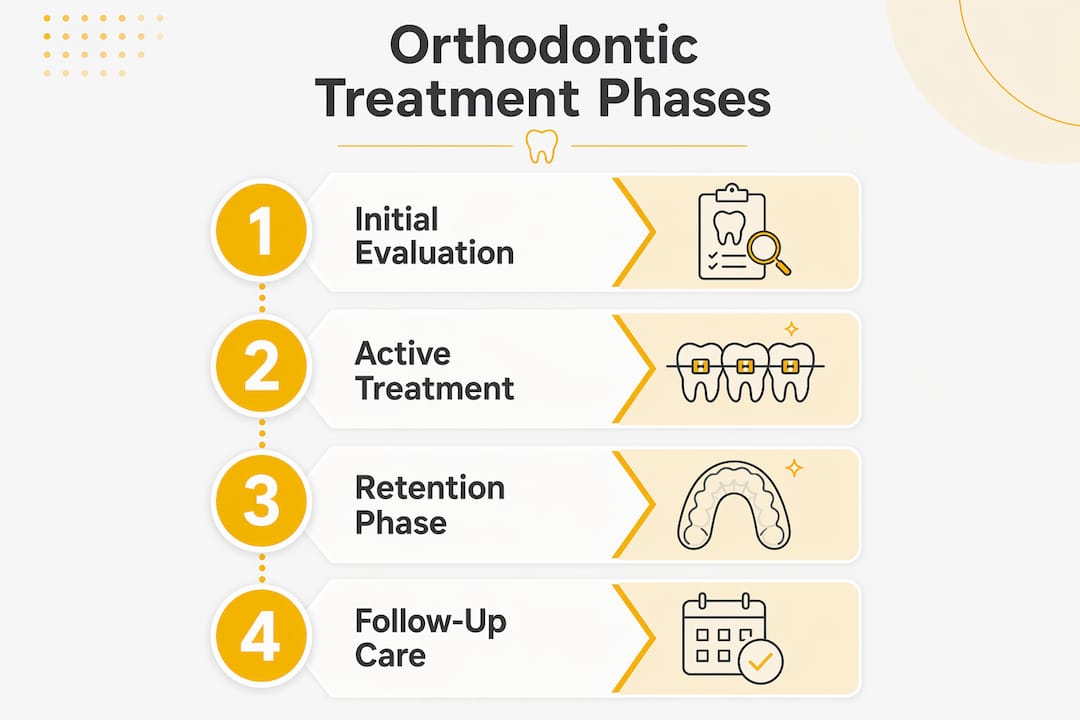
Treatment unfolds in two phases. The active phase involves wearing the appliance and attending regular appointments. Fixed braces require adjustments roughly every 4–10 weeks during this phase. Each visit allows the orthodontist to increase pressure and monitor progress. The retention phase follows active treatment and involves wearing a retainer to hold teeth in their new positions.
Standard treatment lasts 12–24 months, with costs typically ranging from $3,000 to $8,000 depending on complexity, appliance type, and location. More complex cases involving jaw correction or significant crowding sit at the higher end of that range.
About 50% of orthodontic cases require tooth extraction, most commonly premolars, to create enough space for proper alignment. That number surprises many patients. Extraction is not a sign that something went wrong. It is a planned step in cases where the jaw simply does not have enough room.
Pro Tip: Ask your orthodontist at the consultation whether your case is likely to need extractions. Knowing early helps you plan for timing and recovery.
| Appliance type | Visibility | Removable | Typical use case |
|---|---|---|---|
| Metal braces | High | No | Complex alignment, all ages |
| Ceramic braces | Low | No | Teens and adults wanting discretion |
| Lingual braces | None | No | Adults with strict aesthetic needs |
| Clear aligners | Minimal | Yes | Mild to moderate cases, adults and teens |
Who should get orthodontic treatment and when?
The AAO recommends a first orthodontic evaluation no later than age 7. That timing surprises most parents because children still have many baby teeth at that age. The reason is that an orthodontist can spot developing jaw problems and bite issues while the bones are still growing, making correction easier and sometimes shorter.
Early evaluation does not always mean early treatment. Many children are monitored for years before active treatment begins. The goal is to catch issues that benefit from intervention during a growth window, such as a narrow palate or a severe crossbite.
Adults are a growing part of the orthodontic patient population. Approximately 30% of orthodontic patients are adults seeking correction for aesthetic or functional reasons. That shift reflects both changing attitudes toward adult treatment and advances in discreet appliance options. Adults can achieve the same results as younger patients, though treatment may take slightly longer because the jaw bones are no longer growing.
Key differences between treating children and adults:
- Children benefit from jaw growth, which can be guided with certain appliances.
- Adults have denser bone, so tooth movement can be slower.
- Adults are often more consistent with compliance, particularly with removable aligners.
- Adults may have existing dental work, such as crowns or implants, that requires additional planning.
Orthodontists complete 2–3 years of specialty residency training focused on tooth movement and jaw alignment after dental school. That training is what separates them from general dentists who may offer limited orthodontic services. For complex cases, seeing a board-certified orthodontist is the right call. You can review treatment options for teens and kids to understand how age-specific approaches differ.
Pro Tip: If your child is approaching age 7, schedule a screening even if nothing looks obviously wrong. Problems visible on an X-ray are often invisible to the naked eye.
What should you expect during and after orthodontic treatment?
The active treatment phase requires regular commitment. Patients with fixed appliances return to their orthodontist every 4–10 weeks for wire adjustments and progress checks. Each adjustment may cause mild soreness for 1–3 days as teeth respond to new pressure. Modern orthodontics uses lighter, more constant pressure appliances, which minimizes discomfort compared to older techniques. The idea that braces are painful for months at a time is outdated.
Here is what the full treatment timeline typically looks like:
- Initial consultation: X-rays, photographs, and impressions or digital scans are taken. Proper diagnosis using X-rays and impressions is the foundation of an effective treatment plan.
- Appliance placement: Brackets are bonded or aligners are delivered. Your orthodontist explains care instructions.
- Active adjustment phase: Regular appointments every 4–10 weeks. Teeth move gradually toward their target positions.
- Debonding or final aligner: Brackets are removed or the last tray is completed. A final set of records is taken.
- Retention phase: Retainers are fitted and worn as directed. This phase has no fixed end date for most patients.
The retention phase is the part most patients underestimate. Failure to wear retainers leads to relapse, meaning teeth drift back toward their original positions. Retention is arguably more important than the active treatment itself for preserving long-term results. Many orthodontists now recommend indefinite retainer use, at least at night, to keep teeth stable for life.
Cost is a real factor. Treatment in the $3,000–$8,000 range represents a significant investment. Many orthodontic offices offer payment plans, and some dental insurance plans cover a portion of treatment costs. Understanding braces insurance coverage before you commit helps you plan without surprises.
Pro Tip: Ask for a fixed retainer bonded behind your front teeth in addition to a removable one. Fixed retainers provide constant protection against relapse without relying on your memory.
The functional and aesthetic benefits after treatment are well documented. Patients report easier chewing, clearer speech, improved confidence from a straighter smile, and better oral hygiene because straight teeth are easier to clean. The long-term payoff extends well beyond appearance.
Key Takeaways
Orthodontia corrects misaligned teeth and jaws through structured treatment phases, and the retention phase is as critical as the active treatment for lasting results.
| Point | Details |
|---|---|
| Definition of orthodontia | Orthodontia is the dental specialty that diagnoses and corrects misaligned teeth and jaws. |
| Common conditions treated | Malocclusion types include overbite, underbite, crossbite, open bite, crowding, and spacing. |
| Treatment duration and cost | Standard treatment lasts 12–24 months and costs $3,000–$8,000 depending on complexity. |
| Best age for first evaluation | The AAO recommends a first orthodontic screening no later than age 7. |
| Retention is non-negotiable | Skipping retainer use after treatment causes relapse; most orthodontists recommend lifelong nighttime wear. |
What I have learned about orthodontia after years of watching patients transform
The biggest misconception I encounter is that orthodontia is purely cosmetic. Patients come in focused on how their smile looks, and they leave understanding that the treatment changed how they eat, how they sleep, and how they feel about their own face. That shift in perspective is consistent across age groups.
Adults hesitate more than children do, and I understand why. The idea of wearing braces at 35 or 45 feels like a step backward. But modern clear aligner technology has made treatment genuinely discreet. Most of my adult patients report that colleagues never noticed they were in treatment at all. The hesitation is almost always greater than the actual experience.
The other thing I would push back on is the idea that orthodontic results are permanent without effort. They are not. The retention phase is where many patients lose the gains they worked months to achieve. Wearing your retainer is not optional maintenance. It is the final and ongoing phase of treatment. Patients who treat it that way keep their results for decades.
Personalized treatment planning makes a real difference. Two patients with similar-looking crowding can need completely different approaches depending on jaw width, growth stage, and existing dental work. Cookie-cutter treatment produces cookie-cutter results. The practices that invest in thorough diagnosis produce outcomes that hold up over time.
— Juiced
Gloworthodontics: expert orthodontic care for every stage of life
Gloworthodontics serves patients across the Langley, British Columbia area with personalized orthodontic treatment for teens and adults. The team combines thorough diagnosis with treatment options that fit real lives, including Invisalign and traditional braces with flexible scheduling.

Whether you are a parent ready to schedule your child’s first evaluation or an adult who has been putting off treatment for years, Gloworthodontics makes the process clear and manageable. Read the complete teen orthodontic guide to understand what family treatment planning looks like, or explore the Invisalign treatment process if a discreet option is your priority. Book a consultation at gloworthodontics.ca to get a treatment plan built around your specific needs.
FAQ
What is the difference between orthodontia and orthodontics?
Orthodontia and orthodontics are the same field. Orthodontia is an older or informal variant of the term, while orthodontics is the standard clinical name used by the American Association of Orthodontists.
At what age should a child first see an orthodontist?
The AAO recommends a first orthodontic evaluation no later than age 7, when enough permanent teeth have emerged to identify developing alignment or bite problems.
How long does orthodontic treatment take?
Standard orthodontic treatment lasts 12–24 months, though complex cases involving significant jaw correction or crowding can extend beyond that range.
Can adults get orthodontic treatment?
Adults make up approximately 30% of orthodontic patients. Modern appliances, including clear aligners, make treatment effective and discreet for adults at any age.
What happens if you stop wearing your retainer?
Teeth drift back toward their original positions without retainer support, a process called relapse. Most orthodontists recommend wearing a retainer indefinitely, at minimum during sleep, to preserve results long term.