Why orthodontics matters: health, confidence, and smiles
May 1, 2026
Why orthodontics matters: health, confidence, and smiles
TL;DR:
- Orthodontics improves chewing, speaking, posture, and boosts self-esteem beyond just straight teeth.
- Early treatment leads to better outcomes and stability, especially in children and teens.
- Adults benefit from increased confidence and social ease, making orthodontics valuable at any age.
Straight teeth are nice. But if you think orthodontics is only about looks, you’re missing most of the story. Orthodontic treatment reaches into areas most people never consider: how well you chew, how clearly you speak, how confidently you walk into a room, and even how your jaw sits in relation to your posture. For families in Langley weighing options for their kids, or adults thinking about Invisalign for the first time, understanding the full picture makes every difference. This guide breaks down what orthodontics actually does, what the research says, and how to decide what’s right for you.
Table of Contents
- Understanding orthodontics: Beyond straight teeth
- The lifelong impact: Health, function, and confidence
- Braces vs. Invisalign: Comparing treatment choices
- Advanced orthodontics: Managing complex cases
- Orthodontics and oral health: Fact vs. fiction
- Our perspective: Why the value of a confident smile is underrated
- Ready to explore orthodontic care? Next steps for your family
- Frequently asked questions
Key Takeaways
| Point | Details |
|---|---|
| Orthodontics goes beyond looks | Treatment improves more than smiles, supporting oral health, self-esteem, and quality of life for kids and adults. |
| Early care offers big advantages | Starting orthodontics sooner boosts treatment stability and long-term function especially for growing children. |
| Choosing the right appliance matters | Invisalign and braces each have strengths, and matching the right one to your needs is key for success. |
| Expert guidance is essential | Orthodontists can manage everything from simple to complex cases, ensuring safe and effective results. |
Understanding orthodontics: Beyond straight teeth
Orthodontics is the branch of dentistry that focuses on diagnosing, preventing, and correcting misaligned teeth and jaws. That includes overbites, underbites, crowding, spacing, and a wide range of bite issues called malocclusions (when upper and lower teeth don’t meet properly). What it does not mean is simply “making teeth look nice,” even though that’s often the visible result.
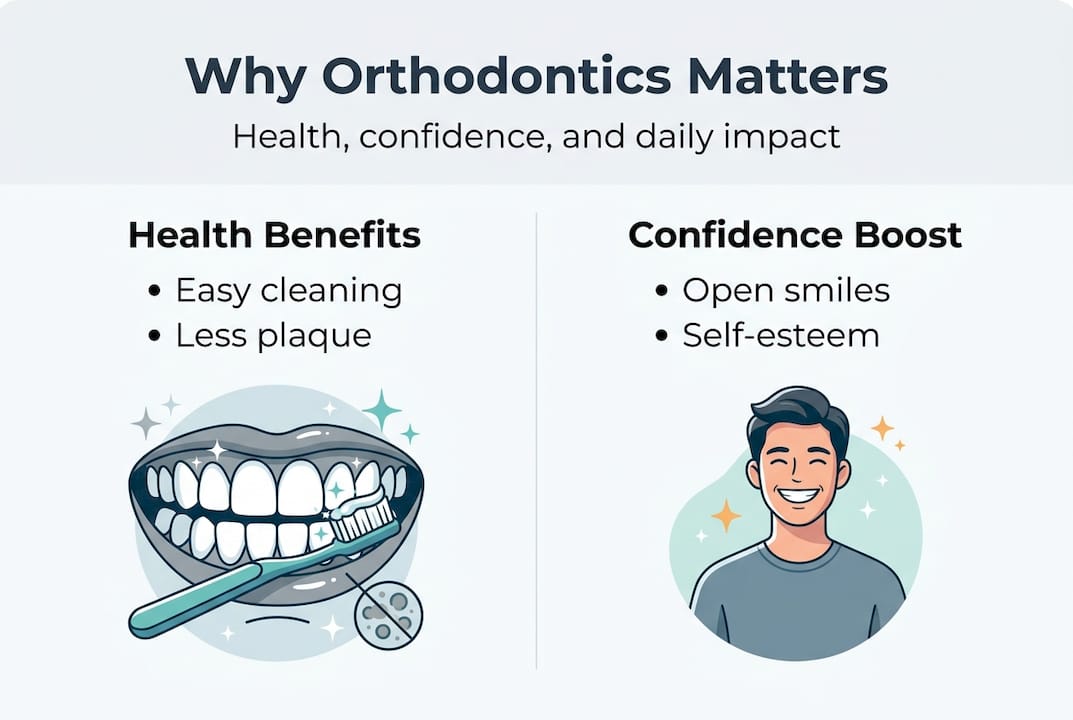
Here’s what many families don’t realize: the research on whether misaligned teeth directly cause poor oral health is more nuanced than popular belief suggests. A recent expert review notes that evidence linking malocclusion to general oral health problems is weak, except in specific cases involving overjet (when upper front teeth protrude significantly) and the risk of dental trauma. What is consistently strong in the evidence? The psychosocial benefits. Patients report improved self-esteem, greater social confidence, and better quality of life after treatment, and those outcomes often matter more than any clinical measurement.
That matters for families in Langley because it reframes the question. You’re not just asking “is my child’s bite medically dangerous?” You’re asking “will this treatment help my child thrive?” The answer to that second question is frequently yes, for reasons that go beyond what an X-ray shows. For a deeper look at how those benefits unfold for younger patients, our family orthodontics guide is a practical starting point.
Key reasons families pursue orthodontic care include:
- Injury prevention, particularly when overjet increases the risk of front tooth trauma from falls or impacts
- Improved bite function, making chewing and speaking more comfortable
- Aesthetic goals, which are completely valid and often the primary driver for both kids and adults
- Confidence and social ease, which connect directly to mental health benefits that support overall well-being
“The psychosocial impact of a corrected smile is often more meaningful to patients than any clinical metric. Feeling good about how you look is not a shallow goal. It’s a health outcome.”
The lifelong impact: Health, function, and confidence
Once you understand why orthodontics matters, the next question is how those benefits actually show up in someone’s daily life. The answer depends heavily on timing, the type of treatment chosen, and the individual patient’s situation.
Well-aligned teeth make it easier to brush and floss properly, which reduces the buildup of plaque in hard-to-reach areas. They also distribute biting forces more evenly across the jaw, reducing stress on individual teeth and the joints that support them. For children, the stakes are especially high: postural benefits from corrected jaw alignment can even influence how a child carries their head and shoulders, though this area of research is still developing.

One of the most compelling arguments for treating children earlier rather than later comes from the data on outcomes. Early intervention reduces overjet by an average of 7.0mm compared to 4.8mm with late treatment, Class II bite correction (when the upper jaw sits too far forward) succeeds in 82% of early cases versus 65% when treated later, and treatment stability holds at 75 to 90% over two to seven years. Those are meaningful differences.
For adults, the equation shifts slightly. You may not be in a growth phase, but your teeth can still move effectively with the right treatment. Adults often report that the most significant change after orthodontic treatment isn’t a clinical one. It’s the shift in how they feel walking into meetings, presenting ideas, or smiling in photos. That kind of confidence has ripple effects that are difficult to measure but impossible to ignore.
Pro Tip: If your child is around age 7, a screening with an orthodontist doesn’t commit you to any treatment. It simply tells you whether early intervention is worth considering, or whether you can wait with peace of mind.
Here’s a quick look at how orthodontic benefits break down across life stages:
- Children (ages 7 to 12): Early interceptive treatment can guide jaw growth and reduce the severity of later treatment
- Teens (ages 12 to 18): The most common treatment window, with good bone flexibility and plenty of options including braces and Invisalign
- Adults (18+): Fully effective orthodontic treatment with a stronger focus on aesthetics, though complex cases may take longer
Comparing treatment options early is smart. Our guide on Invisalign vs braces for kids walks through the specific differences families should know.
Braces vs. Invisalign: Comparing treatment choices
When most families sit down to talk about orthodontics, the first real decision is usually: braces or Invisalign? Both work. Both have strong track records. But they’re not the same, and knowing the difference helps you choose what fits your life.
Research comparing long-term outcomes shows that braces and Invisalign produce comparable alignment and stability results. Invisalign is preferred by many patients for its aesthetics and the ability to remove the trays for eating and cleaning. Braces are often better suited for more severe bite problems where precise, continuous force is needed throughout treatment.
| Feature | Traditional braces | Invisalign |
|---|---|---|
| Visibility | Noticeable metal/ceramic | Nearly invisible |
| Removability | Fixed in place | Removable for eating, brushing |
| Compliance required | Low (they stay on) | High (20 to 22 hours per day) |
| Best for | Complex cases, all ages | Mild to moderate cases, teens and adults |
| Cleaning ease | Requires more effort | Easier oral hygiene |
| Appointment frequency | Regular adjustments | Tray changes every 1 to 2 weeks |
The biggest practical difference is compliance. Invisalign works only when worn consistently, which means 20 to 22 hours every single day. For motivated adults, that’s rarely a problem. For some teenagers who might forget or lose trays, braces remove the decision entirely and just get the job done. Parents should have an honest conversation with their child about this before choosing.
Key things to consider when choosing:
- Your child’s or your own lifestyle: Invisalign suits athletes and musicians well because it can be removed during practice
- The complexity of the case: Severe crowding, significant bite corrections, or impacted teeth often respond better to braces
- Aesthetic priorities: For adults in professional settings, Invisalign’s near-invisibility can be a deciding factor
- Budget and insurance: Both options vary in cost; a consultation will clarify what’s covered
Pro Tip: Ask your orthodontist to show you a digital simulation of your expected results before committing to any treatment. Seeing a preview of your projected smile takes the guesswork out of the decision and helps you feel confident about the path forward.
For a detailed side-by-side breakdown, read our guide on clear braces vs Invisalign or explore whether clear aligners really work for your specific situation.
Advanced orthodontics: Managing complex cases
Most orthodontic cases are straightforward. But some patients, both children and adults, present challenges that require more specialized approaches. Knowing when you’re dealing with a complex case and when to seek specialist care can save significant time and prevent complications.
Complex cases often involve:
- Impacted teeth, where a tooth hasn’t erupted properly and is stuck in the bone or gum tissue
- Ectopic eruption, when a tooth emerges in the wrong position and pushes neighboring teeth out of alignment
- Significant jaw asymmetry, where the upper and lower jaws don’t line up symmetrically
- Severe skeletal discrepancies, particularly large overbites, underbites, or crossbites that may eventually require surgical correction
For issues like impacted or ectopic teeth, surgical-orthodontic combinations are often required. Techniques like Gopex (a specific type of orthodontic appliance used to guide tooth movement) and miniscrews (small titanium anchors placed temporarily in the bone to support force application) allow orthodontists to move teeth in ways that were once impossible without surgery. Jaw asymmetry cases require what specialists call “asymmetric mechanics,” meaning the treatment plan applies different forces to different sides of the mouth to achieve a balanced result.
“Not every case is complex, but complex cases demand a specialist’s eye. An experienced orthodontist will tell you honestly when you need more than standard treatment, and exactly what that looks like.”
The good news is that modern orthodontic tools have dramatically expanded what’s treatable without major surgery, and outcomes for genuinely complex cases continue to improve. If you’ve ever been told a dental problem is “too complicated” to fix without seeing a specialist, that may not be accurate anymore. Our guide to orthodontic emergencies also covers situations where you need to act quickly rather than wait for a scheduled appointment.
Orthodontics and oral health: Fact vs. fiction
There’s a lot of conflicting information out there about how much orthodontics actually improves oral health. Some of it is overstated. Some of the skepticism goes too far the other way. Here’s what the evidence actually supports.
Fiction: Crooked teeth always lead to gum disease and tooth decay.
Fact: The link between malocclusion and serious oral health problems is not as strong as many people assume. There are exceptions, particularly with overjet and trauma risk, but most bite variations don’t directly cause disease.
Fiction: Orthodontics is purely cosmetic and doesn’t affect real health outcomes.
Fact: For patients who already have gum disease (periodontitis), the evidence shows real clinical benefit. Orthodontic treatment after periodontal therapy improves clinical attachment level gains by 0.55mm and reduces pocket depth by 1.07mm, with fewer treatment failures. That’s a meaningful improvement for patients managing serious gum conditions.
Fiction: Adults don’t really benefit from orthodontics beyond aesthetics.
Fact: The psychosocial and well-being benefits of orthodontics for adults are well documented. Adults who complete treatment report higher self-confidence, greater willingness to smile in social situations, and measurable improvements in quality of life.
Pro Tip: If you or your child have been told you need gum treatment before orthodontics can begin, that’s actually a sign your orthodontist is being thorough. Treating the gums first and then aligning the teeth produces significantly better long-term outcomes than skipping steps.
The truth is that orthodontics serves both health and happiness, and neither goal is less legitimate than the other. Wanting a smile that makes you feel good is a real reason to pursue treatment. Our family guide to orthodontic health helps put both goals in context for parents making decisions for their teenagers.
Our perspective: Why the value of a confident smile is underrated
Here’s something we’ve observed working with patients in Langley over the years: the biggest transformation from orthodontic treatment almost never shows up in a clinical chart. It shows up in behavior.
A child who used to cover their mouth when laughing starts grinning openly at school. A working adult who avoided presentations volunteers to lead one. A teenager who ate lunch alone because they were embarrassed about their teeth starts joining their classmates. These changes are real, they’re significant, and traditional approaches to evaluating orthodontic “success” often miss them entirely because they’re focused on millimeters of tooth movement rather than moments in someone’s life.
We think that’s a problem worth naming. The medical community sometimes treats aesthetic motivation as a lesser reason to pursue treatment, as if wanting to feel good about your smile is somehow less valid than a clinical necessity. But self-perception and social confidence are not trivial. They connect directly to mental health, career outcomes, relationship quality, and overall life satisfaction.
The patients who tell us orthodontic treatment changed their lives aren’t exaggerating. They’re describing a version of themselves they couldn’t access before. Adults especially, who waited years thinking treatment was “just for kids,” often feel a mix of relief and frustration when they see their results. Relief that they finally did it. Frustration that no one told them sooner it was an option worth exploring.
If you’re an adult in Langley who has been curious about Invisalign, our guide on Invisalign effectiveness for adults will answer most of the questions holding you back. And if you’re a parent unsure whether your child “really needs” treatment, consider what it might mean for them to head into their teenage years with a smile they’re proud of. That’s not a small thing.
Ready to explore orthodontic care? Next steps for your family
Understanding the full value of orthodontics is just the beginning. Taking action is what actually changes lives. Whether you’re exploring options for a child entering their teen years or you’re an adult who has been quietly wondering what treatment might look like for you, the next step doesn’t have to feel overwhelming.

Start by exploring our orthodontic care for teens guide, which walks families through everything from the first consultation to what to expect during treatment. If the braces versus Invisalign question is on your mind, our breakdown of the key differences between braces and Invisalign makes the comparison clear and practical. And if you’ve already decided Invisalign might be your path, our Invisalign step-by-step guide explains exactly how the process works from tray one to the final retainer. At Glow Orthodontics, we’re here to make every step feel approachable, personalized, and worth it.
Frequently asked questions
At what age should my child see an orthodontist?
A first orthodontic check-up is recommended around age 7, when early bite issues can be detected and addressed most effectively. Early treatment produces significantly better correction outcomes and long-term stability than waiting.
Does orthodontic treatment really improve oral health?
While not every bite problem leads to disease, aligned teeth are easier to clean and carry less injury risk. The evidence on malocclusion shows the strongest health case for correcting significant overjet, with psychosocial benefits consistently strong across all cases.
How do I choose between braces and Invisalign?
Braces are often the better choice for complex cases requiring precise, continuous force. Invisalign delivers comparable outcomes for mild to moderate cases and suits patients who want a more discreet option and can commit to wearing trays consistently.
Is adult orthodontics worth it?
Absolutely. Adults can achieve lasting alignment improvements and often experience the most significant gains in confidence and social ease. The psychosocial benefits of treatment are well documented and frequently described by adult patients as life-changing.