Why Retainers Are Necessary for Lasting Straight Teeth
May 29, 2026
Why Retainers Are Necessary for Lasting Straight Teeth
TL;DR:
- Teeth continue to shift after braces due to biological forces and natural aging, making retainer wear essential. Full-time retainer use in the first year greatly reduces relapse risk, with fixed and removable options suited to individual needs. Consistent retainer care and ongoing monitoring are crucial for maintaining long-term orthodontic results.
Most people assume the hard part ends when braces come off. You’ve done the time, the adjustments, the soreness, and now you have a straight smile. But here’s what surprises nearly every patient: your teeth are already working to move back. Understanding why retainers are necessary is not just about following orthodontic orders. It’s about knowing what’s happening inside your jaw and why skipping your retainer, even for a few weeks, can quietly undo months of treatment.
Table of Contents
- Key Takeaways
- Why teeth shift after braces
- Fixed vs. removable retainers
- What happens when you skip your retainer
- Care of retainers: practical daily habits
- Orthodontic aftercare as a long-term system
- My take on what patients get wrong about retainers
- Protect your smile with the right aftercare support
- FAQ
Key Takeaways
| Point | Details |
|---|---|
| Teeth never fully stop moving | Biological forces like periodontal ligament elasticity continue pulling teeth back toward their original positions after braces. |
| Full-time first-year wear matters most | A 2026 study found full-time retainer wear in the first year dramatically lowers relapse risk with an odds ratio of just 0.070. |
| Fixed and removable retainers serve different needs | Your orthodontist selects retainer type based on your bite, bone density, and lifestyle, not just personal preference. |
| Skipping retainer wear has real financial costs | Relapse requiring retreatment is far more expensive than consistent retainer replacement and maintenance. |
| Aftercare is a system, not just a device | Retention works best when combined with regular monitoring, fit checks, and early intervention at the first sign of shifting. |
Why teeth shift after braces
The reason why retainers are necessary starts with biology, not just caution. When braces move your teeth, the bone surrounding each tooth root has to remodel. Old bone dissolves on one side of the tooth and new bone forms on the other. That process takes time, and it is not complete the moment your braces are removed.
Even more significant is the periodontal ligament. This thin connective tissue attaches each tooth to the surrounding bone, and it has elastic memory that pulls teeth back toward where they started. Think of it like a stretched rubber band. The moment tension is released, it wants to snap back.
Natural aging adds another layer. Teeth drift forward as you get older regardless of whether you ever had braces. Aging and parafunction habits like grinding or clenching apply constant low-grade pressure that shifts teeth over years. British Orthodontic Society guidelines state clearly that there is no clinical endpoint for retention because teeth continue moving naturally throughout life.
A 2026 study tracking 474 patients confirmed just how much retainer habits matter. Patients who wore retainers full-time during the first year had an odds ratio of 0.070 for relapse, meaning their risk was reduced by more than 90 percent compared to non-wearers. Those who continued nighttime wear beyond two years held an odds ratio of 0.352. The numbers are clear: consistent retainer use is not optional maintenance, it is the treatment continuing in a different form.
Pro Tip: The first six months after braces are removed are the highest-risk window for relapse. Treat your retainer wear schedule during this period as seriously as you treated your orthodontic appointments.
Fixed vs. removable retainers
Not all retainers work the same way, and knowing the difference helps you understand the importance of retainers for your specific situation.
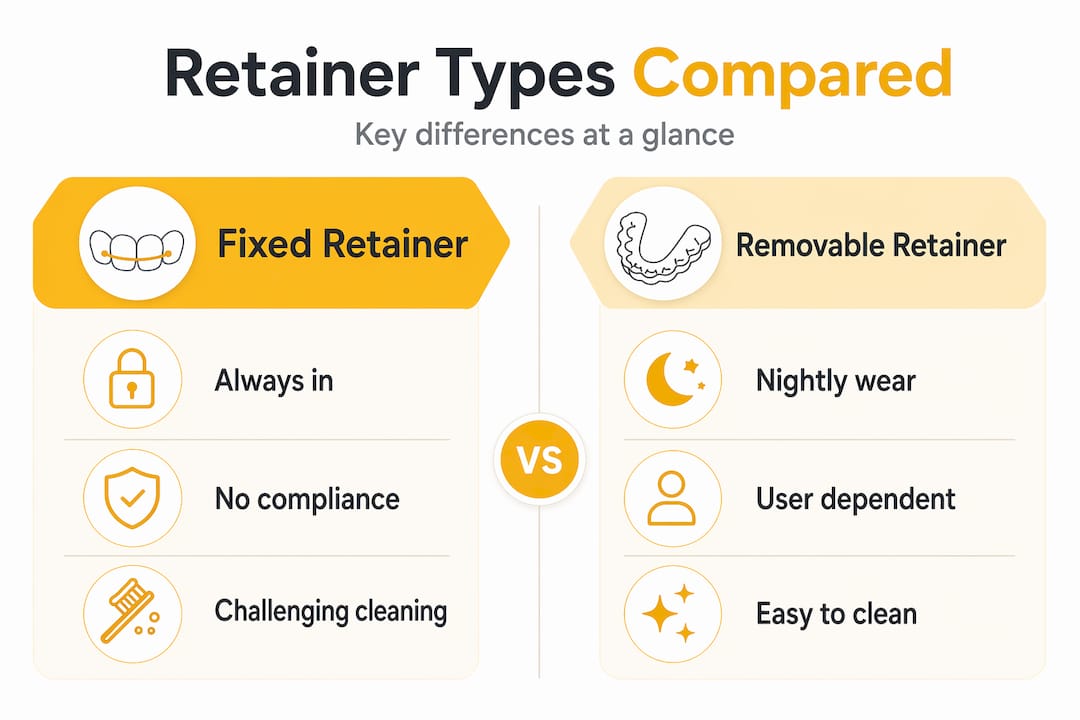
Fixed retainers are thin wire bonded to the back of your teeth, usually the lower front teeth. You cannot remove them yourself. They provide constant stabilization without relying on patient compliance, which makes them particularly useful for teeth that moved significantly or for patients with a history of crowding. The downside is hygiene. Flossing requires a floss threader, and plaque can accumulate around the wire if cleaning is inconsistent.
Removable retainers come in two main types:
- Hawley retainers: A hard acrylic base with a metal wire across the front teeth. Durable and adjustable, they can last for years with proper care.
- Clear plastic retainers (Essix): These fit over your teeth like an invisible tray and are more discreet. They are similar in appearance to Invisalign aligners.
| Feature | Fixed retainer | Removable retainer |
|---|---|---|
| Wear compliance needed | None | High |
| Hygiene effort | More complex | Easier |
| Visibility | Invisible to others | Very discreet (clear) or slightly visible (Hawley) |
| Durability | Long-lasting if intact | Varies; clear retainers last 6 months to a few years |
| Adjustability | Not adjustable | Hawley can be adjusted |
| Risk if broken | Requires immediate repair | Replacement needed quickly |
Your orthodontist decides which type fits your needs based on the complexity of your treatment, your age, your bite pattern, and how reliably you follow instructions. Many patients end up with a fixed retainer on the lower teeth and a removable clear retainer for the upper.
Pro Tip: If you have a clear removable retainer, avoid rinsing it in hot water. Heat warps the plastic and changes the fit, which means it stops protecting your alignment properly.
What happens when you skip your retainer
The risks are not abstract. Relapse is one of the most common outcomes in orthodontics, and it almost always traces back to retainer non-compliance.
Here is how the process typically unfolds:
- Weeks 1 to 4 without wearing: The retainer starts feeling tighter when you put it back in. That tightness is your teeth already shifting.
- Months 1 to 3: Visible crowding or spacing may begin returning, particularly in the lower front teeth where natural drift is strongest.
- 6 to 12 months: Spacing and rotation changes become noticeable even to others. The retainer may no longer fit correctly.
- 3 or more years: Full relapse often requires a full course of retreatment, including new braces or aligner therapy.
The financial impact of relapse is real. A second round of orthodontic treatment can cost thousands of dollars and take another one to two years. Replacing a lost retainer costs a fraction of that. The importance of retainers becomes obvious when you compare those two numbers.
“Retainer non-compliance is the single most preventable cause of orthodontic relapse. The treatment did not fail. The retention plan did.”
Studies show that even nighttime retainer wear significantly reduces the odds of relapse compared to wearing no retainer at all. You do not need to wear it every waking hour forever. You do need to wear it consistently during the night, long-term, and take it seriously if it breaks or gets lost.
Care of retainers: practical daily habits
Good retainer habits are not complicated, but they do require intention, especially in the first year after braces.
For daily care of retainers, start with these basics:
- Rinse your retainer with lukewarm water every time you remove it
- Clean it daily with a soft-bristled toothbrush and mild, non-abrasive soap
- Avoid soaking clear retainers in mouthwash containing alcohol, which degrades the plastic
- Store it in a hard case whenever it is not in your mouth
- Keep it away from pets and out of napkins at mealtimes (the most common cause of accidental loss)
For anyone building a nighttime wear habit, the tips for wearing retainers at night include setting a phone reminder for the same time each evening and keeping your retainer case on your nightstand rather than in a drawer.
If your retainer breaks or no longer fits, contact your orthodontist right away. Retainers degrade over time and require periodic replacement. Wearing a warped or cracked retainer gives you false confidence that your teeth are protected when they are not.

Long-term retainer use also benefits your gum health. When teeth stay aligned, they are easier to clean, which reduces your risk of gum disease and decay over time. That is a benefit most patients never think about when they first pick up their retainer case.
Pro Tip: Keep a backup retainer, especially for teens and young adults. A lost retainer during a school trip or vacation can mean weeks without protection during a high-risk period.
Orthodontic aftercare as a long-term system
Retainers are the core of post-treatment care, but they are one part of a larger picture. Orthodontic aftercare includes monitoring, fit assessments, and early micro-interventions when minor shifting is detected before it becomes a significant problem.
Think of it this way: wearing your retainer at night is your daily habit. Seeing your orthodontist for periodic checkups is the safety net that catches what you cannot see yourself.
The table below shows how aftercare needs typically shift over time after braces:
| Time after braces | Retainer wear recommendation | Monitoring frequency |
|---|---|---|
| 0 to 6 months | Full-time (20 to 22 hours daily) | Every 6 to 8 weeks |
| 6 to 12 months | Nighttime wear (8 to 10 hours) | Every 3 months |
| 1 to 2 years | Nightly | Every 6 months |
| 2 or more years | Nightly, indefinitely for most patients | Annually or as needed |
Compliance naturally drops over time. Life gets busy, retainers get lost, and the urgency fades once your smile looks great. This is exactly why aftercare programs with backup plans and regular reviews exist. Early detection of minor shifting allows for micro-interventions that are quick and far less invasive than full retreatment.
Your risk profile also matters. Patients who had severe crowding, significant rotations, or bite correction tend to have a higher risk of relapse and may benefit from permanent fixed retainers rather than relying solely on removable options.
My take on what patients get wrong about retainers
I’ve watched countless people invest real time and money into orthodontic treatment and then quietly stop wearing their retainers six months after getting them. The reasoning is always the same: their teeth look straight, so why bother?
What I’ve learned is that this is exactly the moment when protection matters most. Straight-looking teeth are not stable teeth. The bone is still consolidating, the ligaments are still under tension, and the mouth is looking for any reason to drift.
The patients who maintain their results long-term are not necessarily more disciplined. They simply understand what is at stake. Once you know that relapse risk persists for years after braces come off, nightly retainer wear stops feeling like a chore and starts feeling like protecting an investment.
The other thing I’d tell any parent reading this: your teenager’s retainer compliance is worth a five-minute weekly check-in. Not nagging, just asking. The window for the lowest-effort protection is right now, and it closes faster than most families realize.
— Gloworthodontics
Protect your smile with the right aftercare support
At Glow Orthodontics, we believe finishing treatment is only the beginning. The team works closely with patients and families to build retention plans that fit real life, whether that means a fixed wire, a clear removable retainer, or both together.

From teen orthodontic care to Invisalign aftercare and relapse prevention strategies, Glow Orthodontics provides the ongoing monitoring and guidance families in Langley need to keep results looking their best for years. If you or your child is coming up on the end of treatment, or you are concerned about shifting that has already started, booking a consultation is the fastest way to get a personalized plan in place.
FAQ
Why are retainers necessary after braces?
Retainers are necessary because bone and periodontal ligaments continue shifting teeth after braces are removed. Without a retainer, teeth drift back toward their original positions within weeks to months.
Do I need a retainer if my teeth still look straight?
Yes. Teeth can look straight while still moving underneath the surface. A 2026 study confirmed that retainer wear significantly reduces relapse risk even when no visible shifting is apparent yet.
What are temporary retainers?
Temporary retainers are typically removable devices prescribed for full-time wear in the months immediately after braces. They protect teeth during the highest-risk window before transitioning to nighttime-only wear.
How long do I need to wear a retainer?
Most orthodontists recommend nightly retainer wear indefinitely. Teeth continue moving throughout life, which means there is no point at which retention becomes unnecessary for the majority of patients.
What happens if my retainer breaks or goes missing?
Contact your orthodontist right away and do not wait to see if your teeth shift first. Retainers require timely replacement to stay effective, and even a short gap in wear can allow movement that makes the old retainer no longer fit correctly.