Why Straighten Teeth? Health, Confidence, and Real Family Benefits
May 3, 2026
Why Straighten Teeth? Health, Confidence, and Real Family Benefits
TL;DR:
- Orthodontic treatment improves oral health, function, and emotional confidence beyond just appearance.
- Proper alignment makes cleaning easier, reducing long-term risks of cavities and gum disease.
- Early intervention can lower injury risk and facilitate easier correction of bite issues during jaw development.
Many parents assume that orthodontic treatment is mostly about appearances, a way to give kids a more attractive smile before they head into adulthood. That assumption is understandable, but it misses most of the story. Straightening teeth has measurable effects on oral health, long-term hygiene habits, bite function, and even emotional well-being during some of the most socially sensitive years of a child’s life. This guide breaks down the real reasons families in Langley choose orthodontic care, from protecting teeth against injury to building genuine confidence in your child.
Table of Contents
- More than a smile: Core reasons to straighten teeth
- Oral hygiene and long-term health
- Psychosocial benefits: Confidence and social well-being
- Timing matters: When and why early orthodontic treatment helps
- Treatment options: Braces, clear aligners, and what parents should know
- A parent’s lens on straightening teeth: What matters most
- Next steps: Explore your options with Glow Orthodontics
- Frequently asked questions
Key Takeaways
| Point | Details |
|---|---|
| Health is primary | Straightening teeth makes cleaning easier and reduces risk of future dental problems. |
| Confidence boost | Orthodontic treatment can noticeably improve your child’s self-esteem and social comfort. |
| Timing matters | Early care minimizes injury risk in some cases, but individual evaluation is key. |
| Choose the right method | Braces and clear aligners both work—ask your orthodontist what fits your child’s needs and habits. |
More than a smile: Core reasons to straighten teeth
When parents hear “orthodontics,” they often picture straight, even teeth for graduation photos. That visual result is real, but it is the surface layer of what treatment actually does. Orthodontic care addresses how teeth function together, how easily they can be kept clean, and how well they hold up over years of daily use.
Tooth alignment and bite correction directly affect a child’s ability to chew, speak clearly, and maintain their oral health long term. When teeth overlap, crowd each other, or sit at odd angles, food particles and bacteria find hiding spots that a toothbrush simply cannot reach. That is when cavities and gum problems begin to develop quietly, often without any obvious symptoms until the damage is already done.
Beyond hygiene, there are real physical protection benefits to consider. Protruding upper front teeth, sometimes called “buck teeth” in casual conversation, are significantly more likely to be chipped or knocked out during falls, sports accidents, or playground collisions. Correcting that protrusion is not about vanity. It is about making sure a tooth survives impact that would otherwise break it.
Here is a quick look at what orthodontic treatment actually addresses:
- Crowded or overlapping teeth that are harder to brush and floss effectively
- Overbites, underbites, and crossbites that stress the jaw and affect chewing
- Protruding front teeth that are vulnerable to trauma and injury
- Spacing issues that allow food to pack between teeth and increase decay risk
- Speech difficulties tied to how the tongue interacts with misaligned teeth
“Orthodontic treatment is used to improve tooth alignment and correct bite problems, and misalignment can make teeth harder to clean and more likely to become damaged.” — NHS
One practical note for families whose children are already mid-treatment: learning brushing with braces is a skill that matters as much as the treatment itself. Good technique during treatment sets kids up for healthy habits afterward.
Oral hygiene and long-term health
Straight teeth are not just easier to look at. They are genuinely easier to keep clean, and that distinction has major consequences over a lifetime of dental health. When teeth crowd together or sit at awkward angles, the spaces between them become almost impossible to clean with a standard brush. Floss shreds, slides past plaque, or simply cannot reach the contact point between two teeth that are pressed too tightly together.

The risk of cavities and gum disease rises steadily when those hard-to-reach areas accumulate plaque (the sticky film of bacteria that forms on teeth). Left undisturbed, plaque hardens into tartar, which only a dental professional can remove. Over months and years, this cycle leads to decay, inflamed gums, and in serious cases, bone loss around the roots of teeth.
Here is how straight teeth make the basic hygiene routine more effective for kids:
- Brushing reaches more surfaces. When teeth are aligned, bristles can contact each tooth at the correct angle rather than skating over crowded edges.
- Flossing works as intended. Floss slides cleanly between teeth that have proper spacing, removing plaque from the areas a brush cannot reach.
- Rinsing is more thorough. Mouthwash and water circulate more freely when teeth are not tightly overlapping, flushing debris from all surfaces.
- Dental checkups catch less. With fewer problematic areas to monitor, routine visits are more about maintenance and less about damage control.
- Gum health improves. Properly aligned teeth allow gums to sit snugly around each tooth, reducing pockets where bacteria breed.
These are not minor conveniences. They are the foundation of a child’s oral health for decades to come. Teaching kids to maintain their routine is also part of the equation.
Pro Tip: Get your child involved in choosing their toothbrush, floss type, and even a fun timer app. Kids who feel ownership over their hygiene routine are more likely to keep it up consistently, especially during braces treatment. You can find more ideas in these natural oral hygiene tips that work alongside any orthodontic plan.
Psychosocial benefits: Confidence and social well-being
Here is something the clinical literature confirms that parents often feel intuitively: how a child feels about their smile affects how they show up in the world. Adolescence is already a socially pressured time. A child who feels self-conscious about their teeth may smile less in photos, avoid speaking up in class, or pull back from social situations that would otherwise help them grow.
Research published in peer-reviewed literature confirms that orthodontic treatment improves psychosocial outcomes, including self-confidence and social functioning, beyond just the physical appearance change. This is not about teaching kids that their worth depends on their smile. It is about removing a source of genuine anxiety so they can focus on everything else: friendships, school, activities, and figuring out who they are.
The benefits parents and researchers consistently observe include:
- Greater willingness to smile in social situations and photographs
- Reduced self-consciousness during conversations and presentations
- Improved peer relationships as social confidence grows
- Less avoidance behavior around eating in public or laughing openly
- Higher self-reported satisfaction with overall appearance, not just teeth
Statistic to note: Studies consistently show that children and teens report meaningful improvements in self-esteem and social comfort following orthodontic treatment, with effects that persist well after the physical treatment ends.
These psychosocial gains are especially significant during the middle and high school years, when peer perception weighs heavily on a young person’s developing identity. A thoughtful conversation about orthodontic care for teens can help parents understand how to approach the timing and framing of treatment with their child.
Timing matters: When and why early orthodontic treatment helps
Not every child needs orthodontic treatment at the same age. But some children benefit significantly from intervention before all their permanent teeth have arrived, a practice called interceptive orthodontics. The idea is to address problems early, while the jaw is still developing and more responsive to gentle correction, rather than waiting until the full adult dentition is in place.
The strongest evidence for early treatment involves children with prominent upper front teeth. Early treatment in selected cases significantly reduces the risk of incisor trauma. In plain terms, if your child’s upper front teeth protrude noticeably, early intervention lowers the chance that a fall or sports collision results in a broken tooth.
Here is how early and later treatment compare across different bite situations:
| Condition | Early treatment (age 7-10) | Later treatment (age 12+) |
|---|---|---|
| Prominent upper front teeth | Reduces trauma risk significantly | Still effective but trauma risk remains during waiting period |
| Crossbite | Easier jaw expansion while growth is active | May require more complex correction or surgery |
| Severe crowding | Space can be created as jaw grows | Extractions may be needed more often |
| Minor alignment issues | Often better to wait for full adult teeth | Standard timing works well |
| Jaw growth discrepancies | Growth modification is possible | Correction relies more on teeth, not jaw |
This table is a general guide. Every child’s situation is unique, and the right timing depends on what the orthodontist finds during a thorough exam.
Pro Tip: At your child’s next orthodontic or dental visit, specifically ask about risk stratification for their bite type. Questions like “Is there anything in my child’s bite that could cause injury or be harder to fix later?” will get you much more useful information than a general checkup conversation.
Treatment options: Braces, clear aligners, and what parents should know
Once you know that treatment makes sense for your child, the next question is which type of appliance fits your family’s life. The two main options are traditional braces and clear aligners, and each has genuine strengths that match different kids, different bite problems, and different personalities.
Traditional braces are brackets bonded directly to each tooth, connected by a wire that the orthodontist adjusts gradually over time. They work around the clock because they cannot be removed. For complex tooth movements, significant bite corrections, or younger children who may not reliably wear a removable device, braces are often the stronger clinical choice.
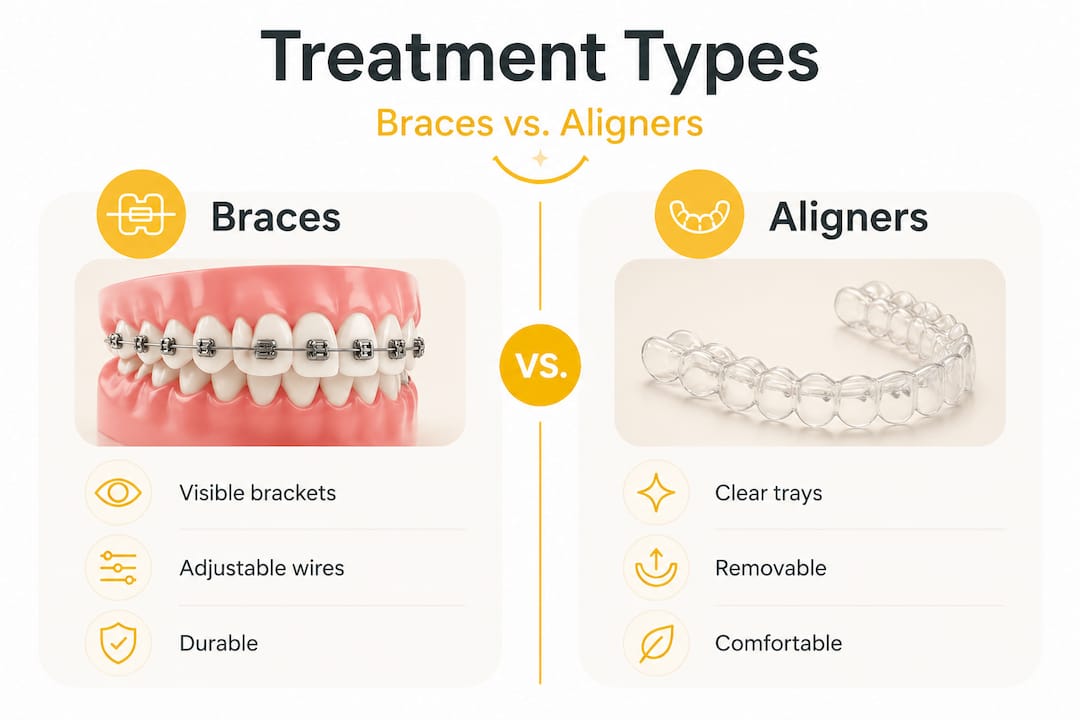
Clear aligners are a series of custom-made plastic trays worn over the teeth. Each tray makes small adjustments, and the patient moves through the series every one to two weeks. Clear aligners are effective for many cases, but their success depends heavily on the patient wearing them for 20 to 22 hours per day. A tray left sitting on a nightstand does nothing.
| Feature | Traditional braces | Clear aligners |
|---|---|---|
| Appearance | Visible brackets and wire | Nearly invisible when worn |
| Removability | Fixed, cannot be removed | Removable for eating and cleaning |
| Compliance required | None, always working | High, must be worn consistently |
| Complex case suitability | Excellent | Moderate, depends on case |
| Oral hygiene during treatment | Requires extra care around brackets | Easier, remove trays to brush |
| Typical treatment length | 18 to 36 months | 12 to 24 months for suitable cases |
Parents sometimes ask whether their teenager is a good candidate for aligners. The honest answer is that it depends on two things: the clinical complexity of the case and how reliably your teen will keep the trays in. For a motivated teen with a mild to moderate alignment issue, aligners can be a great fit. For a child who forgets things regularly, fixed braces may produce better results because compliance is not a variable.
You can explore a detailed breakdown of clear aligners vs braces to see how they compare across seven specific factors. When talking with your orthodontist, bring these questions:
- Which appliance is better suited to my child’s specific bite issue?
- What happens if my child does not wear the aligners consistently?
- How long do you expect treatment to take, and what affects that timeline?
- Will there be a retainer afterward, and for how long?
Understanding clear aligner effectiveness across different case types can help you go into that consultation with realistic expectations and smarter questions ready.
A parent’s lens on straightening teeth: What matters most
After working with families across Langley, we have noticed a pattern worth naming directly. The parents who feel most satisfied with their child’s orthodontic journey are rarely the ones who chased the most perfect result. They are the ones who stayed focused on what actually mattered: their child’s comfort, their oral health, and their growing sense of confidence.
Social media has created a kind of “orthodontics perfection” pressure that is not grounded in what treatment can or should do. Perfectly symmetrical, brilliantly white, magazine-ready teeth are an aesthetic ideal, not a clinical goal. Orthodontic treatment is successful when your child can chew without discomfort, keep their teeth clean, and feel genuinely good about their smile, not when it matches a filter.
What experienced parents often say in hindsight: they wish they had worried less about which appliance looked coolest and asked more questions about their child’s specific bite concerns and the experience of the orthodontist guiding the process. A local, collaborative practice that knows your child by name, tracks their progress carefully, and explains every step in plain language is worth far more than the trendiest treatment option.
Working with an orthodontist who offers real family orthodontic guidance means your decisions are grounded in your child’s actual needs, not a one-size-fits-all approach. That is where the real difference is made.
Next steps: Explore your options with Glow Orthodontics
Straightening your child’s teeth is one of the most meaningful investments you can make in their long-term health and confidence. At Glow Orthodontics in Langley, we work with families throughout every stage of the process, from that first question to the final retainer check.

Whether you are just starting to research options or ready to book a consultation, we have resources to guide you. Start with our fixing crooked teeth guide for a clear picture of what treatment involves. If Invisalign or clear aligners are on your radar, our step-by-step Invisalign treatment process guide explains exactly what to expect. And if you are weighing options, our comparison of clear braces versus Invisalign will help you ask the right questions at your consult. We would love to meet your family.
Frequently asked questions
Does straightening teeth really improve oral hygiene?
Yes, straight teeth are easier to clean, which means brushing and flossing reach more tooth surface, directly reducing the risk of cavities and gum disease over time.
Is early orthodontic treatment always better for my child?
Not always. Early treatment reduces injury risk for certain bite problems like prominent upper front teeth, but the ideal timing genuinely depends on your child’s specific bite type and development stage.
Will straightening teeth boost my child’s confidence?
Research consistently shows that children report improved confidence and social comfort after orthodontic treatment, with benefits extending well beyond just the physical appearance change.
Are clear aligners as effective as braces for kids?
Clear aligners work well for many cases, but their effectiveness depends heavily on consistent wear. Complex bite issues or low-compliance situations often respond better to traditional fixed braces.