Adult orthodontic care tips that get real results
April 28, 2026
Adult orthodontic care tips that get real results
TL;DR:
- Adults increasingly choose orthodontics for health, confidence, and discreet aesthetic options.
- Clear aligners work well for mild to moderate cases but require high patient compliance.
- Success depends on habits, communication, and commitment, not just technology or product choice.
Orthodontic treatment isn’t just a teenage rite of passage. Adults across Langley, BC are choosing to straighten their teeth and improve their bites in greater numbers than ever before, whether for cosmetic confidence, long-term oral health, or both. But adult orthodontic care comes with its own unique decisions, trade-offs, and expectations that nobody tells you about upfront. This guide breaks down what you actually need to know, from choosing between clear aligners and braces to making the most of every tray, so you can walk into your consultation prepared and walk out of treatment thrilled with your results.
Table of Contents
- Why more adults are choosing orthodontic care
- Clear aligners vs. braces: What adults should consider
- Maximizing clear aligner success: Practical tips for adults
- What to ask your orthodontist before starting treatment
- The honest truth most adults miss about orthodontic care
- Take the next step in your adult orthodontic journey
- Frequently asked questions
Key Takeaways
| Point | Details |
|---|---|
| Adults get great results | Modern orthodontic options can provide adults with outcomes similar to teens, whether using braces or clear aligners. |
| Aligners require discipline | Success with clear aligners depends on wearing them consistently, as compliance is key for tooth movement. |
| Predictability varies | Clear aligners are highly effective for mild to moderate tooth movements but may be less certain for complex cases. |
| Customize with your provider | Work closely with your orthodontist on aligner choice, material thickness, and treatment plan for comfort and results. |
Why more adults are choosing orthodontic care
After outlining what adults need to know, it’s important to understand why so many are turning to orthodontic options now.
The idea that braces are “just for kids” has been fading for years, and for good reason. Adults today are living longer, investing more in their appearance and health, and increasingly aware that a well-aligned bite is about more than cosmetics. Crooked teeth, gaps, and bite issues can contribute to uneven wear, jaw discomfort, and difficulties maintaining good oral hygiene. Fixing alignment problems in adulthood isn’t vanity. It’s preventive care.
That said, aesthetics do play a real role. Adults in professional environments often cite confidence as a primary motivator. Walking into a meeting, a first date, or a job interview with a smile you’re proud of matters. And unlike a decade ago, modern orthodontic options make it possible to treat alignment issues discreetly, without a mouth full of metal brackets.
Here’s what’s driving adult interest in orthodontic care today:
- Improved aesthetics. Clear aligners, ceramic braces, and other low-profile options make treatment far less noticeable than traditional braces.
- Oral health gains. Properly aligned teeth are easier to brush and floss, reducing long-term cavity and gum disease risk.
- Functional improvement. A corrected bite can reduce jaw tension, teeth grinding, and uneven wear patterns.
- Increased accessibility. More orthodontic providers, flexible payment options, and better technology have lowered the barriers for adults to start care.
- Social normalization. Adults seeing peers go through aligner treatment has made it feel less unusual and more attainable.
Research supports real optimism for adult patients. Studies confirm that aligner outcomes are comparable to braces for overall alignment, occlusal improvement, and long-term stability in adult patients. That’s a meaningful finding for anyone wondering whether it’s “too late” to see real results.
“In adults, aligner outcomes can be comparable to braces for overall alignment and long-term stability, making clear aligners a viable and often preferred choice for cosmetic-focused adult patients.”
If you’re wondering whether clear aligners really work as well as they claim, the short answer is yes, with some important nuances that depend on your case complexity and your commitment to the process.
Clear aligners vs. braces: What adults should consider
Knowing why adults are seeking care, the next crucial decision is choosing between clear aligners and braces.
For most adults, this is the biggest fork in the road. Both treatment types can produce excellent results, but they serve different needs and suit different lifestyles. Understanding the real differences will help you have a much more productive conversation with your orthodontist.
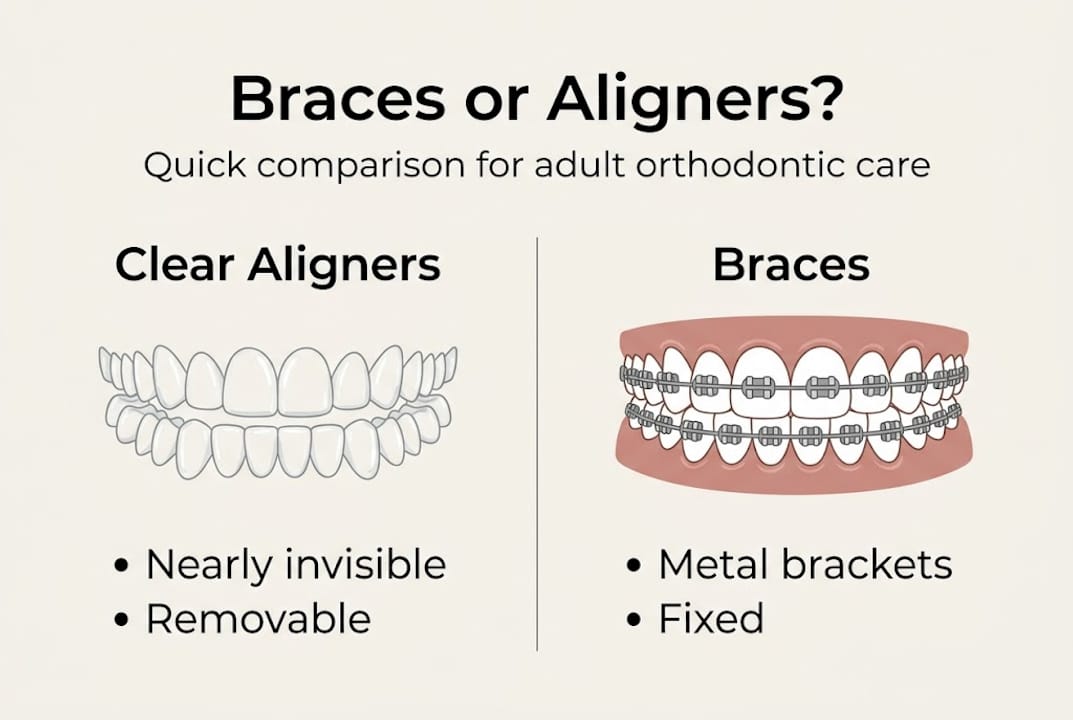
Clear aligners use a series of custom-molded plastic trays that are swapped out every one to two weeks. Braces use brackets bonded directly to teeth, connected by wires that apply continuous pressure. Both move teeth, but they do so differently, and that distinction matters for certain types of tooth movement.
Research shows that clear aligners are effective for mild to moderate adult orthodontic cases, but some clinical aspects, including occlusal contacts, torque control, and precise root positioning, can be less predictable with aligners than with braces. This doesn’t mean aligners can’t handle complex cases. It means your orthodontist needs to plan carefully and possibly use attachments, small tooth-colored bumps bonded to certain teeth, to help aligners achieve specific movements.
| Factor | Clear aligners | Traditional braces |
|---|---|---|
| Aesthetics | Nearly invisible | Visible metal or ceramic |
| Removability | Removable for meals and cleaning | Fixed for entire treatment |
| Comfort | Smooth plastic, no sharp edges | Brackets can irritate cheeks |
| Compliance required | High (22 hours/day) | Low (no patient action needed) |
| Complex movements | Less predictable for some | Generally more precise |
| Oral hygiene | Easier to brush and floss | Requires more careful cleaning |
| Adjustment visits | Every 6 to 10 weeks | Every 4 to 6 weeks |
One important note about patient satisfaction: adults who prioritize discretion and aesthetics during treatment tend to report higher satisfaction with aligners, even when treatment times are comparable. The ability to remove trays for important events, photos, and dates is a quality-of-life advantage braces simply can’t match.
Understanding the full picture of clear aligners vs braces differences helps you frame the right questions for your consultation. And if you want a deeper side-by-side look, reviewing an Invisalign vs traditional braces comparison can give you more context before your appointment.
Pro Tip: Ask your orthodontist specifically about which tooth movements your case requires and whether those are movements where aligners perform predictably. Some orthodontists offer hybrid treatment, starting with braces for complex movement phases and finishing with aligners for refinement.
Maximizing clear aligner success: Practical tips for adults
Once you’ve considered your options, it’s time to focus on maximizing results with clear aligners.

The technology in modern clear aligners is impressive, but it’s only as good as the habits you build around wearing them. Adults who get exceptional results aren’t just lucky. They follow consistent routines, communicate with their provider, and treat their treatment as an active commitment rather than a passive fix.
Here’s what actually makes the biggest difference:
-
Wear your aligners 20 to 22 hours every day. This is the single most important factor in your results. Aligner success depends on compliance because aligners are removable, and tooth movement requires continuous force delivery. Every hour you skip is an hour your teeth aren’t moving as planned.
-
Build a meal routine that keeps aligners out for minimal time. Remove them to eat, rinse immediately after, and put them back in. Keeping removal to three or four eating windows per day, rather than grazing all day, makes hitting your wear-time targets much easier.
-
Always brush and rinse before reinserting trays. Food particles and bacteria trapped under aligners can cause cavities and staining. Pair your meal routine with a quick rinse of your aligners and a brief brush of your teeth. Read up on how to clean aligners to avoid damaging the plastic with hot water or harsh toothpastes.
-
Keep a travel kit everywhere you go. A small pouch with your case, a travel toothbrush, and floss eliminates the excuse of skipping reinsertion after meals away from home. Many people underestimate how much “just this once” eating without reinserting costs them over a full treatment course.
-
Track your progress actively. Take photos of your teeth every month. Not only does this keep you motivated, but it helps you notice if a tray isn’t fitting correctly, which can indicate teeth aren’t tracking as planned.
-
Communicate discomfort early. Soreness after switching to a new tray is normal. Persistent pain that doesn’t ease within 48 to 72 hours is worth a call to your provider. Research shows that aligner thickness affects both comfort and movement, with thinner aligners generally producing less pain but slightly different expansion dynamics. If pain is a real obstacle to consistent wear, that’s a conversation your orthodontist can help solve.
-
Never skip refinement trays. Most aligner treatments include a refinement phase near the end to fine-tune results. Adults who stop engaging with treatment when their teeth “look good enough” often miss out on the bite adjustments and finishing details that make results last.
For a full breakdown of day-to-day habits, the practical Invisalign tips resource covers situations like traveling, eating out, and handling alignment plateaus in detail.
Pro Tip: If you’re genuinely struggling to keep aligners in, don’t just white-knuckle it. Ask your orthodontist about thinner aligner options or staged wear protocols that gradually increase daily wear time while your habits build.
What to ask your orthodontist before starting treatment
To make sure your orthodontic journey is smooth and tailored, thoughtful questions are your best tool.
Walking into a consultation without a clear list of questions is one of the most common mistakes adults make. Many people spend more time researching a hotel than they do preparing for a conversation that affects their smile for life. The good news is that orthodontists genuinely appreciate informed patients. It makes the planning process better for everyone.
Here are the essential questions to bring to your first appointment:
- What tooth movements does my case require, and are any of them less predictable with aligners? This gets straight to whether your case is a strong aligner candidate or whether braces or a hybrid approach might produce better results.
- How many trays do you estimate for my treatment, and what does a refinement phase look like? Refinements are often necessary and can add several months to treatment. Knowing this upfront prevents frustration.
- What attachments will I need, and how visible will they be? Attachments affect both aesthetics and the feel of your aligners. Understanding this matters if discretion is your main motivation.
- What happens if a tray doesn’t fit properly? This is a sign of non-tracking, where teeth aren’t moving as expected. Knowing your provider’s protocol for this gives you peace of mind.
- What does post-treatment retention look like? Retainers are not optional. Ask whether you’ll need fixed retainers, removable retainers, or both, and how long you’ll need to wear them.
- How do we adjust if I experience significant discomfort? Research confirms that aligner design and material choices affect pain levels and movement outcomes, so your provider should be able to discuss options like thinner trays or adjusted protocols.
| Question | Why it matters |
|---|---|
| Movement predictability for my case | Determines whether aligners are the right primary tool |
| Refinement expectations | Prevents timeline surprises |
| Attachment visibility | Manages aesthetic expectations |
| Non-tracking protocol | Sets expectations for troubleshooting |
| Retention plan | Ensures you protect your investment long-term |
| Pain management options | Supports consistent wear and comfort |
For a more detailed guide on navigating your first appointment, the questions to ask your orthodontist resource walks through additional scenarios and follow-up questions worth having ready.
Going in prepared signals to your provider that you’re a committed patient, which often translates to more personalized attention and a more customized treatment plan.
The honest truth most adults miss about orthodontic care
Armed with the right questions, it’s also key to step back and consider what actually determines success.
Here’s what we’ve seen repeatedly: adults spend enormous energy choosing between aligner brands or researching the newest tray materials, then undermine their results by skipping wear time or avoiding uncomfortable conversations with their provider. The technology matters less than the habits built around it.
The orthodontists who consistently produce outstanding adult outcomes aren’t necessarily the ones using the most sophisticated software. They’re the ones who set expectations clearly from day one, check in consistently, and build relationships where patients feel comfortable saying “this isn’t working” before it becomes a bigger problem.
Real success in adult orthodontics is built on daily discipline and honest communication, not on any single product choice. If you’re not honest with your provider about pain, non-compliance, or lifestyle constraints, the best aligner system in the world won’t produce the smile you’re imagining.
Understanding clear aligners vs braces explained is valuable. But the deeper work is committing to the process, staying engaged through the less glamorous middle stages of treatment, and trusting that consistent effort over months pays off in results that actually last.
Take the next step in your adult orthodontic journey
With a clear plan in mind, here’s how to act on what you’ve learned and get support locally.
If you’re an adult in Langley, BC considering orthodontic care, the best next step is a personalized consultation with a provider who can assess your specific case and goals. Reading about clear braces vs Invisalign is a great starting point, and walking through the Invisalign treatment process can help you understand what to expect from start to finish.

At Glow Orthodontics in Langley, we work with adults at every stage, whether you’re just starting to explore your options or ready to book your first scan. Our team is committed to personalized care that fits your lifestyle, your goals, and your schedule. Booking a consultation is simple, and it’s the fastest way to get answers specific to your smile.
Frequently asked questions
Are clear aligners as effective as braces for adults?
For most adults, clear aligners can achieve similar results to braces for alignment and bite improvement, particularly in mild to moderate cases. Research confirms that aligner outcomes are comparable to braces for overall alignment and long-term stability in adult patients.
What are the main challenges with clear aligners for adults?
Some complex tooth movements and bite adjustments can be less predictable with aligners, and consistent daily wear is essential. Studies show that aligners can be less predictable for certain movements like torque control and require strict patient compliance to deliver planned results.
Does aligner thickness affect comfort or results?
Yes, aligner thickness directly influences both pain levels and how much tooth movement occurs. Research shows that thicker aligners yield more movement but also more discomfort, while thinner aligners tend to feel more comfortable but may produce slightly less expansion per tray.
How long does adult orthodontic treatment usually take?
Treatment length varies based on case complexity, but most adults complete treatment in 12 to 24 months, with mild cases sometimes finishing closer to the lower end of that range.
Can adults start orthodontic care later in life?
Absolutely. There is no upper age limit for orthodontic treatment, and adults of all ages can achieve meaningful improvements in alignment, bite function, and smile aesthetics with the right care plan.