Early Orthodontic Treatment: What Langley Parents Need to Know
April 17, 2026
Early Orthodontic Treatment: What Langley Parents Need to Know
TL;DR:
- Most children do not need early orthodontic treatment; targeted cases benefit most.
- An orthodontic evaluation by age 7 helps identify specific problems like crossbites or severe crowding.
- Research shows limited long-term differences between early and delayed treatment, with benefits for trauma prevention.
Many Langley parents feel caught between two camps: one side says treat early, the other says wait. If you’ve sat in a waiting room wondering whether your 8-year-old needs braces now or whether you’re jumping the gun, you’re not alone. The truth is that early orthodontic treatment is genuinely life-changing for some children and completely unnecessary for others. This guide cuts through the noise, explains what the research actually shows, and helps you ask the right questions at your child’s next evaluation so you can make a confident, informed decision.
Table of Contents
- What is early orthodontic treatment and who needs it?
- How do experts decide if early orthodontic treatment is needed?
- Benefits and limitations: What the studies show about early orthodontic treatment
- Common orthodontic appliances for early treatment
- A clearer approach: why ‘wait and see’ isn’t always risky or always wise
- How Glow Orthodontics Langley supports your child’s smile journey
- Frequently asked questions
Key Takeaways
| Point | Details |
|---|---|
| Early isn’t always better | Most kids only need monitoring, but some benefit greatly from acting early. |
| Targeted treatment works | Early orthodontics can reduce trauma risk and address specific dental issues in young children. |
| Evidence matters | Strong studies show few long-term advantages for routine early treatment—selective care is best. |
| Talk to an expert | An orthodontist can help you decide whether to treat now or later for your child’s unique case. |
What is early orthodontic treatment and who needs it?
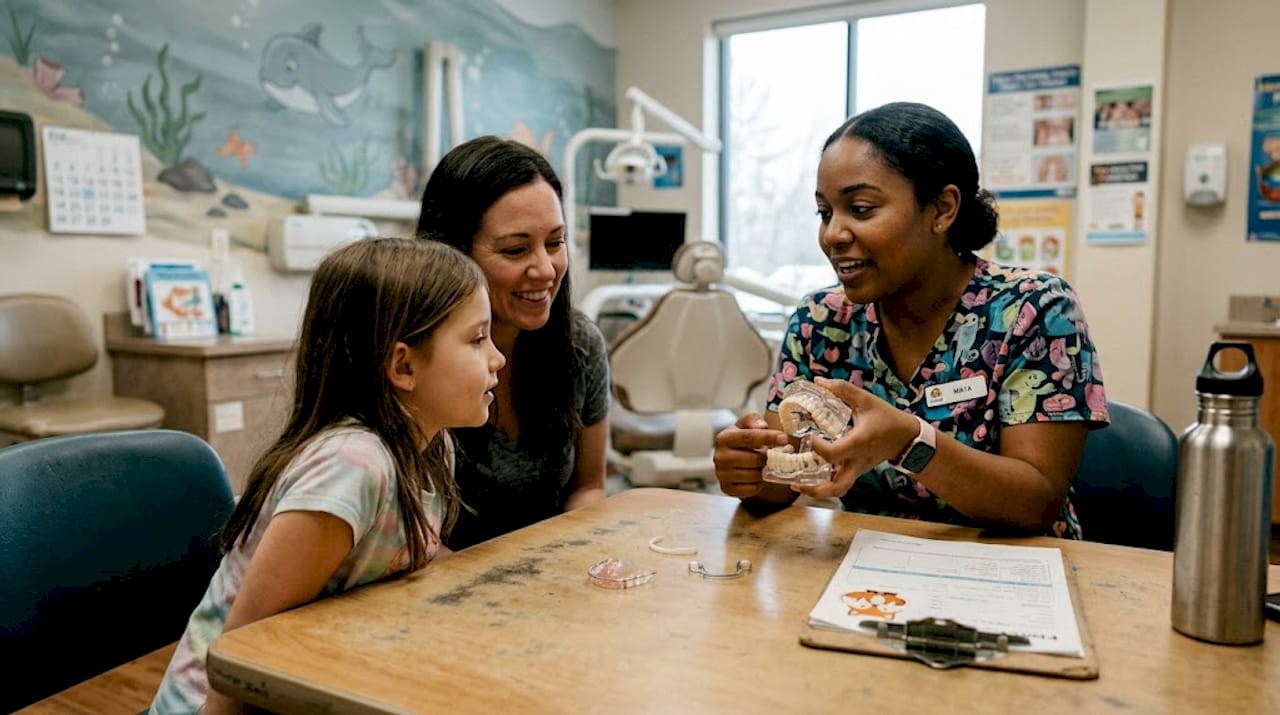
Early orthodontic treatment, sometimes called Phase 1 treatment, refers to orthodontic care that begins while a child still has a mix of baby and permanent teeth. This typically happens between ages 7 and 10. The goal is not to give every child a perfect smile before middle school. It’s to catch specific problems early enough that the jaw and teeth can be guided into better positions while growth is still on your side.
Here’s the thing most parents don’t hear clearly: most children do not need early treatment. A routine check with an orthodontist at age 7 is smart, but a check is very different from starting treatment. The malocclusion types that genuinely benefit from early care are a subset, not the norm.
So who does benefit? The children who gain the most from early intervention tend to share specific characteristics:
- Crossbites where upper teeth sit inside lower teeth, which can shift the jaw permanently if left untreated
- Severe crowding that may lead to impacted permanent teeth
- Protruding upper front teeth that increase the risk of dental injury during sports or a fall
- Underbites caused by jaw discrepancies that are easier to correct during growth
- Habits like prolonged thumb-sucking that are actively changing the shape of the palate
An expert review on early treatment confirms that early care is best suited to these edge cases, including crossbites, crowding, trauma risk, and jaw discrepancies in children aged 7 to 12. For everything else, observation is often the smarter path.
Pro Tip: Routine orthodontic monitoring is not the same as urgent early intervention. If an orthodontist recommends a check every six months without starting appliances, that is a good sign, not a missed opportunity.
Watch for signs like a jaw that shifts visibly to one side when your child bites down, teeth that are extremely crowded even in baby teeth, or a noticeable underbite. These are worth flagging. A child who simply has crooked teeth or mild spacing? That’s usually a conversation for later. Understanding the difference between fixing crooked teeth now versus monitoring them is one of the most valuable things you can take away from an early evaluation.
How do experts decide if early orthodontic treatment is needed?
Once you know who might need early care, it’s important to understand how professionals make the call. An orthodontist doesn’t look at your child’s teeth and guess. The evaluation process is structured and draws on multiple data points.
Here’s what a typical early orthodontic evaluation involves:
- Clinical examination: The orthodontist checks tooth alignment, bite, jaw symmetry, and any visible crowding or spacing.
- Panoramic X-ray: This shows all teeth, including those still developing under the gums, and reveals whether permanent teeth are forming correctly.
- Cephalometric X-ray: A side-profile image that maps jaw position and predicts growth direction.
- Bite analysis: The orthodontist checks how upper and lower teeth meet and whether there are any crossbites or open bites.
- Growth prediction: Using the X-rays and the child’s age, the orthodontist estimates how much jaw growth remains and whether intervention now would change the outcome.
The American Association of Orthodontists (AAO) and the American Academy of Pediatric Dentistry (AAPD) both recommend that children have their first orthodontic evaluation by age 7. This doesn’t mean treatment starts at 7. It means a baseline is established.
“Not every child who comes in for an early evaluation will need treatment. Many will simply be monitored until the right time.” This is the standard of care, not a workaround.
Here’s where it gets interesting. While the AAO and AAPD support early evaluation and selective early intervention, systematic review findings show limited long-term benefits for most children beyond trauma prevention, with no significant differences in overjet, jaw position (ANB angle), or overall alignment scores between children treated early versus those treated later. A Cochrane review found that early treatment does reduce incisal trauma in children with prominent upper front teeth, but found no long-term difference in overjet or jaw position compared to delayed treatment.
The takeaway: early evaluation is always smart. Early treatment is only smart in specific cases. Comparing your options, including Invisalign vs braces differences for kids, is a conversation worth having once a real need is identified.
Benefits and limitations: What the studies show about early orthodontic treatment
Knowing the assessment process, let’s examine what the best studies actually say about early treatment. The research picture is more nuanced than either camp admits.
Short-term benefits are real for the right cases:
- Reduced risk of trauma to protruding front teeth
- Correction of crossbites before they cause jaw asymmetry
- Improved self-confidence during a socially sensitive period
- Interception of habits that would otherwise reshape the palate
Long-term evidence is more cautious. A late vs early treatment review found short-term overjet reduction and trauma reduction in specific cases, but noted ongoing controversy about whether outcomes at the end of full treatment differ meaningfully. A meta-analysis confirmed no significant long-term differences in overjet, jaw angle, or overall alignment scores between early and delayed treatment groups, with moderate certainty in the evidence.
| Factor | Early treatment | Delayed treatment |
|---|---|---|
| Trauma prevention | Clear benefit for protruding teeth | Higher risk if teeth are prominent |
| Final alignment | Similar outcomes in most cases | Similar outcomes in most cases |
| Treatment duration | Two phases, longer total time | One phase, shorter overall |
| Cost | Often higher due to two phases | Usually lower if one phase suffices |
| Best for | Crossbites, underbites, trauma risk | Mild crowding, spacing, most cases |
| Compliance demand | High, child must cooperate early | Easier at older age |
The Cochrane review is particularly clear: early treatment reduces incisal trauma incidence, which is a genuine and meaningful benefit for children with protruding upper teeth. That alone can justify early care in the right child.
The risks worth knowing: overtreatment is a real concern. Starting appliances when a child doesn’t truly need them adds cost, adds compliance burden, and doesn’t improve the final result. Understanding how long braces last and what a two-phase treatment timeline looks like can help you weigh the full picture before agreeing to Phase 1.
Common orthodontic appliances for early treatment
If treatment is recommended, parents often wonder what devices or appliances their child might need. Here’s what to expect.
Early orthodontic appliances fall into two broad categories: removable and fixed. Each serves a different purpose, and the right choice depends entirely on the specific problem being treated.
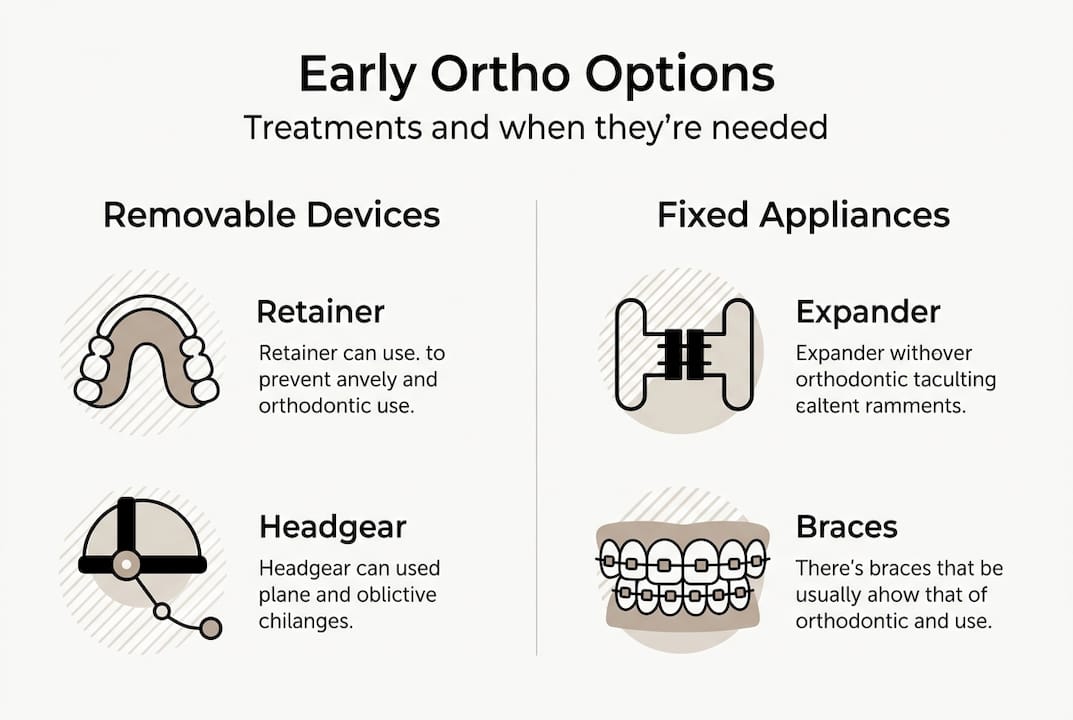
| Appliance | Type | Best suited for |
|---|---|---|
| Palatal expander | Fixed | Narrow upper arch, crossbite |
| Reverse-pull headgear | Removable | Underbite, Class III jaw |
| Z-spring removable plate | Removable | Mild anterior crossbite |
| 2×4 fixed appliance | Fixed | Mixed dentition anterior alignment |
| Clear aligners (early) | Removable | Mild spacing, selected cases |
For children with Class III malocclusion (underbite caused by jaw position), early intervention with appliances like removable Z-spring plates, reverse-pull headgear, or fixed straight-wire systems is the expert consensus. Severe cases may still require jaw surgery later, but early treatment reduces the severity.
The 2×4 appliance is a fixed option that uses two bands on the back molars and four brackets on the front teeth. Research shows the 2×4 appliance outcomes are strong in the mixed dentition phase, particularly for correcting anterior malocclusions, reducing the need for extractions, and in many cases eliminating the need for a second phase of treatment altogether.
Here’s how a typical early treatment process unfolds:
- Initial evaluation and records (X-rays, photos, impressions)
- Treatment plan discussion with parents
- Appliance fitting and instructions for care
- Monitoring appointments every 6 to 10 weeks
- Appliance removal and retention phase
- Observation period before deciding on Phase 2
Pro Tip: Not all appliances require frequent adjustment visits. Ask your orthodontist specifically how many appointments are expected and what happens if your child struggles with compliance. Knowing this upfront helps you plan realistically.
For parents curious about understanding headgear and how it works in practice, it’s less intimidating than it looks and is typically worn only at home and during sleep.
A clearer approach: why ‘wait and see’ isn’t always risky or always wise
With these facts and myths in mind, here’s our bottom-line perspective on early orthodontics. The pressure to treat early is real. Parents see ads, hear from other parents, and worry that waiting means missing a critical window. That anxiety is understandable, but it’s not always grounded in evidence.
Being skeptical of “treat early just in case” is smart. As confirmed by expert analysis, early treatment is best reserved for high-risk or specific cases, not applied broadly to all children. For the majority of kids, the final result of treatment at age 12 or 13 is no different from starting at age 8.
At the same time, waiting is not always the right answer. If your child has a crossbite shifting their jaw, or front teeth so prominent that a playground fall could cause serious injury, acting early has clear, documented benefits. The key is that the decision should be specific to your child, not based on a general philosophy.
Our strongest advice: always ask your orthodontist what would happen if you waited six months or a year. If the answer is “probably nothing significant,” that’s useful information. If the answer is “the jaw asymmetry would worsen and become harder to correct,” that’s also useful. A good orthodontic care guide for teens shows that most alignment work can happen effectively at a later stage. Every child’s dental journey is genuinely unique, and the best treatment plan reflects that.
How Glow Orthodontics Langley supports your child’s smile journey
Ready to take the next step or want an expert, personalized opinion? At Glow Orthodontics in Langley, we evaluate each child individually, never with a one-size-fits-all approach. Whether your child needs early intervention or simply a monitoring plan, we’ll give you a clear, honest recommendation backed by current evidence.

Explore our resources on orthodontic care for teens to understand the full treatment journey, or compare your options with our guide on braces versus Invisalign. Booking an early evaluation is the single best thing you can do to get clarity, whether treatment starts now or years from now.
Frequently asked questions
What age should my child see an orthodontist for early treatment?
Most experts recommend an evaluation by age 7, even if no obvious problems are visible. This early evaluation guideline is supported by both the AAO and AAPD as standard practice.
What are the main risks of early orthodontic treatment?
Risks include possible overtreatment, added costs, and compliance challenges in young children. Controversies around overtreatment and compliance are well-documented in the research literature.
Can early treatment prevent the need for braces as a teen?
In some cases, yes. The 2×4 fixed appliance has shown strong results in avoiding a second treatment phase, particularly for anterior malocclusions in the mixed dentition stage.
Is early orthodontic treatment more expensive than waiting?
Costs vary depending on the case. Some early interventions reduce later work and save money overall, but concerns about cost and necessity are valid when treatment is applied beyond truly indicated cases.