Foods That Damage Braces: What Every Parent Needs to Know
April 27, 2026
Foods That Damage Braces: What Every Parent Needs to Know
TL;DR:
- Certain foods like hard candies, nuts, and sticky treats can break brackets and delay treatment.
- Biological damage from sugary and sticky foods causes enamel white spots, increasing cavity risk.
- Promptly contacting the orthodontist and using protective wax helps minimize damage and treatment delays.
Foods That Damage Braces: What Every Parent Needs to Know
Starting orthodontic treatment is a big investment for any Langley family, and protecting that investment starts at the dinner table. Most parents know to skip hard candy, but the real list of problem foods is much longer and more surprising than you might expect. Everything from a handful of popcorn at movie night to a sports drink after practice can set your child’s treatment back by weeks. This guide breaks down exactly which foods cause damage, why they are so harmful, and what you can feed your child instead, so you can keep treatment on track from day one.
Table of Contents
- Why certain foods damage braces: The science and real impact
- Top foods that damage braces: The must-avoid list
- Comparison chart: Most damaging foods vs. safer swaps
- What to do if damage occurs: Handling broken braces or dental issues
- A local perspective: Why prevention in Langley beats orthodontic repairs
- Where to get help: Expert orthodontic advice for your family
- Frequently asked questions
Key Takeaways
| Point | Details |
|---|---|
| Hard and sticky foods harm braces | Foods like hard candy and sticky gum can break or pull off brackets, causing delays. |
| Sugary drinks worsen oral health | Soda and sports drinks lead to a significantly higher risk of decay and white spots with braces. |
| Prevention reduces emergencies | Planning meals and snacks can nearly eliminate the most common orthodontic issues for kids. |
| Safe swaps make life easier | Choosing softer, braces-friendly alternatives keeps treatment on-track without sacrificing taste. |
Why certain foods damage braces: The science and real impact
Braces are a system of brackets, wires, and bands working together under constant, carefully calibrated pressure. Every single piece plays a role. When a bracket snaps off or a wire bends, that pressure is disrupted, and the tooth that bracket was guiding stops moving until the repair is made. That is not just inconvenient. It adds real time to your child’s overall treatment.
The damage happens in two main ways. First, there is mechanical damage. Hard or crunchy foods apply sudden, intense force to brackets and wires, physically breaking or bending them. Think about biting into a whole apple or crunching down on a handful of chips. The impact travels straight into the bracket bond, which is strong but not designed for that kind of shock loading.
Second, there is biological damage. Sticky and sugary foods cling to brackets, wires, and the spaces between teeth where a toothbrush cannot easily reach. That trapped sugar feeds bacteria, which produce acid. That acid attacks enamel, and because brackets block saliva from naturally rinsing the tooth surface, the damage concentrates in a ring around each bracket. The result is called decalcification, which shows up as permanent white spots on teeth even after braces come off.
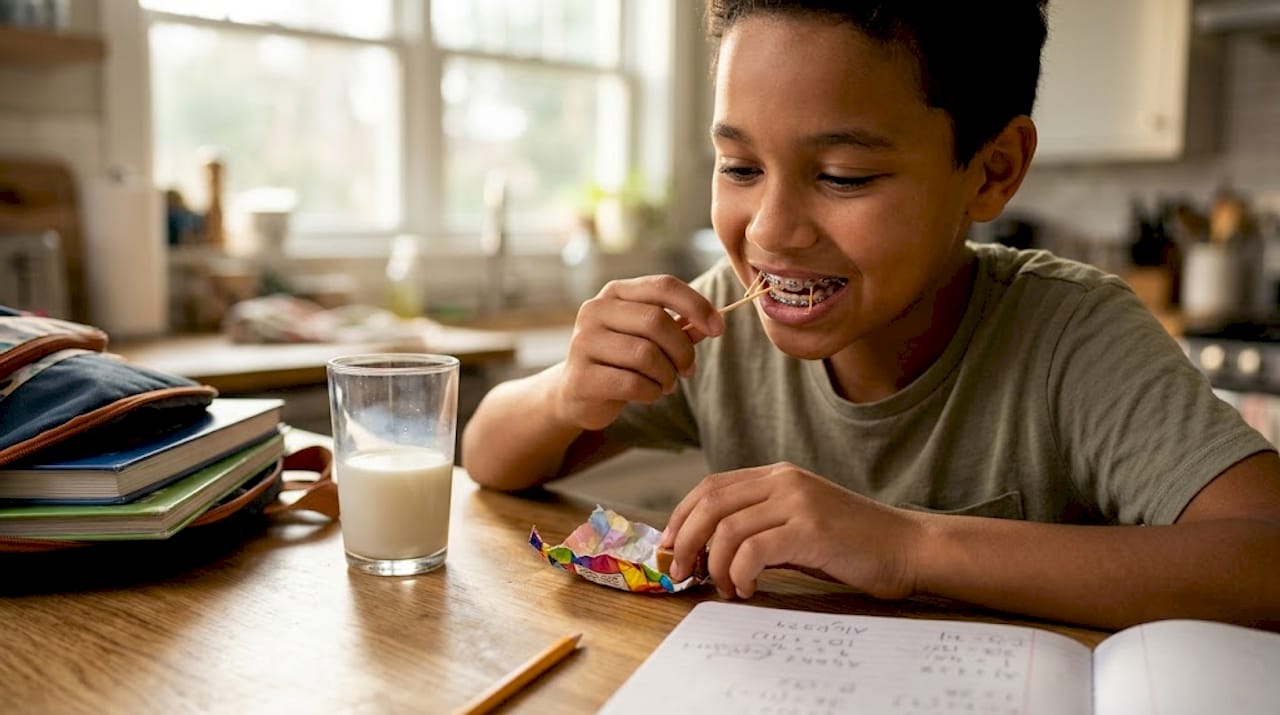
The numbers here are striking. Patients who do not follow dietary guidelines face a 42% higher incidence of white spots and decay around their brackets. That is nearly half of all non-compliant patients walking away from treatment with visible, lasting enamel damage. Separately, 1 in 6 patients experiences treatment delays directly caused by broken brackets or wires, and cavity rates climb 15 to 50% without proper food choices.
To help you see the full picture at a glance, here is a quick reference:
| Food type | Mechanical risk | Biological risk | Likely outcome |
|---|---|---|---|
| Hard foods (candy, nuts, raw carrots) | Very high | Low | Broken brackets, bent wires |
| Sticky foods (caramel, gummy candy) | High | High | Pulled brackets, trapped sugar, decay |
| Sugary drinks (soda, sports drinks) | None | Very high | White spots, enamel erosion |
| Chewy breads (bagels, hard rolls) | Moderate | Low | Wire displacement |
| Crunchy snacks (popcorn, chips) | High | Moderate | Broken brackets, lodged hulls |
Making sure your child understands avoiding cavities with braces as an active goal, not just a side effect of brushing, helps them take ownership. Pairing that with a solid understanding of brushing with braces reduces the biological risk dramatically, especially after meals where sugar was involved.
Key risks to keep in mind:
- Bracket bonds are strong but not indestructible under sudden force
- Saliva cannot reach beneath brackets to neutralize acid naturally
- Nut-related bracket failures spike seasonally, particularly around the holidays when mixed nuts, brittle, and nut-based treats are everywhere in the house
- One broken bracket can stall tooth movement for two or more weeks until it is repaired
Top foods that damage braces: The must-avoid list
With the risks clearly mapped, here is the practical list every parent needs. These are the foods that consistently cause the most problems across orthodontic practices, and the reasons why each one is genuinely risky rather than just cautiously flagged.
All major orthodontic sources, including the American Association of Orthodontists and dental professionals nationwide, are unanimous on avoiding hard, sticky, chewy, and sugary foods during treatment. There are no contrarian voices on this one.
-
Hard candies. Your child is tempted to bite down eventually, and when they do, the impact on brackets is severe. Even sucking on hard candy floods the mouth with sugar for extended periods, dramatically raising decay risk.
-
Popcorn. The hulls are the real enemy. They wedge under wires and between brackets, causing inflammation and sometimes small infections. The unpopped kernels at the bottom of the bowl are bracket-breakers.
-
Nuts and nut brittle. Firm, dense, and full of sudden resistance. Nut-related failures spike predictably in fall and winter when holiday snacking peaks. Even small nuts can shear a bracket bond cleanly off.
-
Chewing gum. Gum wraps around wires and pulls at brackets with every chew. It also traps sugar right against the enamel surface around each bracket. Even sugar-free gum creates mechanical stress.
-
Caramel and toffee. Dense and aggressively sticky, these two foods pull brackets off teeth and are nearly impossible to clean out from around wires afterward.
-
Raw, crunchy vegetables (whole carrots, celery sticks). These are nutritious but need to be modified. Biting into a whole raw carrot generates the same sudden force as biting into hard candy. Steaming or cutting into small pieces solves this.
-
Ice chewing. Many kids absentmindedly chew ice from their drinks. Ice is harder than most foods and hits brackets at unpredictable angles, making it one of the sneakiest causes of bracket breaks.
-
Chips and crackers. They feel soft but splinter into sharp fragments that jam into brackets and under wires. Thick-cut chips are especially risky.
-
Chewy breads and bagels. The chewing force required to get through a dense bagel pulls repeatedly at wires, bending them out of position over time.
-
Soda and sports drinks. The acid and sugar combination in these drinks creates the ideal environment for white spots and decay to form, especially because kids often sip throughout the day, keeping acid levels continuously elevated.
“The consistent message from orthodontic professionals is clear: most foods can be modified or substituted to make them brace-safe, but hard, sticky, and sugary items should simply be removed from the menu during treatment. The adjustment period is short; the results last a lifetime.”
Check out these braces-safe eating out tips for practical strategies when your family is ordering at restaurants or grabbing takeout.
Pro Tip: Soften vegetables by steaming them lightly or cutting them into small, bite-sized pieces. Your child gets the nutrition without the bracket risk. The same approach works for fruits like apples and pears: slice them thin rather than biting in whole.
Comparison chart: Most damaging foods vs. safer swaps
Knowing what to avoid is only half the battle. Your child still needs satisfying snacks and meals throughout the day. Here is a practical side-by-side swap chart you can print out and stick on the fridge.
| Avoid | Safer swap | Why it works |
|---|---|---|
| Hard candy | Dark chocolate (melts, low stickiness) | Less mechanical force, easier to clean |
| Popcorn | Cheese puffs or soft crackers | No hulls, less crunch force |
| Raw carrots and apples | Steamed carrots, thinly sliced apples | Same nutrition, zero bracket risk |
| Gummy candy | Yogurt-covered raisins (in moderation) | Softer texture, less wire wrapping |
| Bagels and chewy rolls | Soft sandwich bread, tortillas | Less repeated jaw force |
| Soda and sports drinks | Water, milk, or diluted fruit juice | Neutral pH, no bracket-area acid pooling |
| Caramel and toffee | Pudding or soft chocolate | Satisfies sweet cravings without sticking |
| Ice chewing | Crushed ice or cold water | Far less hardness, no impact force |
| Thick-cut chips | Soft pretzels or pita with hummus | Less splintering, gentler on brackets |
| Nuts and brittle | Soft cheese cubes or nut butter on bread | Same protein, completely braces-safe |
The AAO guidelines confirm that these kinds of modifications make it possible for kids to enjoy a varied, satisfying diet throughout treatment without risking their brackets or their enamel.
For families considering Invisalign as an alternative, the rules are different. Review the full breakdown of Invisalign-friendly foods to see how that treatment compares for meal flexibility.
Quick braces-safe snack ideas your child will actually enjoy:
- Banana or mango slices
- Soft cheese cubes with whole wheat crackers
- Yogurt with soft granola mixed in
- Scrambled eggs or soft-boiled eggs
- Avocado toast on soft bread
- Smoothies with protein powder for after-school fuel
- Soft-cooked pasta or rice dishes
- Pudding, Jell-O, or soft-serve ice cream for treats
Having these options stocked at home removes the temptation to reach for something risky when hunger strikes after school.
What to do if damage occurs: Handling broken braces or dental issues
Even the most careful families run into accidents. A bracket pops off, a wire pokes the cheek, or your child admits they snuck some popcorn at a friend’s house. What you do in the next few hours matters a lot for how much the incident sets treatment back. Remember, 1 in 6 patients faces a treatment delay from breakage, and most of those delays are made worse by waiting too long to act.
Here is a clear step-by-step process for handling braces damage at home:
-
Stay calm and check the damage. Ask your child where the discomfort is and visually check their mouth with a flashlight. Identify whether a bracket has come loose, a wire has bent, or a band has slipped.
-
Call your orthodontist right away. Do not wait to see if it resolves on its own. Contact the office and describe what happened. At Glow Orthodontics, the team can advise you over the phone on whether the issue needs same-day attention or can wait until the next available appointment. Our orthodontic emergencies guide outlines which situations are urgent.
-
Apply orthodontic wax for comfort. If a wire is poking the cheek or lip, roll a small piece of orthodontic wax into a ball and press it over the sharp end. This is temporary but effective at preventing irritation.
-
Avoid the affected area when eating. Until the repair is made, keep your child eating on the opposite side of the mouth and sticking to extremely soft foods like soup, yogurt, and mashed potatoes.
-
Do not try to fix it yourself. It is tempting to push a wire back into place with a finger or a pencil eraser, but this can cause more damage and make the orthodontist’s job harder.
-
Bring the bracket if it fell out completely. Save it in a small zip-lock bag and bring it to the appointment. The team can often reattach original brackets.
Pro Tip: Put together a small braces first aid kit to keep at home and in your child’s school bag. Include orthodontic wax, a small dental mirror, a travel-size bottle of alcohol-free mouthwash, and a soft-bristled travel toothbrush. Being prepared means you can handle a poking wire or sudden discomfort without panic. Pair this with consistent cleaning braces habits to reduce the chance of damage going unnoticed.
A local perspective: Why prevention in Langley beats orthodontic repairs
Here is something worth saying plainly: the idea that one small treat will not make a difference is the thinking that derails more orthodontic treatments than almost anything else. We see it consistently. A caramel here, a handful of trail mix there, and suddenly a bracket is off and the appointment schedule is disrupted.
Orthodontic repairs in Langley are not just a minor inconvenience. They require your child to miss class or activities, they add stress to your family’s schedule, and they stretch out treatment that you and your child are both eager to finish. The AAO consistently reports that general dietary guidelines apply universally, and the families who follow them closely finish treatment sooner and with better outcomes.
Prevention is not restrictive. It is actually freeing. When Langley parents approach braces food rules as a temporary, purposeful trade-off rather than a deprivation, the whole family adjusts faster and the child experiences far less frustration. Planning snacks ahead, keeping braces-safe foods stocked, and making swap substitutions part of normal family meals eliminates most of the pressure. The result is a smoother, shorter, less stressful orthodontic journey for everyone involved.
Where to get help: Expert orthodontic advice for your family
Every family’s situation is a little different, and sometimes you need answers that go beyond a general guide.

At Glow Orthodontics in Langley, we are here to support your child’s treatment at every stage, from initial consultation through to the final reveal of their completed smile. Whether you have questions about a specific food, need to address an urgent bracket issue, or simply want reassurance that everything is on track, our team makes it easy to reach us. Explore our full orthodontic family guide to understand every phase of treatment, and bookmark our braces hygiene guide to keep your child’s oral health in excellent shape throughout their journey. We are always a call or click away.
Frequently asked questions
Can my child ever eat popcorn or nuts with braces?
Popcorn and nuts should be completely avoided throughout treatment because they are among the most common causes of bracket breaks and wire damage, contributing directly to the 1-in-6 patient delay rate from food-related breakage.
Why do sugary drinks like soda cause more damage compared to other foods with braces?
Sugary drinks flow into every crevice around brackets and stay in contact with enamel far longer than solid foods, producing a 42% greater risk of white spots and decay when dietary guidelines are not followed.
Is it okay to eat sticky candy if my child brushes right after?
Brushing right after eating is always a good habit, but sticky candies can physically pull brackets off or wrap around wires before your child even reaches the toothbrush, and all orthodontic authorities unanimously recommend avoiding them entirely regardless of brushing habits.
If a bracket breaks, what should we do before seeing the orthodontist?
Call your orthodontist right away to report the damage, avoid eating on the affected side, and apply orthodontic wax over any sharp areas for comfort until the appointment; acting quickly reduces the risk of the treatment delays that affect roughly 1 in 6 patients.