Invisalign for Teens: Clear, Confident Smiles in Langley
April 30, 2026
Invisalign for Teens: Clear, Confident Smiles in Langley
TL;DR:
- Recent studies show aligners can treat teens faster and with fewer clinic visits than braces.
- Invisalign offers similar long-term results to braces, with higher patient comfort and satisfaction.
- Success depends on teen responsibility in wearing aligners consistently and parental monitoring.
Most parents walking through our doors in Langley assume metal braces are the only reliable way to fix their teenager’s teeth. It’s a reasonable assumption, but it’s outdated. Recent research shows that teens treated with aligners often finish treatment faster and with fewer clinic visits than those in braces, while reporting higher satisfaction with their experience. Invisalign has come a long way, and today it’s a clinically credible, teen-friendly option that many families don’t realize they have. This guide walks you through exactly how it works, how it compares, and what your teen needs to succeed.
Table of Contents
- How does Invisalign work for teens?
- Comparing Invisalign and traditional braces for teens
- What challenges and responsibilities come with Invisalign for teens?
- Is Invisalign right for your teen? Key factors to consider
- A different perspective: Why involvement matters more than appliance choice
- Next steps: Expert Invisalign support for Langley families
- Frequently asked questions
Key Takeaways
| Point | Details |
|---|---|
| Comparable results | Invisalign and braces deliver similar long-term results for teens. |
| Higher satisfaction | Most teens prefer the comfort and discreet look of Invisalign aligners. |
| Responsibility is critical | Success with Invisalign depends on consistent daily wear and good habits. |
| Consultation matters | A professional assessment ensures Invisalign is the right fit for your teen. |
How does Invisalign work for teens?
Understanding the mechanics of Invisalign helps parents feel confident when their teen is asking about it. It’s not a gimmick or a cosmetic shortcut. It’s a structured orthodontic treatment that uses a series of custom-made, clear plastic aligner trays to shift teeth into the correct position over time.
The step-by-step process looks like this:
- Initial consultation: Your orthodontist evaluates your teen’s teeth, bite, and jaw alignment to determine whether Invisalign is appropriate.
- Digital scanning: Instead of messy impressions, a 3D digital scan maps your teen’s teeth precisely. This data generates a treatment simulation so you can actually see the projected result before anything starts.
- Custom aligner trays: A series of trays is fabricated, each one slightly different, designed to move specific teeth by small increments. Teens typically switch to a new tray every one to two weeks.
- Progress check-ins: Your teen comes in for monitoring appointments, which are generally shorter and less frequent than braces adjustments.
- Refinements: Near the end of treatment, small refinements may be made to fine-tune the final result.
One feature specifically designed for teen patients is the compliance indicator. Each Invisalign tray for teens includes small blue dots that fade with wear time. If the dots are still vivid blue when they should be faded, you know the aligners haven’t been worn enough. This is a practical, built-in monitoring tool that removes the guesswork for parents.
“Understanding whether clear aligners work as effectively as traditional options is one of the first questions families ask us, and the clinical data now gives us clear answers.”
In terms of timeline, teens receiving aligner treatment with mild to moderate issues often complete treatment in approximately 16.9 months compared to 23.4 months for traditional braces, and with an average of 13.7 visits versus 19.3 visits for braces. That’s a meaningful difference in both time and convenience for busy Langley families managing school, sports, and extracurricular schedules.
Teens value Invisalign for obvious reasons. There’s no metal to catch on lips, no brackets to break during football or dance, and no awkward smiling at school photos. The aligners are nearly invisible, and they come out for meals, brushing, and special events. For teenagers navigating one of the most self-conscious stages of life, that kind of discretion genuinely matters.
Comparing Invisalign and traditional braces for teens
Once families understand how Invisalign works, the most pressing question is almost always: but does it actually work as well as braces? It’s a fair question, and the answer is more reassuring than many parents expect.
A long-term study of 200 patients found that both Invisalign and traditional braces produced nearly identical dental alignment outcomes, with post-treatment irregularity measured at 1.6mm for Invisalign and 1.5mm for braces. At the five-year follow-up, both groups measured 0.2mm. Overjet reduction was similarly comparable. The one area where Invisalign pulled ahead? Patient satisfaction. Teens wearing aligners consistently reported higher comfort and greater satisfaction with their overall treatment experience.
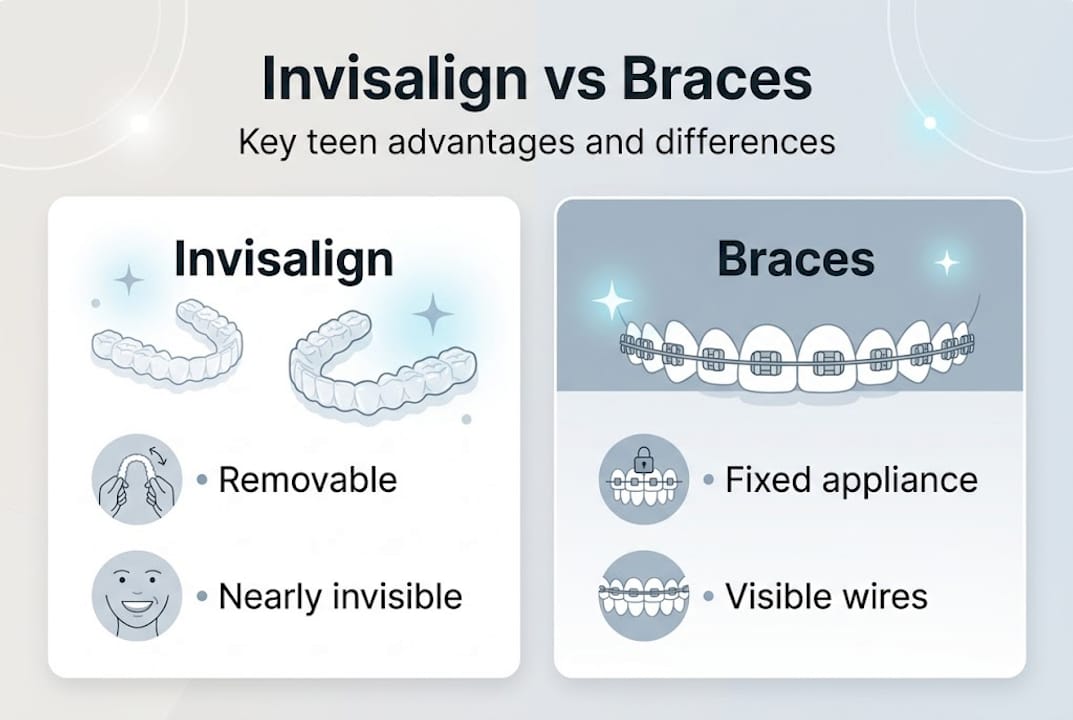
Here’s a direct side-by-side comparison of the two options:
| Factor | Invisalign | Traditional braces |
|---|---|---|
| Visibility | Nearly invisible | Noticeable metal brackets |
| Comfort | Smooth plastic, less irritation | Wire and bracket friction common |
| Eating restrictions | None, remove before meals | Many foods off-limits |
| Oral hygiene | Brush and floss normally | More complex, requires special tools |
| Compliance required | High (20–22 hrs/day) | Built-in (non-removable) |
| Sports and activities | Aligners removed for contact sports | Mouthguard required, more risk |
| Appointment frequency | Less frequent | More frequent adjustments |
| Effectiveness | Comparable for most cases | Proven for complex cases |
“Families comparing the differences between braces and Invisalign often discover that the practical day-to-day experience is where the biggest contrasts show up.”
Looking at practical daily life, braces win in one specific category: they don’t require willpower. Because they’re fixed, teens don’t have to remember to put them back in after lunch. That’s a real consideration. But on almost every other daily factor, including eating, hygiene, comfort, and confidence in social settings, Invisalign has a clear edge.
For Langley parents with active teens in sports, music, or performing arts, the removable nature of aligners means fewer interruptions and far less risk of injury. There’s no wire to snap during a volleyball game, and no bracket to cut a cheek during a school play. When exploring your options, reviewing what Invisalign vs braces means for kids in terms of real daily life can help you make the decision with confidence rather than assumptions.

The honest takeaway is this: both options work. The choice comes down to your teen’s specific case, their maturity, and what will support the best daily experience over the course of treatment.
What challenges and responsibilities come with Invisalign for teens?
Being honest about the challenges is just as important as celebrating the benefits. Invisalign is not the right fit for every teen, and most treatment failures come down to one thing: inconsistent wear.
Aligners must be worn 20 to 22 hours every single day to move teeth as planned. That leaves only two to four hours for eating, drinking anything other than water, and brushing. This sounds simple until you’re a teenager who forgets the case at school, pockets the aligners before lunch and doesn’t put them back in for three hours, or removes them for band practice and loses them in a backpack.
Empirical data on aligner efficacy confirms that Invisalign delivers comparable long-term results to braces when worn consistently, but that success genuinely hinges on teen responsibility and parental monitoring of the wear indicators.
The top five responsibilities every teen needs to commit to:
- Wear aligners for 20 to 22 hours daily, no exceptions during the week.
- Remove aligners only for eating, drinking, and oral hygiene, not for convenience or comfort.
- Brush teeth thoroughly before reinserting aligners to prevent bacteria and staining.
- Clean the aligners daily using a soft brush and lukewarm water, never hot water which warps the plastic.
- Store aligners in the case whenever removed. Napkin disposal is the most common cause of lost trays.
Parents play a genuinely important role here. Checking the blue compliance indicators at each tray change takes about ten seconds and tells you a lot. Keeping a spare aligner case in the school bag, car, and at home reduces lost-tray situations dramatically. If your teen is motivated and understands the stakes, reviewing practical Invisalign tips together early in treatment sets everyone up for fewer frustrations.
Good oral hygiene with aligners is also non-negotiable. Trapping food particles under aligners creates an ideal environment for cavities and gum irritation. Teens who skip brushing before reinserting their trays often end up with unnecessary dental problems on top of their orthodontic treatment.
Pro Tip: Set a phone alarm for after every meal as a reinsertion reminder. It takes about three weeks to build the habit, and after that, most teens do it automatically without the prompt.
Is Invisalign right for your teen? Key factors to consider
Not every teenager is automatically a candidate for Invisalign, and part of making a confident decision is knowing what situations it handles best and where it has limits.
Invisalign works well for a broad range of orthodontic concerns, including:
| Condition | Invisalign effectiveness |
|---|---|
| Mild to moderate crowding | Excellent |
| Spacing issues | Excellent |
| Open bite | Very good |
| Overbite | Good |
| Crossbite | Good for mild cases |
| Severe crowding or jaw issues | Better with braces |
For open bite specifically, the results are impressive. A clinical study of 50 patients showed that Invisalign improved mean overbite from -3.5mm to +1.5mm over 18 months, with 90% patient satisfaction. That’s a significant correction for a condition many parents assume requires more aggressive treatment.
Understanding the difference between conditions like overjet vs overbite is worthwhile before your consultation, so you can have an informed conversation with your orthodontist about which measurements apply to your teen and what treatment would address them most effectively.
Questions worth asking your Langley orthodontist:
- Is my teen’s bite issue within the range Invisalign handles well?
- What’s the estimated treatment length based on their specific case?
- What happens if aligners are lost or damaged?
- Are there any features of Invisalign Teen, like the compliance indicators and extra replacement trays, included in the plan?
On the financial side, Invisalign for teens is often priced comparably to braces in Langley practices, especially when your teen’s dental plan includes orthodontic coverage. Understanding your insurance for Invisalign before the consultation means you won’t have any surprises when the treatment plan is presented. Many families discover their coverage applies equally to both braces and aligners, making the decision genuinely about fit rather than cost.
Pro Tip: Ask the orthodontic office to run a pre-authorization through your insurance before committing. This gives you a realistic out-of-pocket number and removes financial stress from what should be a health-focused decision.
Teens who are self-motivated, active in school or sports, and genuinely bothered by the idea of visible metal are typically the best candidates. Teens who tend to lose things, resist routines, or are indifferent to the aesthetic difference may do better with the structure that fixed braces provide.
A different perspective: Why involvement matters more than appliance choice
Here’s something we rarely hear in conversations about orthodontics: the appliance is almost never what determines the outcome. The relationship between the parent, the teen, and the orthodontic team is.
We’ve seen teens in braces who don’t follow care instructions and end up with poor results. We’ve also seen teenagers in Invisalign who track their wear time, clean their trays consistently, and finish treatment months ahead of schedule with beautiful results. The pattern isn’t tied to the hardware. It’s tied to accountability and support.
Invisalign gives teens ownership over their treatment in a way that braces don’t. That can be powerful for the right teenager. But ownership without structure fails quickly. Parents who check in regularly, not to police but to encourage, make a real difference in outcomes.
The best results we see come from families who treat orthodontic treatment as a shared project. The orthodontist provides the clinical roadmap. The teen commits to the daily habits. The parent stays engaged without taking over. That three-way partnership, explored in depth in our complete orthodontic guide, matters more than whether the treatment uses plastic trays or metal brackets.
Don’t let the appliance debate distract from the more important conversation, which is whether your teen is ready to take on the responsibility and whether your family has a plan to support them.
Next steps: Expert Invisalign support for Langley families
If you’ve been weighing Invisalign for your teenager, the clearest next step is a conversation with an orthodontic team who knows the full picture. A proper evaluation, not just a quick opinion, tells you whether your teen’s bite and spacing make them a strong candidate and what a realistic timeline looks like for their specific situation.

At Glow Orthodontics in Langley, we work with teens and their families every day to figure out the right path forward. Whether that means Invisalign, braces, or another approach entirely, we walk you through every step in plain language so there are no surprises. Before your appointment, it helps to review the common Invisalign care mistakes so you walk in with informed questions. Book a consultation with us and get the clarity your family deserves.
Frequently asked questions
How long does Invisalign treatment take for most teens?
Most teens complete Invisalign in roughly 17 months, which is notably shorter than braces at an average of 23.4 months for comparable cases.
Do Invisalign aligners work for teens with bite issues?
Yes, for many bite problems including open bite, Invisalign is highly effective. A clinical study showed overbite improvement from -3.5mm to +1.5mm with 90% patient satisfaction across 50 treated patients.
Is Invisalign as effective as braces for teenagers?
Long-term research shows comparable alignment outcomes for both methods at five-year follow-up, with Invisalign patients reporting higher overall satisfaction with their treatment experience.
How can I help my teen succeed with Invisalign?
Check the blue compliance indicators each time your teen switches trays and encourage 20 to 22 hours of daily wear. Parental monitoring of wear indicators is identified in research as one of the key factors in treatment success.
What should I ask the orthodontist before starting Invisalign?
Ask about your teen’s specific candidacy, projected treatment length, what’s included if trays are lost or broken, how insurance coverage applies, and how the daily responsibilities compare to what braces would require.