Orthodontic Assessment for Kids: What Parents Should Know
April 22, 2026
Orthodontic Assessment for Kids: What Parents Should Know
TL;DR:
- An early orthodontic assessment is recommended by age 7 to detect developing jaw issues.
- The consultation involves history review, facial exam, photos, X-rays, and 3D scans in under an hour.
- Most children are monitored without immediate treatment, with early intervention used only for specific issues.
Many parents believe orthodontic treatment starts with braces during the teen years. The truth is that expert groups like the American Association of Orthodontists (AAO) recommend a first assessment by age 7, well before most parents think to schedule one. If you have a child between 7 and 12 in Langley, BC, this guide walks you through exactly why early checks matter, what happens at a real consultation, and how to make smart, personalized decisions about your child’s smile without rushing into unnecessary treatment.
Table of Contents
- Why assess early? The science behind the recommendation
- Step-by-step: What happens during an orthodontic assessment
- Personalized care: How Langley offices tailor treatment for your child
- Treatment planning: When early intervention is needed (and when to wait)
- A fresh perspective: Why smart assessment is better than early braces for every child
- Next steps for orthodontic assessment in Langley
- Frequently asked questions
Key Takeaways
| Point | Details |
|---|---|
| Start assessments by age 7 | Children should have their first orthodontic check-up at age 7 for best long-term results. |
| Comprehensive evaluations matter | A detailed exam including scans and X-rays reveals hidden issues early. |
| Personalized approaches work best | Langley providers tailor treatments with child-friendly and digital methods. |
| Early intervention is not always needed | Most kids only need regular monitoring, with early treatment reserved for specific cases. |
| Understand all your options | Comparing clear aligners and braces helps families make informed decisions. |
Why assess early? The science behind the recommendation
Most parents picture orthodontics as a teenage rite of passage. Braces come on at 13, come off at 15, done. But the biology of a growing jaw doesn’t wait for high school.
Between ages 6 and 12, children go through what orthodontists call the mixed dentition phase. Baby teeth are falling out, permanent teeth are coming in, and the jaw is actively reshaping itself. This window is uniquely valuable because early detection of jaw problems during this phase is far easier than correcting them later when growth has slowed.
Here’s what an early assessment can identify:
- Crowding: Too little space for permanent teeth to erupt correctly
- Crossbites: Upper and lower teeth that don’t align side to side
- Jaw growth imbalances: Upper or lower jaw developing too far forward or backward
- Thumb-sucking or tongue-thrust habits: Which can reshape the palate over time
- Spacing issues: Gaps that suggest missing or impacted teeth
The risk of waiting is straightforward. Problems that are minor at age 7 can become structurally complex by age 13 because the bones have hardened and jaw growth has largely finished. Early intervention reduces overjet and can shorten total treatment time later on. That’s not a marketing pitch. It’s a measurable clinical outcome.
“The goal of an early assessment is not to immediately start treatment. It’s to know what’s happening so nothing comes as a surprise.”
Families in Langley sometimes feel uncertain about which provider to trust. If you’re still exploring your options, it helps to review a comparison of comparing Langley kids orthodontists before booking.
Pro Tip: An age-7 assessment doesn’t mean your child will leave with braces. Most kids who visit early simply get a growth-monitoring plan. The visit is about information, not commitment.
Establishing why early assessment is critical, next we detail exactly what an orthodontic assessment involves.
Step-by-step: What happens during an orthodontic assessment
Now that the reasons for early checks are clear, here’s what your child’s appointment actually looks like.
A modern orthodontic consultation for a child aged 7 to 12 is thorough but not intimidating. Most offices in Langley complete the full process in under an hour. Here’s the typical sequence:
- Medical and dental history review: The orthodontist asks about past dental work, any breathing or sleeping concerns, habits like thumb sucking, and family history of orthodontic issues.
- Clinical facial and bite exam: The provider looks at facial symmetry, jaw alignment, how the upper and lower teeth meet (called the occlusion), and how the soft tissues behave during movement.
- Photographs: Standardized photos of the face and teeth from multiple angles. These become your child’s baseline record.
- X-rays: Panoramic X-rays show all teeth (including unerupted ones) and bone levels. A lateral cephalometric X-ray reveals jaw position and growth direction.
- 3D digital scan: Many Langley offices now use intraoral scanners instead of messy traditional molds. The scan creates a precise digital model of your child’s teeth in minutes.
Core methodologies include clinical exam, digital imaging, and growth prediction, which together give the orthodontist a complete picture.
| Diagnostic tool | What it shows | Why it matters |
|---|---|---|
| Panoramic X-ray | All teeth, roots, bone | Spots impacted or missing teeth |
| Cephalometric X-ray | Jaw angle and growth direction | Guides timing of intervention |
| 3D digital scan | Tooth shape, spacing, bite | Enables custom aligner planning |
| Clinical photos | Face, smile, profile | Tracks changes over time |
Once data is collected, the orthodontist reviews findings with you during the same visit. You’ll learn whether your child is on track, needs monitoring, or has a specific issue to address. Understanding the range of options available can also help. Reviewing types of braces for kids or reading up on braces vs Invisalign options before the appointment means you’ll be ready to ask informed questions.
Pro Tip: Ask the office ahead of your visit whether they offer complimentary 3D scans during consultations. Many Langley providers include this at no charge, and it removes the most uncomfortable part of a traditional exam.
Personalized care: How Langley offices tailor treatment for your child
After understanding the steps, it helps to know how care is customized for each child.
No two kids have the same jaw, the same growth timeline, or the same comfort level in a dental chair. That’s why the best orthodontic assessments in Langley go beyond collecting data. They use that data to build a plan that fits your specific child.
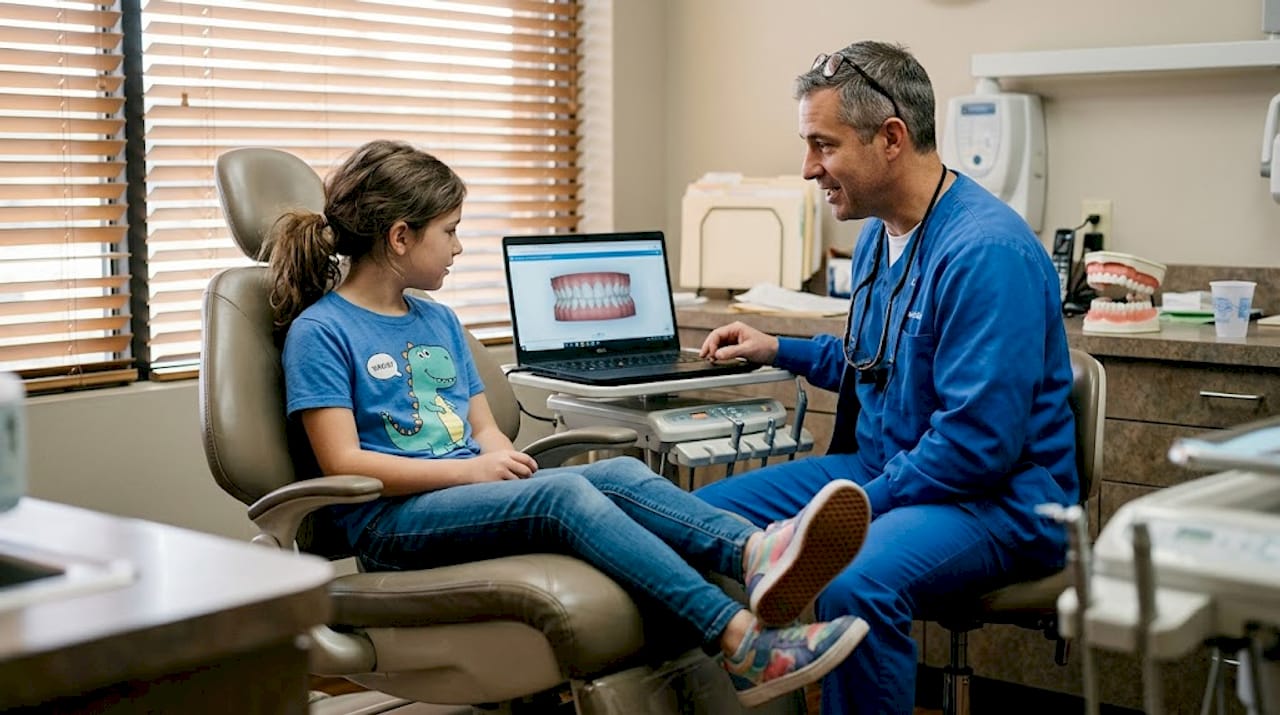
Digital scans and clear aligner planning go hand in hand. When a provider has a precise 3D model, they can map out aligner stages, predict tooth movement, and determine whether Invisalign or a similar system is developmentally appropriate. Personalized care using 3D scans for custom Invisalign plans is now standard practice for children aged 7 to 12 in well-equipped Langley clinics.
| Feature | Metal braces | Invisalign (clear aligners) |
|---|---|---|
| Comfort | Fixed, may cause irritation | Removable, generally more comfortable |
| Hygiene | Harder to clean around brackets | Removable for brushing and flossing |
| Appearance | Visible metal | Nearly invisible |
| Suitability (ages 7-12) | Most bite and crowding cases | Milder cases, strong compliance needed |
| Cost range | Often lower baseline cost | Varies; often comparable with digital planning |
Child-friendly offices also adapt the environment itself. Shorter appointment times, gentle staff communication, and less invasive imaging tools all reduce anxiety and build trust over time.
Key factors to consider when choosing a Langley provider:
- Does the office follow AAO and Canadian Dental Association (CDA) guidelines?
- Is a free or low-cost consultation available?
- Do they offer 3D scanning without traditional impressions?
- Are they transparent about whether early treatment is actually recommended for your child?
“The right orthodontic office feels less like a medical appointment and more like a team working with your family.”
Connecting with child-friendly orthodontic providers in Langley can help you find an office that checks every box.
Treatment planning: When early intervention is needed (and when to wait)
Once the assessment is complete, the orthodontist will discuss if action is needed—or not.
This is where a lot of parents feel pressure. The assessment is done, the scans are in front of you, and you’re wondering: does my child need something now? The honest answer is: probably not immediately.
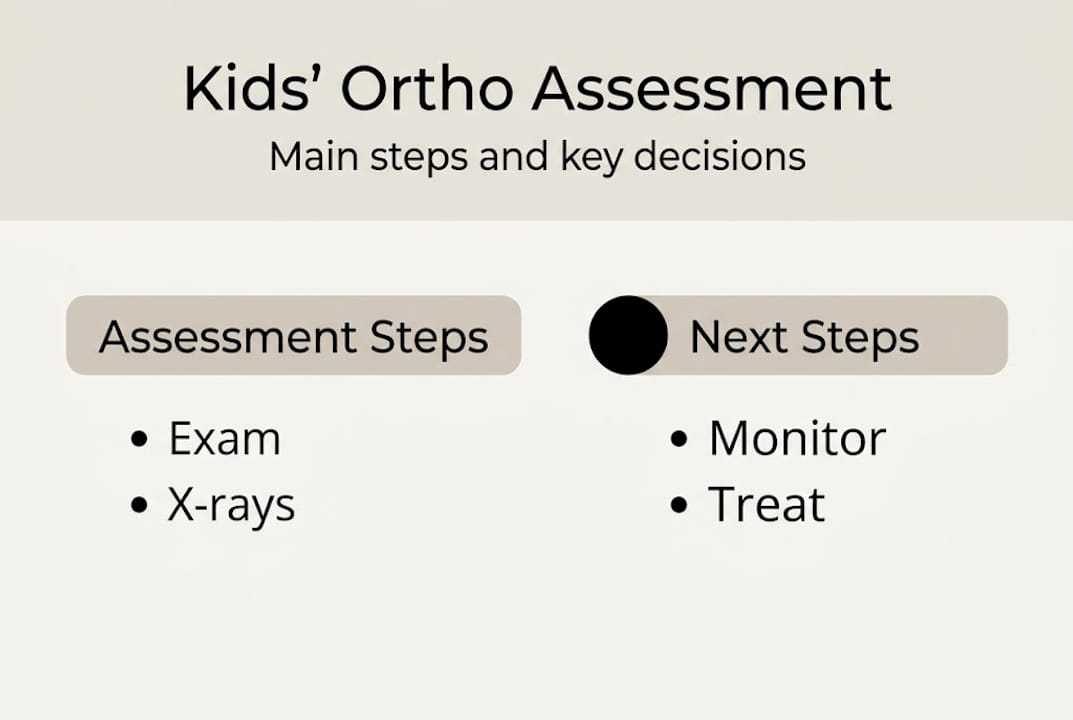
Phase 1 treatment, also called interceptive orthodontics, refers to early action taken before all permanent teeth have erupted. It typically involves palate expanders, partial braces, or growth-guidance appliances. It usually lasts 9 to 18 months and is followed by a resting period before any Phase 2 (full braces or aligners) begins.
Here’s the important reality: only about 15% of children who have an orthodontic assessment actually need Phase 1 treatment. The majority are best served by monitoring as they grow.
Single-phase treatment in adolescence is just as effective as two-phase treatment for many children. A good orthodontist will tell you that directly.
Signs that early action may genuinely be needed include:
- A confirmed crossbite affecting jaw development
- Significant crowding with no room for incoming permanent teeth
- Jaw growth imbalance that will worsen if not guided early
- Oral habits (like thumb sucking past age 6) reshaping the palate
- Difficulty chewing or biting due to bite misalignment
For issues like a Class III underbite (lower jaw extends beyond upper), providers sometimes recommend waiting until growth slows before deciding on surgical vs. orthodontic correction. The so-called “ugly duckling stage,” where front teeth look widely spaced, often resolves on its own as canines erupt.
Treatment plans are never static. A good provider revisits the plan every 6 to 12 months as your child grows. Exploring what comes next for older kids is also worth reading about, including orthodontic care for teens and understanding the safety of braces for children in Langley.
A fresh perspective: Why smart assessment is better than early braces for every child
There’s a version of orthodontic marketing that treats early intervention as the safest default. Start early, avoid problems later. It sounds logical. But the evidence doesn’t fully support that position.
Two-phase treatment is not universally superior to waiting and treating in adolescence. For many children, monitoring and then treating at the right developmental moment produces outcomes just as good, with less total chair time and lower cost.
What does make a difference is the quality of the initial assessment. A provider who collects thorough 3D records, tracks growth over time, and makes decisions based on what your child specifically needs is worth far more than one who defaults to early intervention for every crooked tooth.
The smarter question to ask at any Langley orthodontic office is not “when do we start?” but “what does the data say we should do?” Good monitoring is an active choice, not a passive delay.
Pro Tip: Ask your orthodontist to specifically explain which findings would trigger treatment versus continued monitoring. A confident provider will give you a clear, personalized answer.
Many offices in Langley now use digital records and 3D planning tools that make these decisions far more precise than they were even five years ago. That precision is what protects your child from unnecessary procedures.
Next steps for orthodontic assessment in Langley
You now have a clear picture of what early assessment involves, why it matters, and how to tell whether your child actually needs treatment or just careful monitoring. The next step is connecting with a provider who takes this approach seriously.

At Glow Orthodontics Langley, families receive personalized consultations that use 3D digital scanning and evidence-based planning to match each child’s unique development. Whether you’re comparing clear braces versus Invisalign or exploring what a growth-monitoring plan looks like, the team is ready to walk you through it. For older kids approaching their teen years, you can also read more about orthodontic care for teens. Booking a consultation is the simplest first step toward a confident decision.
Frequently asked questions
At what age should my child have their first orthodontic assessment?
Most experts, including the AAO, recommend an initial check by age 7, even if your child has no visible issues. Earlier checks give providers a useful growth baseline.
What will happen at my child’s initial orthodontic consultation?
The orthodontist will review your child’s history, examine the face and bite, take photos and X-rays, and often complete a 3D digital scan to support personalized planning. The whole visit typically takes under an hour.
What is Phase 1 treatment, and does every child need it?
Phase 1 is early interceptive care, usually expanders or partial braces, for specific developmental problems. Only about 15% of kids need it based on current guidelines. Most children do well with monitoring.
Are clear aligners like Invisalign an option for children?
Yes, especially when digital scans allow for precise planning. Aligner readiness depends on your child’s dental development, daily habits, and the provider’s clinical recommendation.
What if the orthodontist says my child just needs monitoring?
That’s actually a positive outcome. Monitoring is often preferred over routine early intervention, meaning your child will have regular check-ins so the right time for treatment, if needed, is never missed.
Recommended
- Top 6 Virtual Orthodontic Consultations – Expert Comparison 2025 – RG API
- 7 Key Differences Between Invisalign vs Braces for Kids – RG API
- Invisible Braces for Kids: Confidence Without Metal – RG API
- Are Braces Safe? What Families in Langley Need to Know – RG API
- Play and child development: A parent’s guide for 2026 – The World Game