Orthodontic Emergencies Explained: Solutions for Parents & Teens
April 14, 2026
Orthodontic Emergencies Explained: Solutions for Parents & Teens
TL;DR:
- Most orthodontic emergencies are minor and manageable with proper knowledge and calm response.
- Key emergency situations include severe pain, trauma, bleeding, and swallowed appliances; others can often wait.
- Preparation, including having a kit and clear plans, helps families handle issues confidently and reduces stress.
When your child’s bracket snaps off at 9 PM on a Friday, panic sets in fast. The truth is, bracket failure occurs in ~32% of orthodontic patients over the course of treatment, making these moments far more common than most families expect. Orthodontic emergencies can feel overwhelming, but the vast majority are manageable with the right knowledge and a calm approach. This guide is built specifically for parents and teens in Langley, BC, who want to know exactly what to do, when to call for help, and how to stay prepared so a broken wire never ruins your week again.
Table of Contents
- What counts as an orthodontic emergency?
- Most common causes of orthodontic emergencies in kids and teens
- Immediate steps to handle common orthodontic emergencies
- When to seek urgent care vs. wait for your next appointment
- Our perspective: What most parents miss about orthodontic emergencies
- Local support for Langley families: Choosing your orthodontic expert
- Frequently asked questions
Key Takeaways
| Point | Details |
|---|---|
| Emergencies defined | Most orthodontic emergencies in children and teens are minor and manageable at home. |
| Common triggers | Sports, hard foods, and flossing mistakes are the leading causes of bracket and wire problems. |
| Immediate actions | Wax and saltwater rinses solve most issues while waiting for an orthodontist. |
| When to seek help | Severe pain, bleeding, or trauma always require prompt professional attention. |
| Support matters | Teamwork between families and orthodontic providers lowers anxiety and prevents complications. |
What counts as an orthodontic emergency?
Not every orthodontic problem is a true emergency, and knowing the difference saves you a lot of stress. Pediatric dental emergencies are about 8% orthodontic-related, which means most kids will experience at least one issue during treatment. But “issue” does not always mean “emergency.”
A true orthodontic emergency involves one or more of these situations:
- Severe or uncontrolled pain that over-the-counter pain relief cannot manage
- Trauma to the mouth, jaw, or face (from a fall or sports injury)
- Active bleeding that does not stop within a few minutes
- A loose or swallowed appliance that poses a choking or swallowing risk
- Significant swelling around the gums, jaw, or face
A non-emergency covers things like a loose bracket that is still attached to the wire, mild soreness after an adjustment, or a slightly poking wire that orthodontic wax can cover temporarily. Understanding what qualifies as an orthodontic emergency helps you respond with confidence rather than fear.
Here is a quick-reference table to help you sort out your situation:
| Situation | Emergency? | Action |
|---|---|---|
| Severe pain or trauma | Yes | Call your orthodontist or go to urgent care |
| Active, uncontrolled bleeding | Yes | Seek immediate care |
| Loose bracket (still on wire) | No | Apply wax, call next business day |
| Poking wire causing irritation | No | Use wax, call to schedule repair |
| Lost aligner | No | Wear previous tray, contact office |
| Swallowed appliance | Yes | Seek medical attention immediately |
| Mild soreness after adjustment | No | Rinse with salt water, monitor |
“Most orthodontic issues that feel urgent are actually minor and can be safely managed at home for a short period. The goal is knowing which situations truly cannot wait.” This is the reassurance every parent needs when the panic hits.
For a broader look at the topic, this orthodontic emergencies resource walks through common scenarios in detail.
Most common causes of orthodontic emergencies in kids and teens
Once you know what emergencies are, it is important to understand what causes them and how to prevent many common issues before they happen.
Sports injuries are one of the leading triggers, especially for kids aged 10 to 14 who are active in contact sports like hockey, soccer, and basketball. Hard and sticky foods (think caramel, popcorn, and hard candy) are close behind. Rough or careless flossing can also dislodge brackets or bend wires unexpectedly.

Research shows that bracket failure is around 32%, with mandibular (lower jaw) brackets failing more often than upper ones. The longer a patient is in treatment, the higher the cumulative risk of experiencing at least one detachment.
Here is how causes compare between younger children and teenagers:
| Cause | Children (7-12) | Teenagers |
|---|---|---|
| Sports injuries | Moderate risk | High risk |
| Hard or sticky foods | High risk | High risk |
| Poor compliance with care | Lower (parent-supervised) | Higher (independent) |
| Rough flossing or brushing | Moderate | Moderate |
| Longer treatment duration | Less common | More common |
For special considerations for teens, independence plays a big role. Teens are more likely to eat foods they should avoid and less likely to report a problem right away.
Here are three practical ways to reduce your family’s risk:
- Stick to the approved food list. Avoid hard, crunchy, and sticky foods throughout treatment. This single habit prevents the majority of bracket failures.
- Use proper brushing and flossing technique. Gentle, consistent care around brackets protects both the appliance and the gums. Learn more about preventing bracket issues with good oral hygiene habits.
- Schedule regular check-ins with your orthodontist. Catching a slightly loose bracket early prevents it from becoming a bigger problem later.
Pro Tip: If your child plays any contact sport, invest in a custom-fitted mouthguard. A standard over-the-counter guard is better than nothing, but a custom one fits over braces properly and offers significantly better protection.
Immediate steps to handle common orthodontic emergencies
Understanding causes is great, but quick action matters most in the moment. Here is what to do right away if your child encounters a problem.
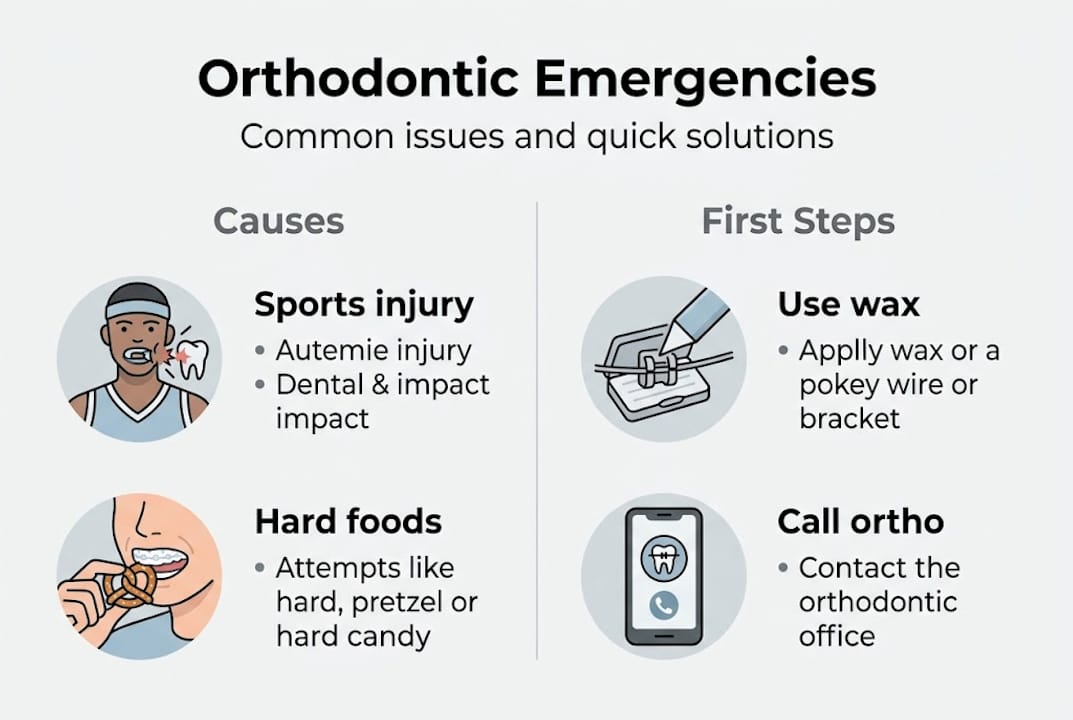
Over 30% of patients experience bracket or wire failure at some point during treatment. That means you are very likely to face one of these scenarios, so having a plan ready makes all the difference.
Follow these steps based on the most common situations:
- Loose or broken bracket: Do not try to remove it. If it is still attached to the wire, leave it in place and cover it with orthodontic wax to prevent irritation. Avoid hard foods until it is repaired.
- Poking wire: Use the eraser end of a pencil or a clean cotton swab to gently push the wire flat against the tooth. If it will not move, cover the tip with a small ball of orthodontic wax. Do not cut the wire yourself unless you have been instructed to do so.
- Lost or broken aligner: Put in the previous aligner in your series to hold your teeth in position. Contact your orthodontist as soon as possible to arrange a replacement.
- Sore spots or mouth irritation: Rinse with warm salt water (half a teaspoon of salt in eight ounces of water) two to three times a day. This reduces inflammation and keeps the area clean. Check out detailed emergency handling steps for more specific guidance.
- Broken retainer: Stop wearing it immediately if it has sharp edges. Store it safely and call your orthodontist to schedule a replacement.
For keeping the area around a damaged bracket clean, follow tips for cleaning around broken brackets to avoid buildup and irritation while you wait for your repair appointment.
“The most important thing a parent can do in an orthodontic emergency is stay calm. Kids take their cues from you. A measured, practical response turns a stressful moment into a manageable one.”
If your child is new to braces or adjusting to a new appliance, getting used to new appliances can help set the right expectations from the start.
Pro Tip: Build a small ortho first-aid kit and keep it in your bathroom or your teen’s backpack. Include orthodontic wax, a small mirror, a clean pair of tweezers, over-the-counter pain relief, and a container of salt. You will be glad you have it.
When to seek urgent care vs. wait for your next appointment
It is just as important to recognize when you need a professional’s help versus when at-home solutions are enough.
Bracket failure increases with length of treatment, which means the longer your child is in braces, the more likely you are to face a repair situation. Most of these situations do not require a same-day visit. But some absolutely do.
Go to urgent care or call your orthodontist immediately if you notice:
- Facial swelling that is spreading or getting worse
- A jaw injury or suspected fracture after a fall or impact
- Bleeding from the mouth that does not stop after 10 minutes of gentle pressure
- A piece of appliance that has been swallowed or inhaled
- Severe pain that is not relieved by over-the-counter medication after one hour
It is usually safe to monitor at home and call during office hours if:
- A bracket is loose but still attached to the wire
- A wire is slightly poking but manageable with wax
- There is mild soreness after a recent adjustment
- An aligner feels slightly tight after a missed wearing session
Watch for these symptoms at home over the next 24 to 48 hours:
- Increasing pain or swelling (this signals you should call sooner)
- Redness or pus around the gums near a bracket
- Difficulty swallowing or breathing (go to the emergency room immediately)
- A wire that has shifted and is now pressing into soft tissue
For guidance on deciding between urgent care and home care, the key question to ask is: “Is this getting better or worse?” If it is getting worse, do not wait. Understanding the risks of delaying repairs is also worth reviewing, because even a loose bracket left too long can allow teeth to shift out of alignment.
Statistic to keep in mind: The vast majority of orthodontic emergencies resolve without permanent harm when addressed promptly and correctly. Early action almost always prevents bigger problems.
Our perspective: What most parents miss about orthodontic emergencies
Beyond the clinical steps, our experience as orthodontic professionals reveals an important truth: the families who handle emergencies best are not the ones who never have problems. They are the ones who prepared ahead of time.
Most parents either overreact to a loose bracket (rushing to the ER when a little wax would do) or underreact to a genuine warning sign (waiting days to call about spreading swelling). Both extremes come from the same root cause: not knowing what to expect.
What we have seen work consistently is this: have a plan before anything goes wrong. Save your orthodontist’s number in your phone. Keep a small kit at home. Talk to your teen about what to do if something breaks at school. When teens are included in that problem-solving conversation, they feel more confident and are more likely to speak up quickly when something feels off.
For real-life orthodontic examples of how teens and families navigate treatment challenges, it is clear that open communication with your orthodontic team is the single biggest factor in smooth, stress-free treatment. No question is too small. We would always rather hear from you early.
Local support for Langley families: Choosing your orthodontic expert
No family has to face orthodontic emergencies alone, especially with caring experts nearby.

At Glow Orthodontics, we understand that emergencies do not follow a schedule. That is why we make it easy for Langley families to reach us quickly when something unexpected happens. Whether your child has a poking wire, a broken bracket, or you just need reassurance that what you are seeing is normal, our team is here to help. Our emergency care approach is built around fast, friendly responses that put your family first. We also offer dedicated teen orthodontic support to make treatment as smooth as possible from start to finish. Reach out to us at gloworthodontics.ca to book a consultation or get same-day guidance.
Frequently asked questions
How do I know if my child’s orthodontic issue is an emergency?
If there is severe pain, bleeding, trauma, or risk of swallowing an appliance, treat it as an emergency. A loose bracket in ~32% of cases is common and usually not urgent if there is no pain or sharp edge.
What should I do if a bracket or wire breaks?
Apply orthodontic wax to cover any sharp edges, avoid hard or sticky foods, and contact your orthodontist. Over 30% of patients go through this at some point, so your orthodontist will have a clear plan ready for you.
Are orthodontic emergencies more common in teenagers?
Yes. Teens face higher bracket failure rates due to higher activity levels, dietary choices, and longer average treatment durations compared to younger children.
What supplies should I keep at home for orthodontic emergencies?
Keep orthodontic wax, salt, a small mirror, over-the-counter pain relief, and clean tweezers in a dedicated kit so you can handle most common issues quickly and calmly.
Can I wait until the next appointment for a broken bracket?
If there is no pain, no wire poking soft tissue, and the bracket is still attached to the wire, it is usually safe to wait. Always call your orthodontist to confirm and get their specific recommendation for your child’s situation.
Recommended
- Orthodontic Emergencies Guide: Complete Patient Resource – RG API
- Understanding Orthodontic Emergencies: What You Need to Know – RG API
- Invisible Braces for Kids: Confidence Without Metal – RG API
- Orthodontic Care for Teens: Complete Family Guide – RG API
- Understanding Dental Pain: Causes, Relief Strategies, and When to Seek – Stop Oral Care