Kids’ braces cost in Langley: Your 2025 guide
May 14, 2026
Kids’ braces cost in Langley: Your 2025 guide
TL;DR:
- Braces costs for kids in Langley range from CAD 3,000 to 7,000, depending on treatment complexity and appliance types.
- Additional fees for records, retainers, and follow-up visits can significantly impact the overall budget, so thorough, itemized quotes are essential.
Braces quotes for kids in Langley can swing by thousands of dollars, even when you’re comparing seemingly similar treatment plans at nearby clinics. One family walks away with a quote of CAD 3,500, while a neighbor’s child gets quoted nearly double for what sounds like the same job. That gap isn’t random, and it isn’t necessarily a red flag. According to Glow Orthodontics, parents in Langley should budget roughly CAD 3,000 to 7,000 for traditional braces in a typical child case, but the final number depends on complexity, treatment length, appliance type, and add-on fees. This guide breaks down exactly what drives that range, so you can compare quotes with confidence.
Table of Contents
- What determines the cost of braces for kids in Langley?
- Typical price ranges for braces in Langley: What to expect in 2025
- Breaking down the fees: Initial consults, diagnostics, and add-ons
- How dental insurance and coverage affect your out-of-pocket cost
- What most parents miss when budgeting for braces
- Ready for the next step? Connect with Langley’s pediatric orthodontic experts
- Frequently asked questions
Key Takeaways
| Point | Details |
|---|---|
| Most braces for kids cost CAD 3,000–7,000 | Langley families typically pay in this range for a full course of traditional braces, depending on complexity. |
| Initial consults and add-ons increase costs | Upfront consultation and imaging fees plus retainers can add significant charges to the base price. |
| Insurance covers about half (with limits) | Dental insurance usually covers 25–50% of the total, but lifetime maximums can cap reimbursement. |
| Staged treatment spreads costs over time | Phase 1 and Phase 2 approaches can split payments and total expenses but are not always needed for every child. |
| Detailed quotes prevent expensive surprises | Ask for a written, itemized breakdown to ensure you understand all included and extra fees before starting treatment. |
What determines the cost of braces for kids in Langley?
Braces cost is not a fixed menu item. Several moving parts shape the final number, and understanding them helps you ask the right questions before you commit.
The biggest driver is treatment complexity. A child with mild crowding and a mostly cooperative bite will cost less to treat than a child with significant spacing issues, jaw misalignment, or skeletal problems that need early correction. Complexity also affects how long treatment takes, and longer treatment means more appointments, more adjustments, and more clinical time billed to your family.
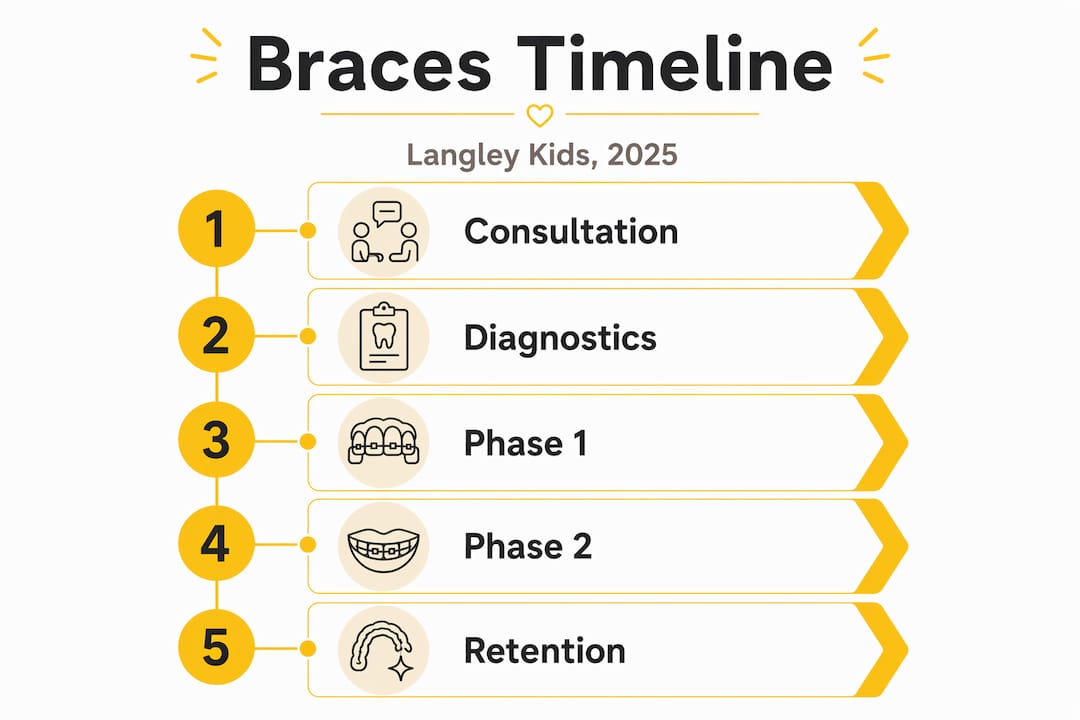
Age and growth stage also matter a great deal for children aged 7 to 12. Orthodontists sometimes recommend a two-phase approach: early intervention (called Phase 1) during the growth window, followed by comprehensive alignment (Phase 2) once most permanent teeth have come in. This staged care, which affects how costs split over time, is one of the most common surprises parents encounter when budgeting.
Beyond the appliance itself, here are the key cost drivers to watch for:
- Appliance type: Metal braces are typically the most affordable, while ceramic braces and clear aligners tend to cost more.
- Records and imaging: X-rays, photographs, and dental molds (called diagnostic records) are often charged separately.
- Retainers: After braces come off, your child will almost certainly need a retainer. This is almost always an additional cost, not included in the headline braces price. Explore your retainer options for kids before finalizing your budget.
- Clinic fees and location: Some clinics bundle a lot of services; others charge piece by piece. Urban Langley clinics may price differently than suburban ones.
- Emergency or repair visits: Broken brackets and popped wires are a normal part of childhood braces. Some clinics include these; others bill separately.
“Total braces cost is not just appliance choice: staged care, complexity, and clinic add-ons like records, imaging, retainers, and supplies are repeatedly flagged as major drivers.” This is a point the best braces comparison guides for kids consistently reinforce.
Pro Tip: Before signing any treatment agreement, ask your clinic for a fully itemized cost breakdown. That means the appliance fee, records fees, retainer fees, and what happens if you need extra visits. This protects you from surprise bills 18 months into treatment.
It’s also worth knowing that braces are safe for children across all these appliance types. Safety is rarely the variable that changes price. The cost difference between options comes down to materials, lab fees, and the level of customization involved.
Typical price ranges for braces in Langley: What to expect in 2025
With the main cost factors in mind, here’s what real families in Langley and BC are seeing for braces pricing in 2025.
For a straightforward child case involving traditional metal braces, the typical Langley range is CAD 3,000 to 7,000. More complex cases, those involving jaw growth issues, unusual spacing patterns, or a combination of appliances, can push past that upper end. This range is consistent across most reputable Langley orthodontic practices, though the specific number your family receives will reflect your child’s individual treatment needs.
For broader context, a nearby benchmark is useful. In Vancouver, metal braces commonly land in a CAD 5,000 to 7,500 range for 2025. Langley tends to run slightly lower on the scale, which can be a meaningful savings for families who don’t need to travel into the city for care.
Here’s a practical breakdown of what to expect at each stage:
| Treatment Type | Typical Age Range | Estimated Cost (CAD) |
|---|---|---|
| Phase 1 (early intervention) | Ages 7 to 10 | $1,000 to $3,000 |
| Phase 2 (comprehensive braces) | Ages 10 to 14 | $3,000 to $8,000 |
| Full metal braces (single phase) | Ages 10 to 14 | $3,000 to $7,000 |
| Ceramic braces | Ages 10 and up | $4,500 to $8,000 |
| Clear aligners for teens | Ages 12 and up | $4,000 to $8,500 |
Important note on phased treatment: If your child needs both Phase 1 and Phase 2, you are potentially looking at a combined cost of CAD 4,000 to 11,000 over several years. This is why it’s important to understand the full braces cost details for kids before starting, not just the Phase 1 number.
Statistic callout: A phased treatment plan for a Langley child aged 8 to 13 could span five or more years from first consultation to final retainer. Planning your finances across that timeline, rather than just for the next 18 months, makes a real difference for most families.
Pro Tip: When comparing clinics, ask each one for the total expected cost of your child’s full recommended treatment, not just the current phase. Some clinics quote Phase 1 at an attractive number but don’t mention that Phase 2 will be billed at a separate (and often higher) rate.
Breaking down the fees: Initial consults, diagnostics, and add-ons
Those headline braces prices aren’t always the whole story. Let’s dig into the extra costs most families encounter before, during, and after treatment.
The orthodontic process typically starts with a consultation. In Langley, initial consults are often a separate fee of CAD 200 to 400, and some clinics charge for diagnostic imaging on top of that. Before your child receives a treatment plan, the orthodontist will want to see X-rays, photographs, and possibly dental impressions or a digital scan. These diagnostic records form the foundation of the treatment plan.
Here’s a comparison of what’s commonly included or excluded from headline braces quotes:
| Fee Category | Often Included | Often Extra |
|---|---|---|
| Diagnostic records (X-rays, photos) | Rarely | Usually |
| Initial consultation | Sometimes | Often |
| Retainers (post-treatment) | Rarely | Almost always |
| Mid-treatment checkup visits | Usually | Sometimes |
| Emergency/repair visits | Sometimes | Often |
| Clear aligner refinements | Sometimes | Often |
Common add-ons that catch families off guard include:
- Retainers: A permanent (bonded) retainer or a removable retainer is necessary after braces come off. Retainer types and costs vary, but budget at least CAD 300 to 700 per retainer set.
- Lost or broken retainer replacement: If your child loses their retainer (which happens, especially with 7 to 12-year-olds), replacement typically costs CAD 200 to 400.
- Palate expanders and other appliances: Some children need supplemental devices before or during braces. These are almost never included in the standard quote.
- Clear braces and aesthetic add-on fees can also be a factor; these additional costs for aesthetic options are worth clarifying upfront if you’re considering tooth-colored brackets.
When comparing providers, look for clinics that offer a full cost outline before treatment begins. A quality kids orthodontist should be transparent about every line item, not just the big number at the top of the quote. You’ll also want to understand what your dental insurance covers before assuming the add-ons are manageable.
If you’re weighing different treatment paths, reviewing your smile makeover options can help clarify whether your child’s needs are best met by braces, clear aligners, or a combination approach.
Pro Tip: Ask for an itemized quote in writing before your child begins treatment. This makes it easy to compare two or three clinics fairly, and it gives you a reference point if you ever question a charge later in treatment.
How dental insurance and coverage affect your out-of-pocket cost
Once you know the fees, it’s just as important to understand how insurance and public programs can offset, or limit, your out-of-pocket cost.
Most private dental insurance plans in BC cover around 50% of orthodontic costs, with lifetime maximums that typically range from CAD 1,500 to 3,500. That means even if your child’s treatment costs CAD 6,000, your insurance might pay out no more than CAD 3,000, leaving a significant balance for your family.
Coverage is also more likely when treatment is deemed medically necessary, such as correcting a severe bite problem that affects chewing or jaw development. Purely cosmetic alignment is less likely to receive full coverage. For a broader benchmark, Vancouver insurance context in 2025 suggests that typical private coverage hovers around 50% before lifetime caps kick in.
Here’s a step-by-step guide for getting the most out of your coverage:
- Review your policy’s orthodontic section before your first consultation. Look for the lifetime maximum, the percentage covered, and any waiting period requirements.
- Request pre-approval or a predetermination letter from your insurer before treatment begins. This gives you a written commitment of what will be covered.
- Ask your clinic about direct billing to your insurer. Many orthodontic offices handle this as a standard service.
- Plan around your annual maximum if you also have a per-year cap. Scheduling treatment start dates strategically can help you use two calendar years’ worth of benefits.
- Check for flexible spending accounts (FSAs) or health spending accounts (HSAs) through your employer. These can cover orthodontic fees with pre-tax dollars, effectively reducing your real cost.
Statistic callout: Based on typical Langley treatment costs and average BC insurance coverage, many families end up paying CAD 1,500 to 3,500 out of pocket after benefits. That’s a meaningful sum, and planning for it in advance avoids financial stress mid-treatment.
If you want a deeper look at how to navigate coverage for your child’s specific situation, the braces insurance guidance from Glow Orthodontics walks through the most common scenarios Langley families encounter.
Pro Tip: Ask your orthodontic office if they have a patient coordinator who helps families maximize their insurance benefits. Many clinics have someone on staff whose entire job is to submit claims accurately and flag unused coverage.
What most parents miss when budgeting for braces
Here’s a perspective that most braces cost guides won’t tell you: the sticker price is often the least important number in the long-term orthodontic budget.
Parents in Langley (and everywhere, really) tend to compare quotes at the appliance level. Clinic A quoted CAD 4,800. Clinic B quoted CAD 5,400. Clinic A wins. But that logic misses several things that will cost real money down the road.
Retention policy is one of the biggest. Some clinics include the first retainer set in the treatment fee. Others charge separately, and replace-if-lost policies vary dramatically. A child who loses two retainers before age 16 (not unusual) could cost you CAD 600 to 800 in replacements that never appeared in the original quote.
Follow-up care philosophy matters just as much. Clinics that invest in thorough mid-treatment monitoring tend to catch problems before they become expensive corrections. An orthodontist who spots a shifting tooth at month six can adjust the plan at low cost. One who doesn’t catch it until month 18 may need to add months of treatment, which could mean additional fees.
The “cheapest braces” trap is also worth naming directly. Parents sometimes choose a provider based on the lowest Phase 1 quote, only to find that Phase 2 is priced aggressively and the two phases together exceed what a mid-range provider would have charged for comprehensive care from the start. Asking for the total expected multi-year treatment cost protects you from this.
The real value in orthodontic care comes from clarity. When a provider communicates clearly about the treatment plan, the timeline, and the full cost from day one, the outcome is almost always better for the family and the child. That kind of transparency is worth more than a few hundred dollars in headline savings.
Ready for the next step? Connect with Langley’s pediatric orthodontic experts
Armed with this breakdown, you’re in a much stronger position to evaluate braces quotes, ask the right questions, and choose a provider that fits your child’s needs and your family’s budget. The numbers matter, but so does the relationship you build with your orthodontic team over the one to three years of treatment.

At Glow Orthodontics, we specialize in welcoming families exactly where they are in the decision-making process. Whether you’re just starting to research or you’ve already received a couple of quotes and want a professional second opinion, our team provides transparent, itemized cost consultations for children and teens across Langley. If you’re comparing appliance types, our guide on clear braces versus Invisalign is a helpful next read. For families with older kids, the orthodontic care guide for teens covers what changes as children move through adolescence.
Frequently asked questions
What is the average total cost of braces for a child in Langley in 2025?
Most families should budget CAD 3,000 to 7,000 for traditional braces in a typical child case, though complex cases can go higher depending on treatment length and appliance type.
How much does dental insurance typically cover for kids’ braces in BC?
Private plans typically cover around 50% with lifetime maximums of CAD 1,500 to 3,500, meaning most Langley families still pay a significant portion out of pocket.
Are the first orthodontic consult and records included in the quoted braces price?
Not usually. Initial consults run CAD 200 to 400 and diagnostic imaging is frequently billed separately, so always ask what the headline quote actually includes.
Does my child need both Phase 1 and Phase 2 treatment?
Not every child needs two treatment phases; your orthodontist will recommend staged care only when early intervention is clinically necessary based on your child’s bite and growth patterns.
What should I ask about when comparing braces quotes?
Ask each clinic what’s included in the quoted price, what is billed separately, how they handle insurance billing, and what the full expected cost is for the entire recommended treatment from start to final retainer.